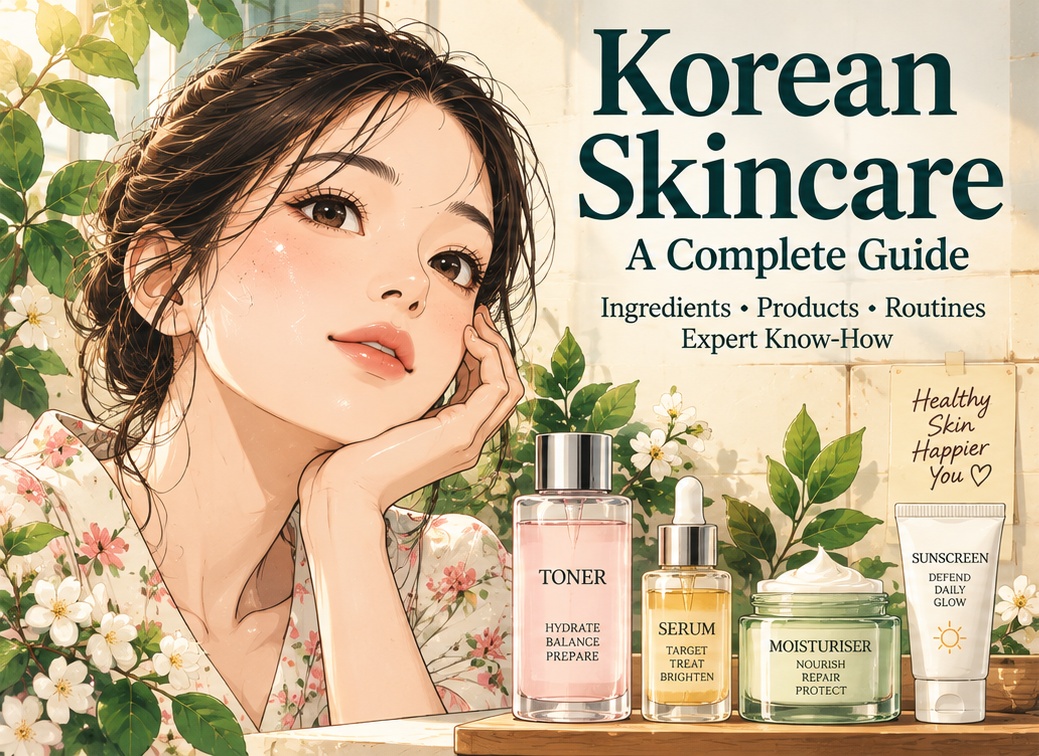
Korean skincare, as I teach it, is not simply about applying a large number of products. The underlying objective is to work on several aspects of the skin together: hydration, removal of dead skin, a more uniform tone and texture, skin tightening, elasticity, and the smooth, glossy appearance often associated with Korean skincare.
A complete routine can therefore contain products that perform quite different jobs. A tonic refreshes and tones the skin. A skin polish exfoliates. A cream moisturizes and carries active ingredients. A mask provides a more occasional treatment. A serum is a more concentrated active product. These products can be used individually, or they can be brought together as a skincare or facial routine.
The interesting part is understanding why each type of product exists and what the different ingredient families are intended to contribute.
The Main Idea Behind This Approach to Korean Skincare
One of the recurring themes is the appearance of healthy, uniform skin rather than treating skincare as simply “making the skin fairer.”
I look at several objectives together:
- keeping the skin hydrated;
- removing accumulated dead skin so that the surface does not look dull;
- supporting elasticity and a tighter appearance;
- addressing pigmentation and uneven tone;
- nourishing the skin;
- and creating a smoother, more even, glossy-looking surface.
Protein and collagen ingredients are particularly important in this approach. Hydrolyzed rice protein is used as a protein source, while hydrolyzed collagen is associated with elasticity. The broader objective is to improve the structure and appearance of the skin while creating the uniform texture and glass-like finish associated with Korean skincare.
That also explains why simply looking for one fashionable “hero ingredient” can be misleading. A well-designed skincare product can contain ingredients doing very different jobs.
Hyaluronic Acid: Hydration at Different Levels
Hyaluronic acid is primarily about moisture.
I distinguish between low-molecular-weight and high-molecular-weight hyaluronic acid. In the workshop, I describe the lower-molecular-weight form as being able to penetrate more deeply, while the higher-molecular-weight form remains more toward the skin’s surface. The idea is therefore to support hydration both at the surface and deeper within the skin.
Hyaluronic acid also affects the character of a serum. During the practical session, the serum was slightly thick rather than watery and absorbed quickly into the skin.
So when thinking about a serum, don’t judge it only by how many active ingredients are listed on the label. Texture, hydration and absorption are also important parts of how the product feels in actual use.
Learn more: What Does Hyaluronic Acid Do in Skincare, and Why Does Molecular Weight Matter?
Lactic Acid and Glycolic Acid: Why Exfoliation Matters
Dead skin is an important part of the discussion because it affects more than how the skin feels.
Lactic acid and glycolic acid are used to remove dead skin. The reasoning is straightforward: when dead skin accumulates on the surface, the skin can look dull, and the beneficial ingredients in a product may not penetrate as effectively. Gentle, regular exfoliation helps deal with that accumulated surface layer.
There is also an important caution. These are not ingredients where “more” automatically means “better.” I specifically distinguish the gentle use of these acids from much higher concentrations that can burn the skin.
Their presence also matters when deciding when to use a product. In the workshop formulations, products containing glycolic or lactic acid were treated as nighttime products, while daytime versions omitted those acids.
That day-versus-night distinction is one of the practical ideas worth carrying into a skincare routine.
Learn more: Why Are Some Korean Skincare Products Better Suited to Nighttime Use?
Rice Is More Than a Theme
Rice appears in several forms in this style of skincare, and those forms should not all be treated as interchangeable.
Hydrolyzed Rice Protein
Hydrolyzed rice protein is used as a protein source and is connected in the workshop with maintaining skin structure.
Rice Starch
Rice starch appears in products such as the skin polish and mask, where it is associated with the benefits of rice and with skin tightening and appearance.
Rice Ferment Filtrate
Rice ferment filtrate is different again. It is fermented rice water that has been processed into a stable cosmetic ingredient. This is an important distinction from simply fermenting rice water at home.
Fermentation involves leaving rice water until it becomes sour, but homemade fermented rice water has not undergone the processing used to make the cosmetic ingredient stable. For a formulated product, I therefore distinguish commercially prepared rice ferment filtrate from homemade fermented rice water.
That distinction illustrates a broader lesson: an ingredient’s familiar kitchen origin does not necessarily mean the kitchen version and cosmetic raw material are equivalent.
Learn more: Rice Ferment Filtrate vs Homemade Fermented Rice Water: What’s the Difference?
Vitamin C, Vitamin E, Niacinamide and Alpha Arbutin
Several familiar skincare actives appear throughout the workshop, but they serve different purposes.
Vitamin C is associated here with collagen production, pigmentation and skin lightening. One form discussed is sodium ascorbyl phosphate, described as a stable form of vitamin C. A practical formulation observation is that it can give a cream a slightly yellowish appearance.
Vitamin E has a different role. It is used for nourishment, moisturization and skin regeneration.
Niacinamide, or vitamin B3, is discussed in relation to acne-causing bacteria, tanning, pigmentation and creating a more uniform appearance. Alpha arbutin is another skin-lightening ingredient used particularly in the context of spots, pigmentation, darker areas and uneven tone.
This illustrates why a multi-active product may contain ingredients that appear, at first glance, to overlap. Their roles are not necessarily identical.
Glutathione: A Good Example of Benefits Versus Product Experience
Glutathione is popular, but it also illustrates something that is sometimes overlooked when people become fascinated by individual actives: a skincare product has to be pleasant enough to use.
In the workshop, glutathione is discussed for skin lightening, brightening, antioxidant properties and cell renewal. But it has a significant practical disadvantage—its smell.
The odour can be very difficult to disguise, even with a strong fragrance or essential oil. More importantly, glutathione is not presented as the single ingredient on which the effectiveness of the whole product depends. Other active ingredients are doing useful work as well.
That gives us an important formulation philosophy without revealing a formulation: a fashionable ingredient does not have to dominate a product simply because consumers recognize its name.
Performance and user experience both matter.
Ginseng, Gotu Kola, Green Tea, Licorice and Pomegranate
Botanical extracts are another recurring ingredient family.
Ginseng is used in the context of skin renewal and tightening. Gotu kola is associated with skin lightening and tightening. An interesting formulation distinction is that gotu kola can be available in both water-soluble extract and oil forms; which type is appropriate depends upon the type of product in which it is being used.
Licorice is discussed as a skin-lightening botanical, while pomegranate and green tea appear in the active systems of the products for their skin-related benefits. In the serum, for example, green tea and pomegranate are discussed in the context of anti-aging, while licorice is associated with skin lightening.
The larger lesson is that extracts are not simply there to make an ingredient list look botanical. Each is selected for a particular purpose.
Snail Mucin: What It Is and Why It Appears in Korean Skincare
Snail mucin is one of the more unusual ingredients discussed in the workshop.
It is a non-vegan ingredient derived from snails. The cosmetic ingredient is supplied as a processed liquid extract rather than simply being used in its raw form. I discuss it primarily for skin tightening.
The workshop also discusses the unusual practice of snail facials, in which snails were allowed to crawl over the face and release mucin directly onto the skin. Whatever one’s reaction to that experience, it helps explain how snail mucin became associated with this category of skincare.
For a consumer, there is also a simple buying consideration that is easy to overlook: because snail mucin is animal-derived, somebody seeking a vegan skincare routine would want to avoid products containing it.
Learn more: What Is Snail Mucin in Skincare, and Is It Vegan?
Ceramides, Peptides and Collagen: The Skin-Tightening Side of the Routine
Not every active in Korean skincare is focused on pigmentation or exfoliation.
Ceramide complex, copper tripeptide and hydrolyzed collagen are discussed in the workshop in connection with the structural and anti-aging side of skincare.
Ceramides are associated with the protein structure and prevention of fine lines, copper tripeptide with tightening and work at the cellular level, and hydrolyzed collagen with elasticity.
This is why I think it is useful to view a skincare routine as a collection of functions rather than a collection of fashionable ingredient names.
One group may be there for hydration. Another addresses surface exfoliation. Another is intended for pigmentation. Another contributes nourishment, while another is concerned with elasticity and tightening.
Korean Rice Tonic: More Than a Basic Toner
A Korean rice tonic is essentially a toner, but the version taught in the workshop is designed as a much more active product than a conventional toner.
It combines the refreshing and toning function of a toner with active skincare ingredients. The result sits conceptually somewhere between a simple toner and a serum, although the serum itself is more concentrated.
For normal use, the tonic can be sprayed onto the face and left there, or gently spread across the skin. It can also be used simply to refresh the face, including when the skin feels oily during the day. The workshop describes it as suitable for all skin types.
A useful sensory observation from the demonstration was that the tonic did not feel sticky.
That matters because a product intended for repeated use during the day needs to feel comfortable enough that people actually want to use it.
Learn more: Toner vs Serum in Korean Skincare: What’s the Difference?
Korean Skin Polish: Why “Polish” Is a Useful Description
A skin polish is essentially a scrub, but the word polish describes the intended effect particularly well.
Think about polishing any uneven surface: the purpose is to smooth it. Skin can have uneven texture, bumps and areas where dead skin remains on the surface. Gentle physical exfoliation makes the skin feel smoother and softer.
The exfoliating material demonstrated in the workshop is aluminum oxide. Its particles are extremely fine and, unlike salt, do not dissolve in water. That means the physical exfoliating effect remains while the product is being massaged.
The practical experience is interesting: you may barely be able to see the particles, yet you can feel the exfoliating action. The workshop compares the sensation to polishing rather than using a conventional coarse scrub. Adding a little water makes the action gentler.
After polishing, if the skin feels tight, a moisturizer can be applied. The workshop recommends this type of exfoliation at least around twice a week rather than treating daily exfoliation as necessary.
Learn more: What Is a Korean Skin Polish, and How Is It Different From a Coarse Scrub?
Korean Pearl Cream: The Pearl Is Not the Whole Story
A pearl cream gets its name from the inclusion of pearl powder, but that does not mean every Korean-style cream must contain pearl.
The broader objective of this cream is skin tightening, lightening and a glossy appearance. Pearl powder is associated with skin glow, while the cream also contains other categories of active ingredients addressing pigmentation, exfoliation, nourishment, collagen and elasticity.
This is another useful example of the difference between a product’s headline ingredient and its complete functional concept. The name may emphasize pearl, but the skincare effect being sought is not attributed to pearl alone.
The finished cream demonstrated in the workshop was quick-absorbing, soft on the skin and not greasy.
Face Masks: An Occasional Treatment Rather Than an Everyday Step
The mask is a different type of product from the tonic, serum or cream.
Kaolin clay is included for excess oil and to help create a smoother, more even-looking skin tone. Pearl powder is associated with the glossy appearance, rice-derived ingredients contribute their own functions, and snail mucin is used for tightening.
In use, the mask is spread over the skin and left on for a period before being removed. The demonstration gives about ten minutes as the normal minimum treatment time.
Unlike the everyday products, the mask and skin polish are treated as occasional products in the routine rather than things that must accompany every daily application.
Serum: Where the Routine Becomes More Concentrated
The serum is described as the more concentrated active product.
It brings together several categories of ingredients: hydration from hyaluronic acid and moisturizing ingredients; botanical extracts; rice ferment; snail mucin; ceramide complex; hydrolyzed collagen; vitamin C; arbutin; and exfoliating acids. Collectively, these are intended to address hydration, brightening, tightening, dead skin, pigmentation, elasticity and fine lines.
The demonstrated serum was slightly thick, did not drip readily and absorbed quickly.
One important usage point is to give a serum time to absorb before immediately putting another product over it. In the demonstration, I allow several minutes before following with the cream.
That is a simple habit, but it changes the routine from merely stacking products to deliberately layering them.
Compare them in detail: Toner vs Serum in Korean Skincare: What’s the Difference?
How the Products Fit Together
You don’t necessarily need every product every day.
For a complete facial-style treatment, the workshop uses the products in this broad order:
- Cleanse the face first.
- Apply the tonic and allow it to settle and absorb.
- Use the skin polish to remove dead surface skin, then remove the remaining scrub particles.
- Massage with the cream and allow it to sit briefly.
- Apply the mask, leave it on for the treatment period, and remove it.
- Finish with the serum and leave it on the skin.
This is the full facial-style sequence rather than a prescription to scrub and mask the skin every day. The tonic, serum and cream have roles in regular skincare, while the polish and mask are more occasional treatment products.
The workshop also makes an important practical point: you don’t necessarily have to use the entire system to benefit from it. Cream and serum can also be used on their own as part of a simpler routine.
Daytime and Nighttime Skincare Are Not Necessarily the Same
One of the most useful distinctions in the workshop is between products designed for daytime and nighttime use.
The cream containing lactic acid, glycolic acid and photosensitive essential oils is treated as a night cream. For a daytime version, those photosensitive components are left out.
The same principle is discussed when layering serum and cream: the serum can be allowed to absorb and then followed with moisturizer, but products intended for daytime use should be selected with the presence of glycolic and lactic acid in mind.
So “Can I use this during the day?” is not simply a question about whether something is called a serum, toner or cream. The ingredients inside that particular version matter.
Learn more: Why Are Some Korean Skincare Products Better Suited to Nighttime Use?
Glycerin or Propanediol? Sometimes Skin Feel Decides
A very practical student question at the end of the workshop concerned glycerin.
Why does glycerin sometimes make the skin feel sweaty or sticky?
Glycerin is highly moisturizing, but some people experience a sticky or sweaty sensation when using it. I describe this as moisture being drawn from the environment onto the skin rather than necessarily being actual perspiration.
What can I use if I dislike that feeling?
Propanediol can be used instead. It is described in the workshop as giving similar hydration while feeling lighter and less sticky, although it is more expensive and less commonly available than glycerin.
This is an excellent example of something that ingredient lists alone cannot tell you.
Two ingredients may both satisfy the broad objective of moisturization, yet produce a different sensory experience. For somebody with very dry skin, glycerin’s character may not be a problem at all; for somebody who dislikes the moist or sticky sensation, the lighter-feeling alternative may be preferable.
Learn more: Glycerin vs Propanediol in Skincare: Why Can Glycerin Feel Sticky?
What to Look for When Thinking About a Korean Skincare Product
Rather than buying a product simply because it contains rice, snail mucin, glutathione or another fashionable ingredient, ask what role the whole product is intended to play.
Is it primarily for hydration? Is it an exfoliating product? Is it intended for pigmentation and uneven tone? Is tightening and elasticity the focus? Is it a daily leave-on product or an occasional treatment? Is it intended for daytime or nighttime use? And, just as importantly, does its texture and feel make it something you will actually enjoy using?
The workshop itself demonstrates why these distinctions matter. Glutathione may have desirable skincare functions but an objectionable smell. Glycerin can moisturize well yet feel sticky to some people. A skin polish can contain particles so fine that they are barely visible while still producing a noticeable physical exfoliating sensation. A serum can contain many active ingredients but still needs to absorb comfortably before the next layer is applied.
That is perhaps the most useful way to understand this style of skincare: don’t think only in terms of ingredients; think in terms of functions, product types and how the products work together.
Hydration, exfoliation, nourishment, pigmentation care, tightening and elasticity are different objectives. A thoughtful routine assigns each product a purpose and then layers or alternates those products appropriately rather than simply accumulating as many active ingredients as possible.
Explore all Korean Skincare guides →
Want to Learn How to Make Korean Skincare Products?
If you want to move from understanding Korean skincare ingredients and product types to learning how the products themselves are formulated, explore the Zestchest Korean Skin Care Course.