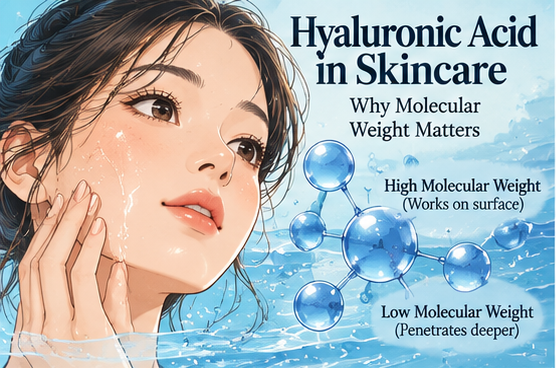
Hyaluronic acid is used primarily for hydration. The important distinction is that low-molecular-weight and high-molecular-weight hyaluronic acid are described as behaving differently on the skin: the lower-molecular-weight form is intended to penetrate more deeply, while the higher-molecular-weight form remains more toward the surface. The reason for discussing both is to think about hydration at more than one level.
Why hydration is central to the discussion
Hyaluronic acid is described as something naturally associated with the skin’s ability to hold moisture. As the skin ages, this moisture-holding support is described as becoming less effective. Using hyaluronic acid in skincare is therefore presented as a way of helping the skin remain moisturized.
Low molecular weight versus high molecular weight
The two forms should not be treated as though they are identical simply because both are called hyaluronic acid. I distinguish them by where they are intended to act. Low-molecular-weight hyaluronic acid is described as being able to penetrate deeper into the skin, while high-molecular-weight hyaluronic acid remains closer to the surface. Used conceptually together, they address both deeper and surface hydration.
What this means in a serum
Hyaluronic acid can also influence the physical character of a serum. In the practical demonstration, the serum was slightly thick rather than completely watery, did not drip very easily and absorbed quickly. This is a useful reminder that an ingredient is not only part of an ingredient list; it can also contribute to how a product feels and behaves in use.
The practical takeaway
When evaluating a hydrating serum, don’t look only at how many active ingredients are advertised. Hydration, texture and absorption are part of the product experience too. With hyaluronic acid, the molecular-weight distinction is useful because it explains why two forms of the same named ingredient may be included for different hydration roles.
Related Guides
- Toner vs Serum in Korean Skincare: What’s the Difference?
- Glycerin vs Propanediol in Skincare: Why Can Glycerin Feel Sticky?
- Why Are Some Korean Skincare Products Better Suited to Nighttime Use?