
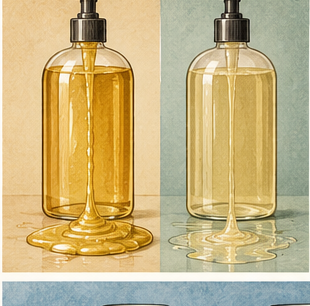
The thickness of liquid Castile soap depends strongly on the oils used. A thin soap is not necessarily weak, and a thick soap is not necessarily more cleansing. In the workshop, coconut-oil soap is the clearest example: it can be almost watery while still producing very high lather and strong cleansing. Olive-oil soap behaves differently and can develop a much thicker texture even though its cleansing and lather are milder.
Thickness and cleansing are different properties
It is easy to judge a liquid cleanser by appearance. A thick body wash can feel rich and substantial in the hand, while a watery cleanser can look as though it has been diluted too far. Castile soap shows why that visual judgement can be misleading. Viscosity is not a direct measure of cleansing performance. Coconut-oil soap can be very thin and still clean strongly and lather abundantly. Olive-oil soap can be considerably thicker while remaining the milder of the two.
Why the oil matters
Different oils give different properties after they have been converted into soap. I ask students to think about cleansing, lather and thickness as separate characteristics. Olive oil is useful when mildness and a comparatively thick liquid texture are wanted. Coconut oil gives very high cleansing and very high lather, but the liquid soap made from it is naturally much thinner. Mixed-oil soaps can be used when the aim is to balance properties rather than maximize only one of them.
Can all Castile soaps be thickened in the same way?
No. Another practical lesson from the workshop is that different soap bases do not respond identically to thickening. An olive-oil-rich soap can respond strongly to ordinary salt, whereas coconut-oil soap does not behave the same way. Hydroxyethyl cellulose is also discussed as a thickening option, although I do not find the resulting feel as pleasing in every case.
Why thickness still matters
Although thickness is not what performs the cleansing, it can matter to the user experience. A thicker face wash or body wash can feel more familiar to a consumer. That makes viscosity an aesthetic and usability decision rather than a reliable indicator of cleaning strength.
The useful takeaway is to stop using thickness as a shortcut for judging a liquid Castile soap. Look instead at what the soap is intended to do and which oils give the cleansing, lather and feel appropriate for that job.
Related Guides
Liquid Castile Soap Explained: Oils, Uses, Lather, Thickness and Common Questions
Start with our complete guide to liquid Castile soap, including oils, cleansing, lather, thickness and different uses.
Explore the Liquid Castile Soap Learning Hub
Browse all our guides and knowledge articles about liquid Castile soap in one place.
Olive Oil vs Coconut Oil in Liquid Castile Soap: What Is the Difference?
See why olive oil and coconut oil produce very different soap textures, lather and cleansing characteristics.
Does More Lather Mean a Liquid Castile Soap Cleans Better?
Understand why thickness, lather and cleansing are separate properties—and why appearance can be misleading.