
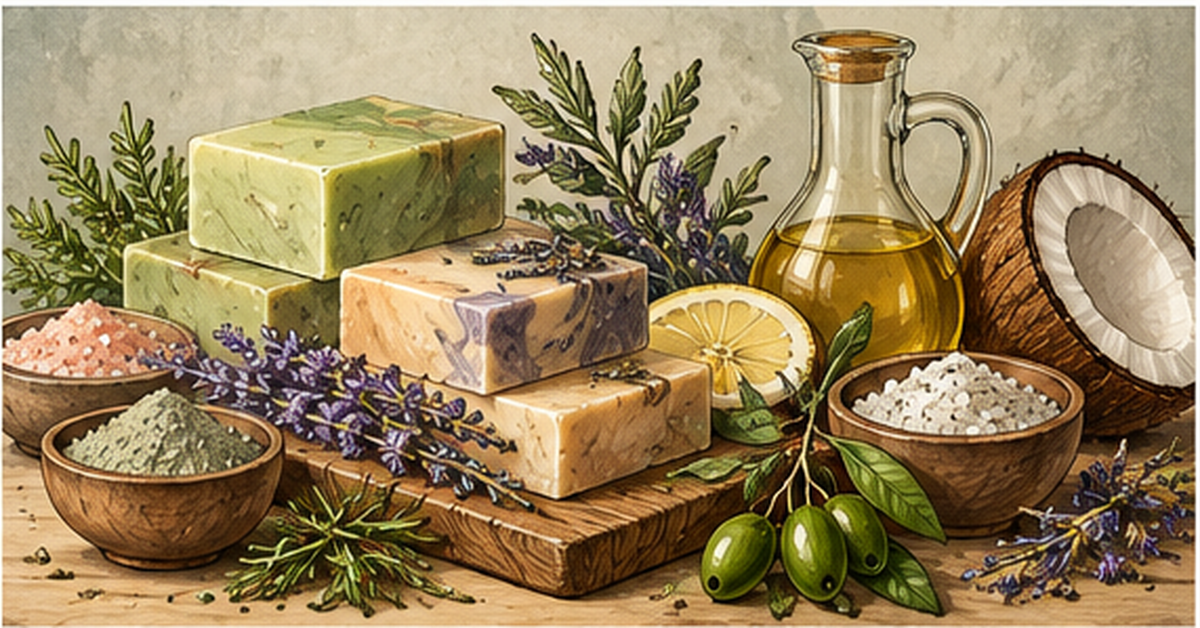
Cold process soap can be much more than a plain cleansing bar. The oils and butters you choose influence qualities such as hardness, lather and skin feel, while clays, powders, milk, plant ingredients, colours and fragrance can give a soap its own character.
Once you understand those relationships, soap making becomes less about following one fixed recipe and more about understanding what each choice does.
Artisanal soap takes this further. Colour gradients, textures, embedded elements and scenery-inspired designs can turn an ordinary rectangular bar into something visually distinctive. But attractive soap still has to work as soap. A beautiful design cannot compensate for poor formulation, unsuitable fragrance or an incorrectly made batch.
The most useful way to approach the subject is therefore to understand the principles first: what creates lather, what creates hardness, why some soaps feel creamier than others, how ingredients change the character of a bar, and what commonly goes wrong.
If you want to explore individual cold process soap topics in more depth, you can also visit the Cold Process Soap Learning Hub.
What Makes Cold Process Soap Different?
At the heart of soap making is the reaction between oils and lye. The product of that reaction is soap.
I use the simple analogy of cooking: heat can speed up a process that would otherwise take considerably longer. The way a soap is processed therefore affects how quickly that reaction progresses and when the finished bar reaches the condition we are looking for.
But the finished bar is not defined by that reaction alone.
Change the oils and you can change the hardness or lather. Introduce butter and the lather may feel creamier. Use milk and you can get a different lather character again. Add particles and you may create an exfoliating bar. Change the fragrance and you may unexpectedly change how manageable the soap becomes while it is being made.
This is why two cold process soaps can behave very differently even when they belong to the same broad category.
The Three Qualities I Consider When Choosing Oils
When looking at oils for soap, three very practical questions are useful:
- Will the soap lather well?
- Will the finished bar be hard enough?
- What kind of skin feel do I want?
Cost is also an important practical consideration, particularly if the soap is eventually going to be sold. An expensive oil is not automatically necessary simply because it sounds more luxurious.
Lathering oils
Some oils contribute much more noticeably to lather than others. Coconut, castor and avocado oils are examples of lathering oils.
Castor oil can contribute beautiful lather, but there is a trade-off: it can also produce a softer bar that gets used up more quickly. Coconut oil is particularly interesting because it contributes both lather and hardness, although using a great deal of it can make the soap feel drying on the skin.
So “more lather” cannot be considered in isolation. Improving one characteristic can alter another.
Hard oils and soft oils
A simple practical way of thinking about hardness is to consider whether an oil or butter becomes solid when cooled.
Coconut oil, palm oil and butters such as cocoa, shea and mango butter can be thought of as hard oils or fats. Oils such as sunflower, olive and castor remain comparatively soft.
A soap made only from soft oils may eventually set, but it will not necessarily develop the kind of firm bar you expected. This is one reason copying a list of fashionable oils without understanding their functions can produce disappointing soap.
For a more focused explanation of this relationship, see What Makes a Cold Process Soap Hard or Soft?
Butters
Butters can change the feel of a soap and are particularly useful when thinking about richer formulations. But simply adding more butter does not automatically produce a better soap.
Think about ordinary butter on your hand: if your hand were covered with a thick greasy layer, you would not expect it to bubble beautifully under water. Soap has similar practical trade-offs. Too much emphasis on richness can compromise the lather you wanted.
The lesson is broader than butter itself: formulation is about balance rather than maximizing every desirable ingredient.
Why Some Soaps Produce Bubbly Lather and Others Creamy Lather
Lather is not one uniform property.
When freshly made soaps are compared, one may produce abundant bubbles while a soap containing butter still lathers well but has a different character. A goat-milk soap can produce a noticeably creamier lather.
This gives us a much better vocabulary for judging soap than simply asking, “Does it foam?”
A bar can have large, bubbly lather or a denser, creamier lather. The oils and other ingredients influence that experience. A recipe without the oils that contribute strongly to bubbles may still lather, but the result can be creamier and less visibly bubbly.
Read the focused guide: Why Do Some Soaps Have Bubbly Lather While Others Have Creamy Lather?
What Is Superfat, Conceptually?
Superfat is one of the most useful ideas for understanding how a soap can be adapted for different skin needs.
In simple terms, the idea is that not all of the oil is converted into soap. A small portion remains as oil in the finished bar.
I compare this with adding a little coconut oil to bath water when the skin feels dry: that small amount of oil changes how the skin feels without turning the entire bath greasy.
In soap, this becomes a way of thinking about skin feel. Less residual oil may be more appropriate when designing for oily skin; comparatively more can be considered when designing for dry skin. A middle approach can be used for a more general-purpose bar.
The important takeaway is not a particular percentage. It is that skin type can be considered at the formulation level rather than simply by adding a fashionable herb or extract at the end.
You can explore the principle separately in What Is Superfat in Soap and Why Does It Matter for Skin Type?
Ingredients Can Enter Soap in Very Different Forms
One of the most interesting parts of soap making is the enormous range of ingredients that can potentially be incorporated. But it helps to think about them by form rather than treating every additive as though it behaves identically.
They can broadly be considered as liquids, pastes or purées, dry ingredients and physical scrubs.
Liquids
Milk is one possibility, including different kinds of milk. Other examples include aloe vera juice, carrot juice, beetroot juice, cucumber juice, potato juice and rice water.
Acidic citrus juices need to be treated differently because their acidity can interfere with the alkaline soap system and lead to softness.
That is an important example of why an ingredient being attractive for skin care does not automatically mean it can simply replace another ingredient in soap.
Fresh pastes and purées
Plant material can also be incorporated as a paste or purée. Examples include aloe vera, cucumber, carrot, potato, rose petals and neem, along with ingredients such as curd, milk cream and honey.
Texture matters. A coarse purée may remain visible as particles in the finished soap. A smoother preparation gives a different appearance.
There is also a practical limit to the “more is better” idea. Too much wet material can leave a soap soft for much longer.
Dry powders and clays
The possibilities for dry additions are broad: orange and lemon peel powders, neem, licorice, turmeric, sandalwood, oats, coffee, cocoa, milk powder, rice and other grain or pulse powders, as well as different clays.
The principle remains the same: adding many ingredients does not mean each should be added at its full individual amount. A multi-herb or multi-clay soap can use several ingredients while keeping the total addition controlled.
Too much powder can also become unpleasant in actual use, with excess material appearing in the lather or rubbing onto the hands.
Does every soap need a scrub?
No.
Scrub particles are an optional sensory choice rather than a requirement for a good soap. Some people enjoy rubbing a textured soap directly over the skin, particularly if they do not use a loofah. Many others do not enjoy a rough bar at all.
Examples include walnut shell powder, coffee, oats, sugar, salt, mustard seeds, cinnamon and chopped lemongrass.
This is another area where restraint matters. A strongly textured soap can become scratchy rather than pleasantly exfoliating. I personally prefer a relatively modest amount of scrub material.
For a deeper look at these different additive types, see Can You Add Fresh Ingredients, Powders and Scrubs to Cold Process Soap?
Essential Oils and Fragrance Oils Are Not Interchangeable
Fragrance is one of the areas where beginners can run into trouble surprisingly quickly.
Essential oils are plant-derived aromatic materials with properties beyond simply giving the soap a smell. Fragrance oils, by contrast, are primarily being used for fragrance.
Fragrance oils can offer stronger and longer-lasting scent, while essential-oil fragrances may not last as long.
There is also an important making consideration: fragrance can change the behaviour of the soap itself.
Some floral essential oils can make the soap thicken extremely quickly. Certain fragrance oils can do the same. That can be manageable for an experienced soap maker who expects it, but extremely frustrating for a beginner trying to create a detailed swirl or artistic design.
For early practice, I prefer better-behaved essential oils such as basil, eucalyptus, lemon and lemongrass. Once you understand how your soap normally behaves, you are in a much better position to experiment with more difficult fragrances.
And fragrance is not compulsory at all.
A fragrance-free soap can be a deliberate product choice, particularly because some people react to fragrances or essential oils. A plain bar does not cease to be soap because it contains no fragrance, colour, clay, fruit or herb.
For more on choosing between the two, read Essential Oils vs Fragrance Oils in Cold Process Soap: What Is the Difference?
More Ingredients Do Not Automatically Mean Better Soap
It is very tempting when you begin formulating to think:
If one beneficial ingredient is good, ten beneficial ingredients must be fantastic.
That is not necessarily a useful way to design a bar.
Soap has a primary job: cleansing. Additives can change its character and can provide additional skin benefits over repeated use. But each addition also has practical consequences.
Wet ingredients can soften a bar. Powders can become excessive. Scrubs can become uncomfortable. Butter can alter lather. Fragrance can make the soap difficult to handle.
A good formulation therefore requires a reason for each ingredient rather than simply a long ingredient list.
How I Think About Soap for Different Skin Types
For dry skin, richer oils and butters can be considered. Olive and almond oils are thicker, more nourishing oils, and butters can also play a role.
For oily skin, the balance can be changed rather than simply removing every rich ingredient. The amount of unsaponified oil left in the bar is another part of that decision.
I do not find the idea of “combination skin” particularly useful for designing one soap, because the same product cannot intelligently behave one way on one part of the face and completely differently on another. I prefer to think more directly in terms of oily and dry skin requirements.
What about soap for babies?
This is one situation where simplicity becomes particularly important.
For very young babies, I recommend keeping the soap fragrance-free and avoiding a long list of herbs, essential oils, clays and other additions. The emphasis is on moisturization and support rather than trying to turn a baby’s soap into a treatment product.
Milk and butter are the kinds of simple ingredients that may be considered, while essential oils should be avoided for very young babies because of their sensitivity.
The broader formulation lesson is valuable even beyond baby products: a sophisticated product is not necessarily the product with the longest ingredient list.
Why Glycerin Does Not Need to Be Added Automatically
A frequent beginner question is whether glycerin should be added to cold process soap.
Glycerin is already produced during saponification. In this kind of soap, it remains in the bar rather than needing to be introduced as a separate essential ingredient.
Additional glycerin can make an ordinary bar softer and more prone to absorbing moisture.
This also helps explain one difference between these soaps and some commercial bars, where glycerin may be removed during manufacture.
Read more: Does Cold Process Soap Need Added Glycerin?
Palm-Free Soap Involves a Trade-Off
Palm oil is important mainly from the perspective of hardness and how long a bar lasts in use.
A palm-free bar can certainly be made, but removing palm oil changes the formulation problem. Some alternatives do not produce the same longevity.
Beeswax, for example, is difficult to use in large amounts because it can cause very rapid thickening and reduce lather.
For a soap made for personal use, a shorter-lasting palm-free bar may be perfectly acceptable. For a commercial product, customers may judge value partly by how many uses they get from the bar.
If you deliberately formulate a shorter-lasting palm-free soap, that trade-off should be understood rather than treated as a formulation failure.
See Palm-Free Soap: What Trade-Offs Should You Expect? for the focused discussion.
Why pH Is an Important Quality Check
Appearance alone cannot tell you whether a soap has been made correctly.
pH strips can be used as an approximate check. More importantly, an unexpected result can tell you that something needs to be investigated.
If the pH remains too high instead of moving into the expected range, a measurement error should be considered. Perhaps an oil was forgotten or a number was misread.
This is where I use one of my favourite analogies:
If you put sugar in tea, the tea should taste sweet. If it does not, you have to question whether the sugar actually went in.
In the same way, if a correctly calculated and measured soap does not behave as expected, go back and question the measurements rather than trying to explain away the result.
A batch with an unsafe pH problem is fundamentally different from a batch that is merely ugly. An unattractive but otherwise correctly made soap may still have another use or be incorporated visually into another soap design. A batch whose chemistry is wrong should not simply be disguised cosmetically.
The distinction is explored further in Why Is pH an Important Check in Cold Process Soap?
Common Problem: The Soap Suddenly Becomes Too Thick
One of the most common practical problems in cold process soap making is unexpected thickening.
There can be several contributors. Over-blending is one. Fragrance is another.
If you continue blending unnecessarily, you can lose the fluidity needed for a design. With a difficult floral essential oil, the change can be dramatically faster: the soap may become difficult to manipulate almost immediately.
That does not necessarily mean the soap itself has failed. If its formulation is otherwise correct, a thickened batch can still become usable soap; you may simply lose the beautiful design you intended.
The distinction is worth remembering:
Aesthetic failure is not necessarily formulation failure.
If you’ve encountered this problem, see Why Does Cold Process Soap Suddenly Thicken?
Common Problem: The Bar Has Speckles
Speckles are not automatically air bubbles or a defect.
Visible particles may simply come from ingredients such as carrot purée or walnut shell powder. Soaps made without those particles can appear much more uniform.
Before diagnosing a visual irregularity, therefore, ask what went into the soap. The appearance may simply be the natural consequence of ingredients you deliberately chose.
Common Problem: The Soap Is Difficult to Cut
Different recipes harden at different speeds.
A bar that cuts beautifully at one point may become frustratingly hard later. The oils and other ingredients change the timing, so there is no single cutting moment that behaves identically for every formulation.
Coconut-oil-rich soap is an extreme example: it can become very hard very quickly and may even crack if cutting is delayed too long. Individual molds can therefore sometimes be more convenient than making a loaf that must later be sliced.
Cutting equipment also accumulates soap. If a knife, wire or cutter starts dragging after several cuts, clean it rather than assuming something has gone wrong with the soap.
Turning Soap Into Art
Artisanal soap begins before you touch the soap itself.
Start with an inspiration: a photograph, scenery, pastry, colour palette or another visual idea. Then reduce it to its essential components.
Ask yourself:
- What are the dominant colours?
- Where does the image become lighter or darker?
- Which boundaries should be straight and which should be irregular?
- What textures matter?
- Which small visual elements make the image recognizable?
A beach scene, for example, can be understood as sand, surf, water, sky, sunlight and recognizable details such as birds or a coconut tree. A night scene uses a very different palette: darker water, dark mountains, a night sky, moon and stars.
This is a much more transferable skill than memorizing one decorative soap. Once you learn to deconstruct an image into colour, gradient, texture and elements, you can begin interpreting other inspirations yourself.
The complete concept is explored in How Do You Plan an Artistic Cold Process Soap Design?
Texture makes handmade soap visually interesting
A perfectly flat top is not always the most attractive choice.
Uneven surfaces can give a bar movement and reinforce the visual idea. A pastry-inspired soap can look more convincing with texture; scenery can become more natural when the surface is not mechanically flat.
Similarly, colour need not be uniform. Gradients can distinguish water from sky, suggest light around a sun or move a night sky from very dark overhead to lighter near the horizon.
Artisanal soap is therefore not simply “soap with several colours.” It is closer to planning a small picture inside a bar.
Finishing matters more than beginners expect
A soap can be technically successful and still look unfinished.
After cutting, small irregularities and sharp-looking edges can be tidied. Rounded edges give the bar a more professional appearance. If the surface needs cleaning, simple finishing approaches can also give the bar a cleaner-looking surface.
These are small details, but they explain some of the difference between a freshly cut handmade bar and the polished soaps seen in professional photographs.
Stamping as part of the artwork
Stamping is optional. It can be used for a brand name or simply as another decorative element.
Both acrylic and metallic stamps can be used. A fine stamp produces a finer impression; a thicker design is generally more prominent.
The surrounding design matters too. A stamp tends to show more clearly on a relatively uniform, uninterrupted area than over a visually busy swirl. Stamping should therefore ideally be considered while planning the artwork rather than treated as an automatic final decoration.
Colour can also be incorporated into stamping. But colour is not always an improvement.
That is a useful artistic lesson in itself:
Not every embellishment improves a design.
Packaging and Shelf Life
There are several packaging possibilities, from paper and boxes to bags and sealed wrapping. The practical objective is to protect the finished bar, retain its appearance and fragrance, and present it appropriately for storage, gifting or sale.
Shelf life is also connected to the raw materials.
Virgin oils have shorter shelf lives, while refined oils generally allow the soap to keep considerably longer. Even when an older soap still lathers and cleans, its appearance can become dull and its fragrance can fade.
That distinction matters commercially:
“Still usable” and “still at the quality I want to sell” are not necessarily the same thing.
The Most Useful Way to Learn Cold Process Soap
Soap making reminds me of baking. You can understand a recipe perfectly and still find that your first cake is not the most beautiful cake you ever make.
Soap is similar.
Learn what the ingredients are doing. Understand the difference between hardness and lather, and between creamy lather and bubbly lather. Know why an ingredient is present instead of adding it because its name sounds attractive. Recognize the difference between an aesthetic problem and a genuine formulation problem. And when you move into artistic soap, plan the picture before trying to reproduce it in the bar.
Practice then becomes much more meaningful because you are no longer simply repeating instructions. You are learning to recognize how soap behaves—and that is what eventually gives you the confidence to create your own variations.
For the complete collection of educational articles on these concepts, visit the Cold Process Soap Learning Hub.
If you want to move from understanding the principles to learning the complete formulation and practical making process, Zestchest also offers the Cold Process Soap Making Course.