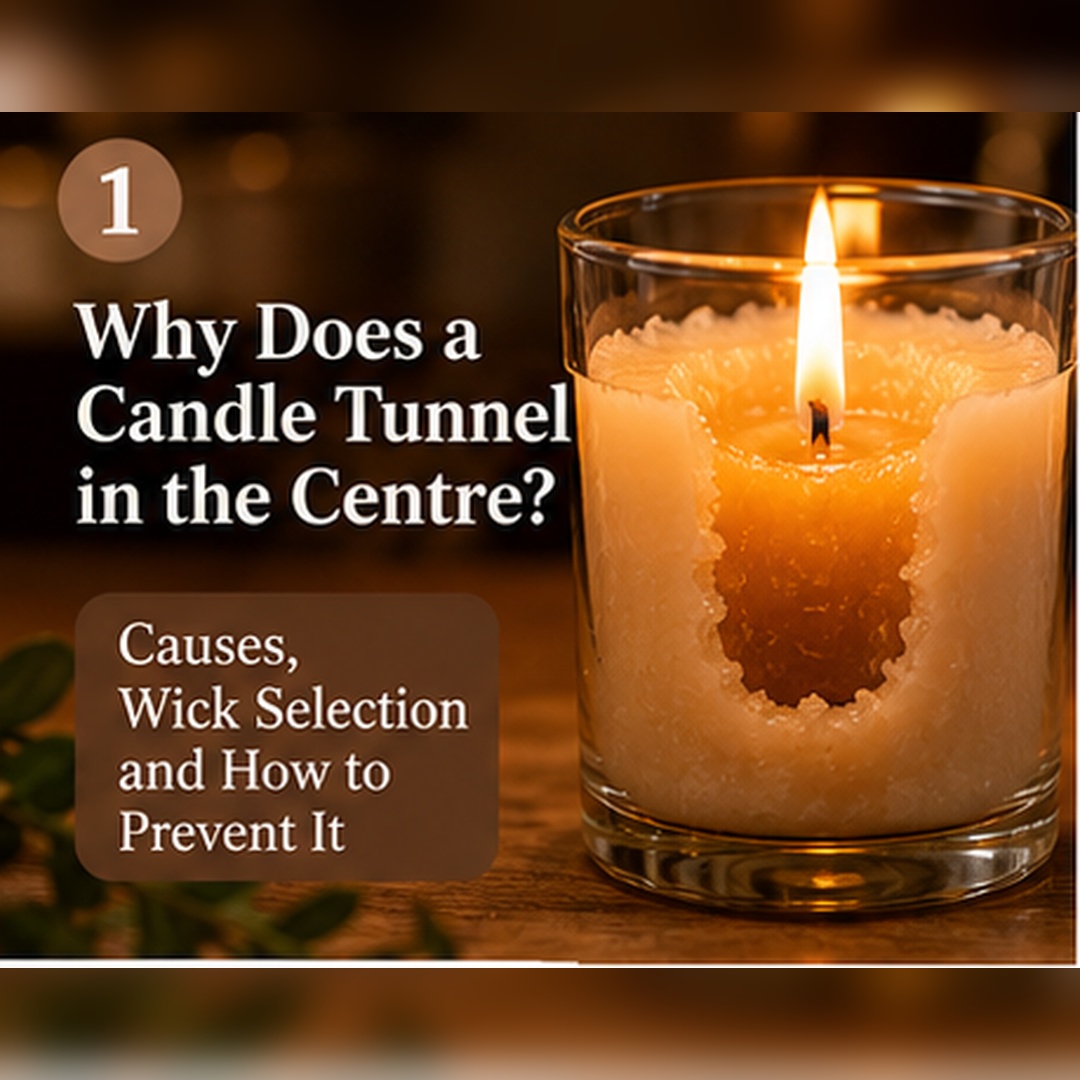
A candle develops a hollow centre when the area around the wick melts repeatedly while the wax farther away remains solid. If this continues over several burns, the centre becomes deeper while the sides remain unused.
One of the most important reasons is a mismatch between the candle’s width and its wick.
Why the Centre Melts but the Sides Do Not
Think of the flame as creating a small melted circle around itself.
If you place one relatively small wick in the centre of a broad candle, the flame can only melt the wax within its immediate area. The outer portion of the candle remains solid.
When the candle is extinguished, that small melted region sets again at a lower level.
The next time the candle is lit, it begins melting from the same lower point. Repeating this creates a deeper and deeper hollow through the centre.
Wick Choice Is Closely Connected to Tunnelling
A wick should not be chosen simply because it physically fits inside the candle.
The wick needs to produce enough heat for the size of the candle.
For a wider candle, this may mean using a broader wick or using more than one wick. The purpose is to create melt areas that cover more of the candle surface rather than concentrating all the burning in one narrow section.
But the opposite extreme is also a problem. Wicks placed too close together can create excessive heat and an unnecessarily large flame.
The correct solution is therefore not simply “add more wicks.” The wick size, candle width and wick placement have to work together.
Why Tunnelling Also Affects Fragrance
Tunnelling is not only an appearance problem.
A scented candle releases its aroma more effectively once a useful amount of wax has melted.
If only a tiny circle around the wick becomes liquid, there is much less melted wax available to spread the fragrance.
This means a candle may appear to have a fragrance problem when the real problem is its burning pattern.
A Beautiful Candle Can Still Tunnel
This is why appearance alone does not tell you whether a candle has been made well.
You can use premium wax, an expensive fragrance and a beautiful container and still end up with a disappointing candle if the wick does not suit the candle.
When evaluating a candle, observe the way the surface melts rather than judging only how attractive it looked before lighting.
A good practical question is:
Is the candle gradually creating an appropriate melted surface, or is it simply digging a deeper hole through the centre?
That observation can tell you a great deal about the wick and the overall candle design.