
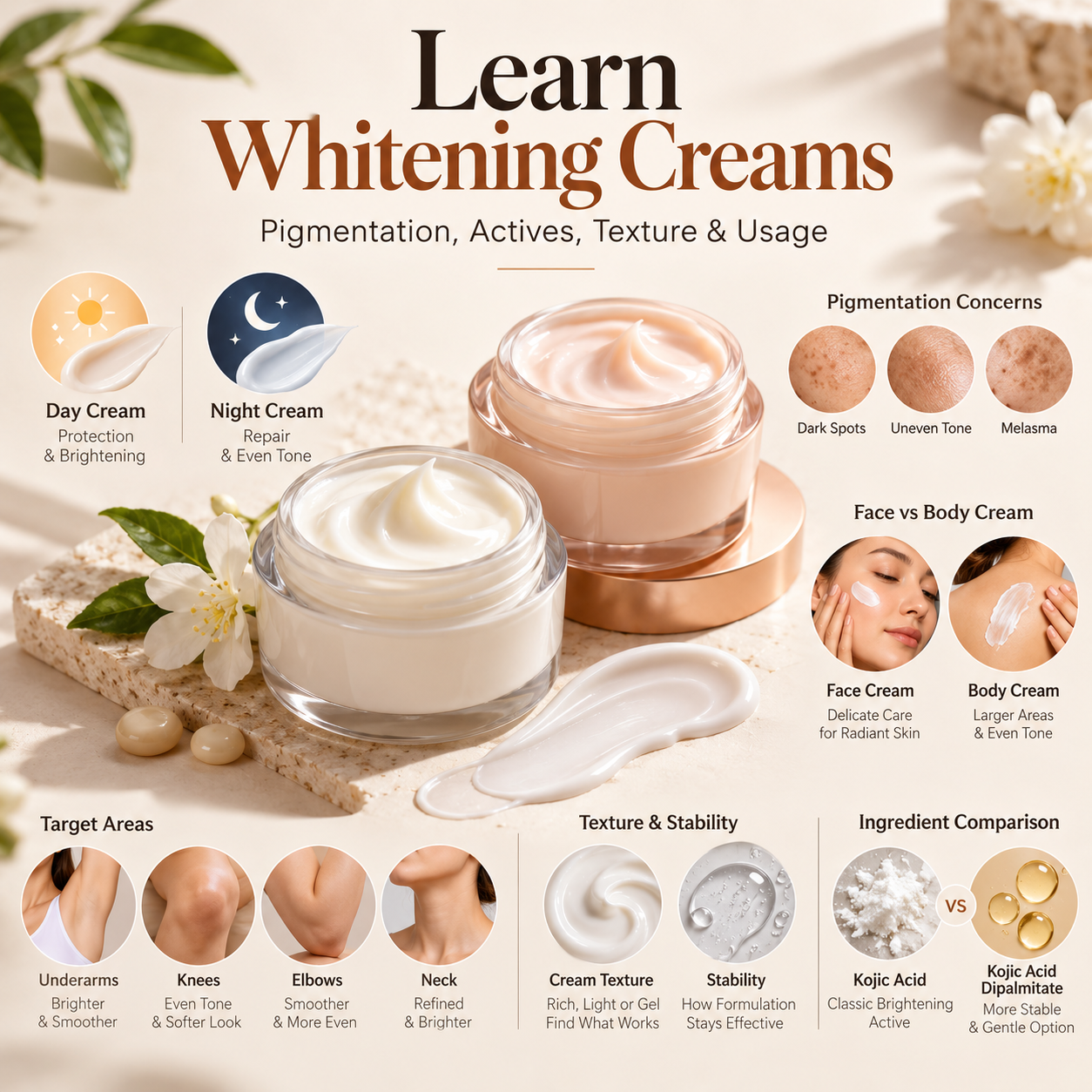
Whitening creams are commonly used for concerns such as pigmentation, tanning, dark spots, post-acne marks and uneven-looking skin tone. However, not every whitening cream is designed in the same way.
A daytime cream may have a different texture and active system from a night cream. A body pigmentation cream needs different spreadability from a facial cream. Even ingredients that appear similar, such as kojic acid and kojic acid dipalmitate, can behave differently inside a formulation.
This learning hub brings together our Whitening Cream Knowledge Articles so you can explore these topics individually and understand the practical differences between products, ingredients and common formulation problems.
Day Whitening Cream vs Night Whitening Cream
Day and night whitening creams may target similar pigmentation concerns, but their active systems and intended use can be different.
The daytime product is designed as the milder option, while the night cream can contain the stronger pigmentation-focused active system.
Read the complete guide:
Day Whitening Cream vs Night Whitening Cream: What Is the Difference?
How Long Does Whitening Cream Take to Work?
Not every type of pigmentation responds at the same speed.
Fresh post-acne marks may show improvement earlier, while older pigmentation and melasma-type patches can require more patience and consistent use.
Learn what affects the expected result time:
How Long Does Whitening Cream Take to Show Results on Pigmentation?
Why Can Whitening Cream Cause Tingling?
Some stronger pigmentation creams may produce a temporary tingling sensation because of the acidic active ingredients used in the product.
The important principle is not to make the cream as strong as possible, but to balance the active system appropriately.
Read more:
Why Can Whitening Cream Cause a Tingling Sensation?
Kojic Acid vs Kojic Acid Dipalmitate
Kojic acid and kojic acid dipalmitate may be associated with the same broad pigmentation concern, but they do not behave identically inside a cream.
One of the most important practical differences is stability, particularly the tendency of ordinary kojic acid to cause discoloration.
Explore the comparison:
Kojic Acid vs Kojic Acid Dipalmitate: What Is the Difference in Whitening Creams?
Why Can’t Every Cream Base Handle Pigmentation Actives?
A cream base that works perfectly well as a moisturizer may not remain stable after stronger pigmentation actives are added.
Some active systems place greater demands on the emulsifier and overall cream structure.
Understand why compatibility matters:
Why Can’t Every Cream Base Be Used for Pigmentation Actives?
Why Does Whitening Cream Split or Become Lumpy?
Splitting, water separation, lumpiness and graininess are not normal characteristics of a good whitening cream.
They can indicate problems with the cream base, compatibility of the active system or the way waxy ingredients have integrated into the product.
Learn the important distinction between thickness and instability:
Why Does a Whitening Cream Split or Become Lumpy?
Can Whitening Cream Be Used on Underarms, Knees, Elbows and Neck?
Pigmentation concerns are not limited to the face.
Body pigmentation creams may be used on areas such as the neck, underarms, knees, elbows and ankles. However, different body areas should not automatically be treated in exactly the same way.
Read the complete guide:
Can Whitening Cream Be Used on Underarms, Knees, Elbows and Neck?
Does Avocado Make an Avocado Whitening Cream Work?
Avocado can contribute to an avocado whitening cream, but it should not automatically be considered the main reason the product works on pigmentation.
The ingredient highlighted in a product name is not always the ingredient doing most of the technical work.
Learn the distinction:
Does Avocado Actually Make an Avocado Whitening Cream Work?
Body Pigmentation Cream vs Face Whitening Cream
A product intended for the body has different practical requirements from one intended mainly for the face.
Spreadability becomes especially important when a cream needs to cover the neck, arms, legs, knees, elbows or other larger areas.
Learn why the two product types are designed differently:
Why Is a Body Pigmentation Cream Different From a Face Whitening Cream?
Explore Whitening Cream Formulation
Understanding pigmentation creams involves more than simply collecting popular brightening ingredients.
The type of product, the strength of the active system, the compatibility of the cream base, the final texture and the intended application area all need to work together.
If you want to learn the complete formulation and practical making process, explore the:
A useful way to approach this subject is to understand each decision separately: what the product is meant to address, when it will be used, where it will be applied, and how the ingredients and cream structure support that purpose.