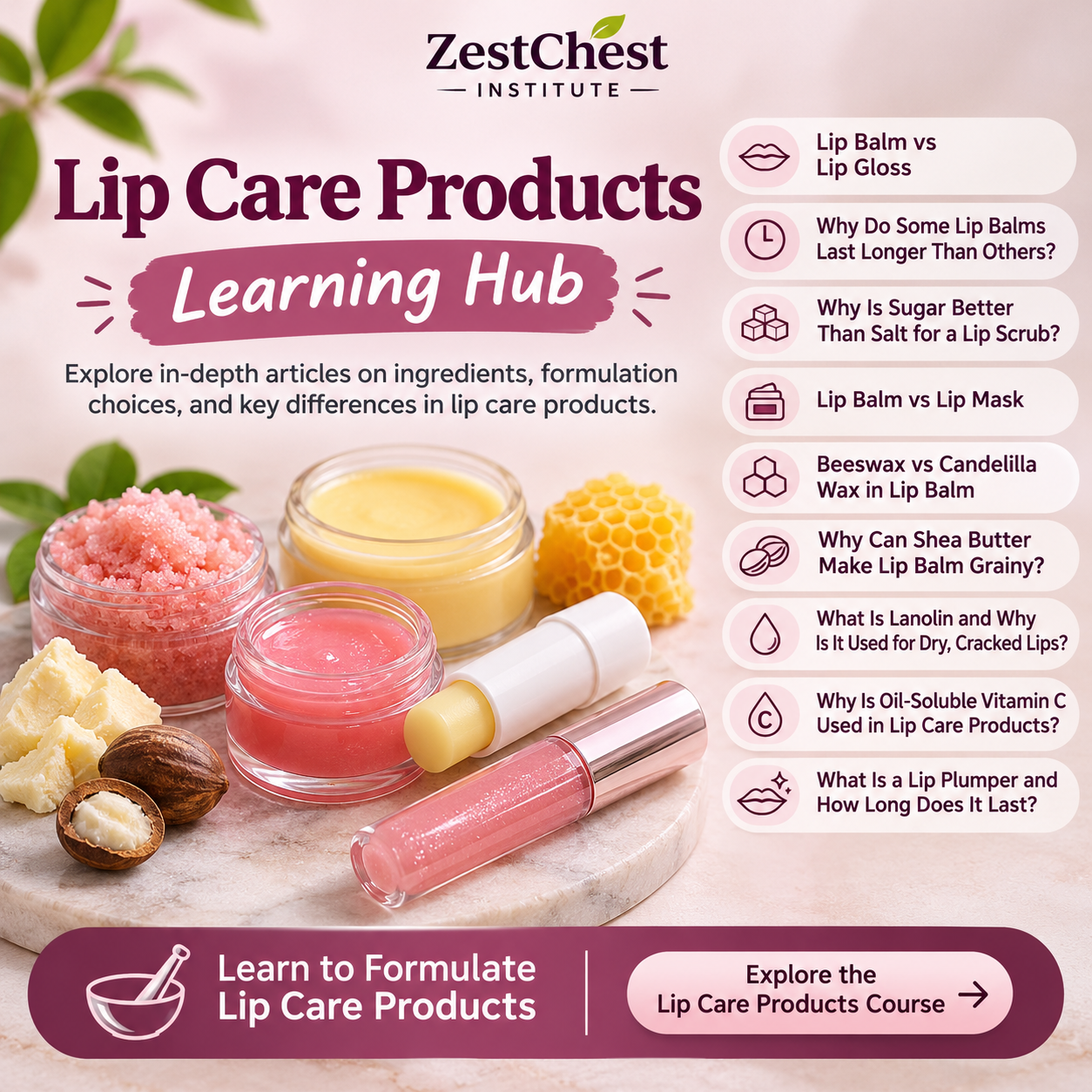
Welcome to the Lip Care Products Learning Hub by ZestChest Institute.
This learning hub is designed to help you understand the science, ingredients, formulation choices, and product differences involved in creating effective lip care products.
Explore the articles below to learn more about lip balms, lip glosses, lip masks, lip scrubs, waxes, butters, lanolin, vitamin C, lip plumpers, and other important concepts used in lip care formulation.
Lip Balm vs Lip Gloss: What Is the Difference?
Lip balm and lip gloss may both be applied to the lips, but they serve different purposes. Learn how they differ in texture, formulation, finish, and function.
Why Do Some Lip Balms Last Longer Than Others?
Some lip balms disappear quickly while others remain on the lips for much longer. Understand how ingredients, waxes, oils, texture, and formulation structure can influence how long a lip balm lasts.
Read: Why Do Some Lip Balms Last Longer Than Others?
Why Is Sugar Better Than Salt for a Lip Scrub?
The lips are delicate and require a different approach to exfoliation compared with many other areas of the skin. Learn why sugar is commonly preferred over salt when formulating lip scrubs.
Read: Why Is Sugar Better Than Salt for a Lip Scrub?
Lip Balm vs Lip Mask: What Is the Difference?
Lip balms and lip masks can both help condition dry lips, but they are designed differently. Learn how their texture, application, purpose, and usage differ.
Beeswax vs Candelilla Wax in Lip Balm
Waxes help give lip balms their structure, firmness, and application characteristics. Learn the differences between beeswax and candelilla wax and how the choice of wax can affect a lip balm formulation.
Read: Beeswax vs Candelilla Wax in Lip Balm
Why Can Shea Butter Make Lip Balm Grainy?
Shea butter is widely used in lip care products, but improper handling can sometimes create an unwanted grainy texture. Learn why this happens and what is occurring inside the formulation.
Read: Why Can Shea Butter Make Lip Balm Grainy?
What Is Lanolin and Why Is It Used for Dry, Cracked Lips?
Lanolin is an ingredient commonly associated with rich, protective lip care products. Learn what lanolin is and why formulators may use it in products designed for very dry or cracked lips.
Read: What Is Lanolin and Why Is It Used for Dry, Cracked Lips?
Why Is Oil-Soluble Vitamin C Used in Lip Care Products?
Different forms of vitamin C behave differently in cosmetic formulations. Learn why an oil-soluble form of vitamin C may be more suitable for certain anhydrous or oil-based lip care products.
Read: Why Is Oil-Soluble Vitamin C Used in Lip Care Products?
What Is a Lip Plumper and How Long Does It Last?
Lip plumpers are designed to create a temporary fuller-looking appearance. Learn how lip plumpers work, what creates the plumping sensation, and how long the effect may typically remain visible.
Read: What Is a Lip Plumper and How Long Does It Last?
Learn Professional Lip Care Product Formulation
Understanding individual ingredients and product concepts is important, but professional formulation also requires learning how ingredients work together to create the correct texture, stability, application, and performance.
The ZestChest Lip Care Products Course provides structured training for learners who want to understand and formulate different types of lip care products.
Explore the Lip Care Products Course
Whether you are learning cosmetic formulation for yourself or planning to develop products for a beauty business, this Learning Hub can help you build a stronger understanding of the principles behind effective lip care formulations.