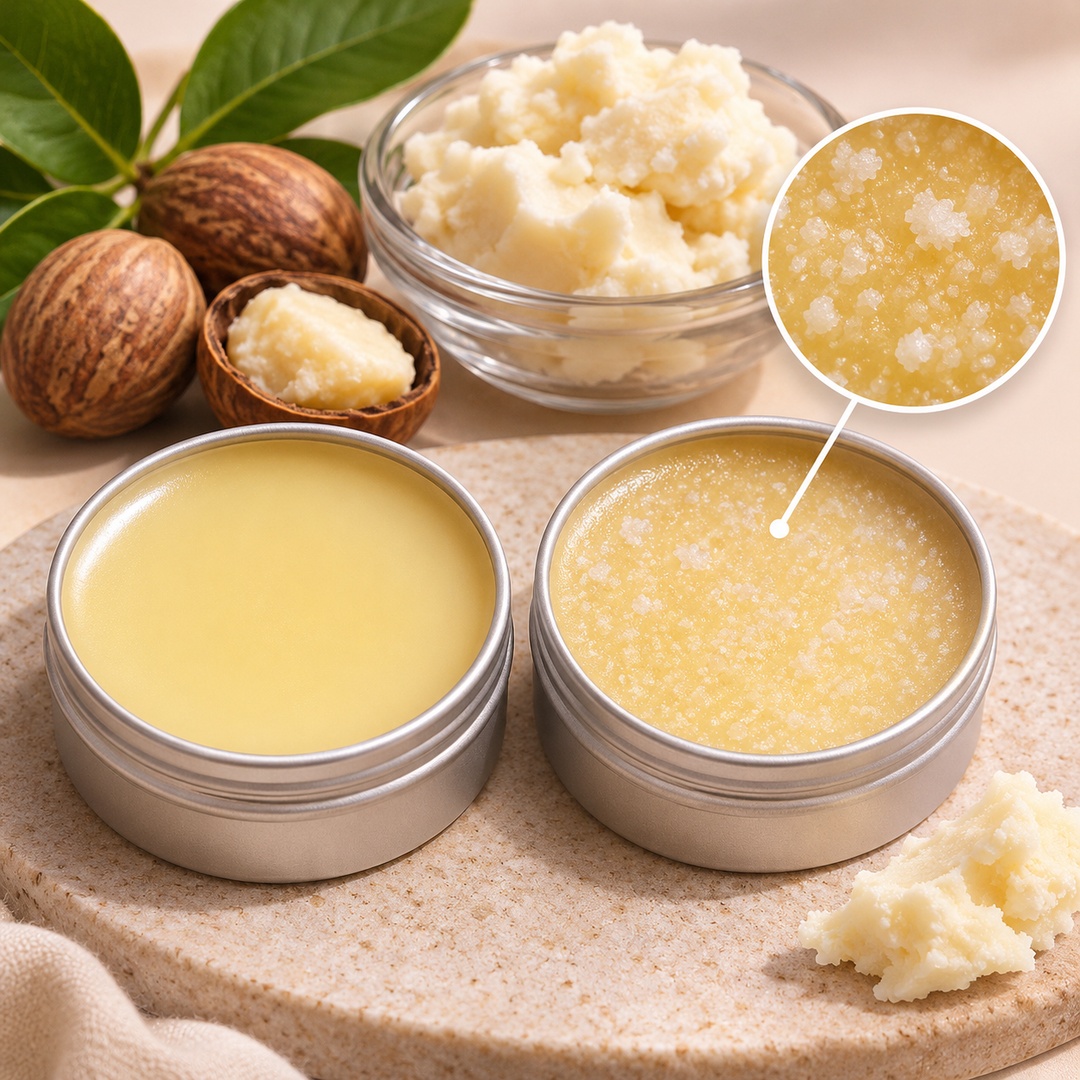
Shea butter can sometimes make a lip balm develop small white or grainy-looking spots because the butter can recrystallize over time.
This does not automatically mean that the lip balm has spoiled.
The graininess discussed in the workshop is a texture and crystallization issue rather than simply evidence of product spoilage.
What Does Shea Butter Graininess Look Like?
A lip balm may initially look smooth.
After storage, small white spots or crystals can begin appearing in the product.
This may happen only after the balm has been sitting for some time.
That delayed appearance can make the problem confusing because the balm may have looked perfectly fine when it was first made.
Why Is the Problem Difficult to Predict?
Natural butters can vary.
One batch of shea butter may remain smooth in a balm.
Another batch may later develop visible crystallization.
That means a formulator cannot assume that a successful result with one batch guarantees identical behaviour with every future batch.
This is why product observation is important before commercial launch.
Does Graininess Mean the Balm Is Unsafe or Spoiled?
Not according to the explanation in this workshop.
The white crystalline appearance associated with shea butter is described as recrystallization.
It should therefore not automatically be confused with microbial spoilage.
That distinction is useful because consumers often assume that any visible change means the product has gone bad.
Can Other Butters Be Used?
Yes.
Cocoa butter is discussed as an alternative when this type of recrystallization is a concern.
Kokum butter is also discussed as an option.
Mango butter is described as behaving more like shea butter in relation to possible recrystallization.
However, every butter also changes the product in other ways.
For example, cocoa butter has its own characteristic smell.
There is rarely a completely consequence-free ingredient substitution.
Why Product Testing Matters
A natural lip balm should not be evaluated only on the day it is made.
Texture can change during storage.
That is particularly important when a formula contains natural butters whose crystalline behaviour may not be immediately visible.
If a brand specifically wants to highlight shea butter, the possibility of this natural texture change should be understood before the product reaches customers.
The key lesson is:
A grainy-looking lip balm is not always a spoiled lip balm. With shea butter, it can be the result of the butter recrystallizing over time.
Related Articles
Beeswax vs Candelilla Wax in Lip Balm: What’s the Difference?