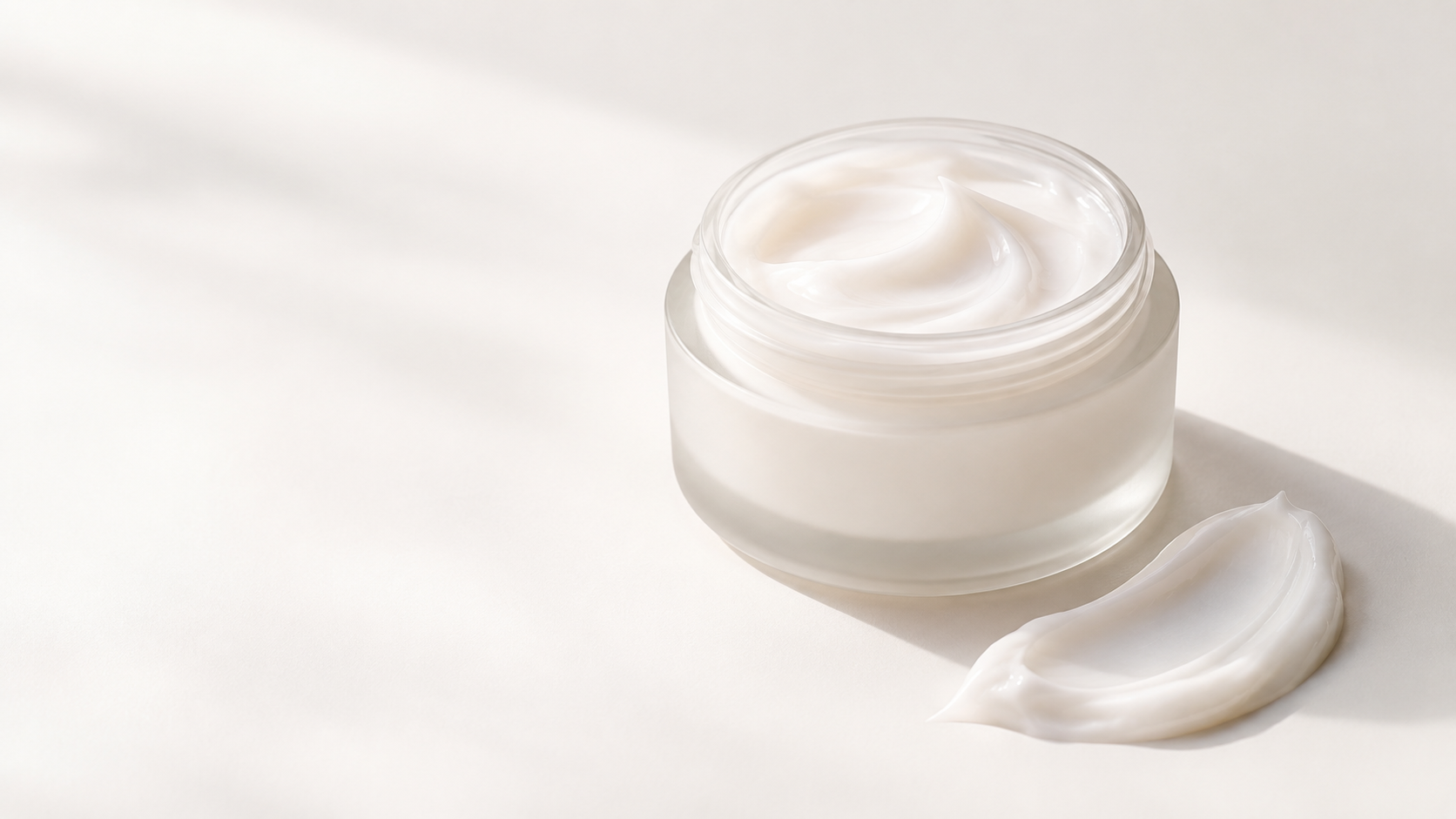
Body yogurt is a lightweight moisturizing cosmetic designed to give some of the richness and comfort of a cream while absorbing faster and leaving considerably less oiliness behind.
Despite the name, body yogurt does not necessarily contain yogurt. The word “yogurt” mainly describes the product’s soft, smooth, yogurt-like appearance and texture.
This makes body yogurt particularly appealing when you want moisturization without the heavy or greasy finish that can come with richer body creams and body butters.
If you are completely new to the term, start with our detailed guide on what body yogurt is and why it is called yogurt.
What Is Body Yogurt?
The easiest way to understand body yogurt is through its texture and skin feel rather than through one particular ingredient.
Cosmetic products are often named according to the sensory experience they create. A gel is associated with a jelly-like consistency. A cream has a creamy consistency. In the same way, body yogurt is named for its soft, smooth and yogurt-like texture.
Depending on the exact texture and positioning, similar products may also be described as body souffle, face souffle or gel cream.
The important distinction is that body yogurt is a texture-based cosmetic format. It does not have to contain fresh yogurt, milk or curd.
For a deeper explanation of this common misconception, read Does Body Yogurt Actually Contain Yogurt?.
What Does Body Yogurt Feel Like?
I think of body yogurt as sitting somewhere between a very light gel cream and a conventional cream.
A very light gel cream can disappear into the skin extremely quickly. A conventional cream usually gives a more noticeable emollient feel.
Body yogurt aims to create a balance between the two.
It should feel nourishing when you apply it and provide enough slip for a short massage, but the oily sensation should reduce considerably as the product absorbs.
The goal is not simply to create something that disappears instantly.
A good body yogurt should still leave the skin feeling comfortably moisturized afterward.
That balance—lightness without sacrificing useful moisturization—is one of the most important ideas behind this type of product.
Body Yogurt vs Body Butter
Body butter is at the richest end of the moisturizing spectrum.
It tends to feel dense, oily and highly emollient. This can feel extremely comfortable during colder weather or for very dry skin.
Body yogurt is designed to reduce that heaviness.
During application, a body yogurt may still feel creamy and luxurious, but after absorption it should leave considerably less persistent oiliness than a traditional body butter.
That does not mean that every body yogurt has to be extremely light. A richer body yogurt can also be created for people who prefer more emollient character.
The important point is that body yogurt and body butter are not simply two different names for the same texture.
Read the full comparison in Body Yogurt vs Body Butter: What’s the Difference?.
Why Body Yogurt Can Be So Comfortable in Summer
Season and climate can completely change how a moisturizer feels.
During winter, a rich oily body butter may feel nourishing and comforting.
During hot weather, the same oily layer may become uncomfortable. Once you step outside and begin to feel warm, a heavy layer sitting on the skin can make the sensation of sweating feel even less pleasant.
Body yogurt provides another option.
It can feel creamy while you are applying it, but the heavy oily sensation should reduce substantially after absorption.
This makes body yogurt particularly attractive for people who still want moisturization during warm weather but do not enjoy the feeling of a rich product sitting on top of their skin.
Lotion can also work perfectly well during summer. The difference is primarily the sensory experience rather than a rule that one format must always be better.
You can explore that distinction in Body Yogurt vs Lotion: Which Is Better in Summer?.
What Makes Body Yogurt Feel Less Greasy?
Creating a lightweight moisturizer is not simply a matter of removing oil.
The skin still needs to feel comfortable after the product has absorbed.
A body yogurt can create moisturization through several different ingredient roles rather than relying entirely on a heavy oily film.
Humectants can contribute moisturization without necessarily creating an oily finish. Lighter-feeling emollients can provide softness and nourishment while reducing persistent greasiness. Gelling ingredients help create the fresh gel-like structure associated with body yogurt and gel creams.
When richer oily materials are included, suitable emulsifying or binding ingredients may also be needed to maintain the cream-like cosmetic structure.
The finished skin feel therefore comes from the balance of the entire product, not simply from whether oil is present.
Our related guide explains this in more detail: Why Does Body Yogurt Feel Less Greasy Than Body Butter?.
Choosing Oils by How They Feel on the Skin
One useful way to understand cosmetic oils is simply to observe what happens after you massage them into the skin.
Some oils continue to feel noticeably oily for much longer.
Others seem to disappear more quickly and leave considerably less greasy film behind.
This difference matters when creating or choosing a body yogurt.
Olive oil, sesame oil, castor oil and almond oil are examples of oils I consider heavier in sensory feel. That does not make them bad ingredients. It simply means they move the product toward a richer experience.
For lighter body-yogurt concepts, lighter-feeling emollient options can be preferred.
The main lesson is that the choice of emollient changes the personality of the finished moisturizer.
Someone with very dry skin may enjoy a richer version. Someone looking for a very matte summer moisturizer may prefer the opposite.
There is no single sensory profile that is ideal for everyone.
Humectants and Lightweight Moisturization
Humectants are useful when the aim is to moisturize without relying entirely on oiliness.
Glycerin is a familiar example. It provides moisturization, but its sensory character does not suit everyone.
In warm or humid weather, some people describe glycerin-rich products as sticky, heavy or even “sweaty.”
That damp sensation does not necessarily mean the skin is suddenly producing more sweat. It is part of the sensory experience the user notices.
Other humectants can create a lighter-feeling profile.
This demonstrates an important formulation principle: asking only “Does this ingredient moisturize?” is not enough.
You also need to consider how the ingredient feels on the skin, how it fits the intended cosmetic experience and what kind of finished product you are trying to create.
What Creates the Yogurt-Like Texture?
The characteristic body-yogurt texture depends heavily on its structuring system.
Gelling ingredients create the gel component that helps distinguish the product from an ordinary cream.
Different gelling systems can create noticeably different sensory results.
Some can create a smooth and polished appearance, while others may produce a more stringy or slimy-looking gel structure.
These differences may seem small when you simply read ingredient names, but they can become very obvious when you actually touch and spread the finished cosmetic.
A product can moisturize effectively and still be rejected by a user because its texture does not feel elegant.
This is why sensory evaluation is such an important part of understanding cosmetic formulations.
Why Some Body Yogurts Look Like Gel and Others Look Creamy
There is no single body-yogurt appearance.
An extra-light version may appear more translucent, gel-like and matte.
A richer version may look more opaque and creamy and may provide a longer massage time before it absorbs.
The balance of the gelling system, oils, butters and other ingredients changes both the appearance and skin feel of the final product.
As more nourishing oils or richer materials are introduced, the product may naturally move further toward the cream side of the spectrum.
This does not mean one version is correct and another is wrong. They have simply been designed to create different experiences.
See the full explanation in Why Do Some Body Yogurts Look Like Gel While Others Look Like Cream?.
Other Moisturizing Ingredients in Body Yogurt Concepts
Body yogurt can be designed as a straightforward lightweight moisturizer or given more targeted positioning.
Aloe vera is one option for a simple moisturizing concept.
Hyaluronic acid can be considered when additional hydration is desired. I often explain its purpose using the analogy of a sponge—the idea is to support the skin’s ability to hold moisture.
Panthenol, or pro-vitamin B5, is another ingredient used for moisture retention.
Hydroxyethyl urea can also contribute moisturization without adding an oily sensation and was discussed particularly in relation to dry, cracked or itchy-feeling skin.
The broader lesson is that moisturization does not have to come entirely from grease.
Different ingredient categories can contribute to the final skin feel in different ways.
Squalene and Dimethicone: Similar Role, Different Experience
Two cosmetic ingredients can perform broadly similar sensory roles without feeling identical.
I compare this with sugar and jaggery. Both can sweeten tea, but the experience is not exactly the same.
Squalene and dimethicone provide a similar example.
Olive-derived squalene can provide smoothness, slip and a light finish while supporting a more natural-positioned concept.
Dimethicone can create the polished slip commonly associated with commercial creams.
The useful distinction is not to reduce the comparison to “good” and “bad.”
They create different sensory experiences and can fit different product concepts.
What matters is what you want the product to feel like while it is being spread and after it has absorbed.
Can Body Yogurt Be Used on the Face?
Yes, a suitably designed body yogurt can also function as a light facial moisturizer.
The word “body” does not automatically restrict the format to body use.
In fact, the quick-absorbing and lower-grease finish can make this type of texture particularly appealing to people who dislike glossy facial moisturizers.
Someone with oily facial skin may enjoy a more gel-like and matte version.
Someone with very dry facial skin may still prefer the comfort of a richer moisturizer.
The important point is to choose according to your skin rather than simply according to the product name.
Read more in Can Body Yogurt Be Used on the Face?.
Choosing Body Yogurt for Your Skin Type
Different skin types may prefer very different versions of body yogurt.
For oily facial skin or anyone who strongly dislikes shine, a more gel-like and matte texture usually makes the most sense.
Normal skin has greater flexibility. Both lighter and somewhat creamier versions may feel comfortable.
For dry skin, I would move toward a richer body yogurt with more emollient character rather than automatically choosing the lightest version available.
Very dry or mature skin may prefer additional moisturization and a creamier feel. If an ultra-light yogurt does not provide enough comfort, a traditional moisturizer or richer product can still be the better choice.
Sensitive skin requires a different way of thinking.
I would not automatically fill a sensitive-skin moisturizer with a long list of targeted actives simply because those ingredients are available. Simplicity can be more appropriate because individual users may respond differently to ingredients that other people tolerate comfortably.
The most useful principle is to choose according to the person using the product rather than assuming that one texture is universally ideal.
For a skin-type-by-skin-type explanation, see How Do You Choose a Body Yogurt for Your Skin Type?.
Can Body Yogurt Be Designed for Specific Skin Concerns?
Yes, but every body yogurt does not need to become a treatment product.
A simple, well-designed body yogurt can function perfectly well as a lightweight moisturizer.
When there is a genuine reason for more targeted positioning, additional cosmetic actives may be considered.
The important distinction is between the base function and the targeted claim.
The base is there to moisturize and create the desired sensory experience.
Additional actives should be selected when there is a clear reason for including them.
Adding more ingredients does not automatically make a cosmetic better.
Can Children Use Body Yogurt?
The basic body-yogurt concept can also be used for children.
However, there is little reason to add unnecessary adult-oriented targeted actives.
Children do not need a moisturizer designed around pigmentation or skin-brightening positioning.
For this type of user, nourishment and protection are more relevant than loading the product with numerous actives.
A simple, richer moisturizing version can therefore make more sense than a highly active treatment-style product.
Is Body Yogurt a Sunscreen?
No.
A body yogurt should not be assumed to become a reliable sunscreen simply because a sunscreen-related ingredient has been mixed into a moisturizing base.
Sunscreen ingredients can change the oil requirements, emulsification needs and overall texture of a cosmetic system.
A body yogurt should therefore be treated as the type of product it was designed to be rather than assuming that adding a sunscreen material automatically provides reliable sun protection.
Natural Colours and Body Yogurt
Colour can create practical challenges in cosmetic products.
Some plant-derived colours may look beautiful initially but fade over time.
A bright natural pink or blue that looks attractive when a product is freshly made may not remain identical after extended storage.
For a commercial product, this can matter because customers may interpret visible colour changes as deterioration or poor quality.
Some more stable colour options may produce softer or more muted shades.
If colour is not essential to the product concept, leaving the product uncoloured can also be completely reasonable.
The priority should be an appearance that remains acceptable rather than forcing a dramatic colour that may become disappointing later.
Common Body Yogurt Mistakes
One of the most common misunderstandings is believing that body yogurt must literally contain yogurt. It does not.
Another is expecting a product built around rich, heavy oils to feel exactly like an ultra-matte gel cream. Ingredient choices change the final sensory result.
Texture also needs to be evaluated carefully. If a gel structure has not developed properly, the product may initially appear thinner or lumpier than expected. Trying to correct texture without first understanding the underlying issue can create further problems.
Hygiene also remains important. Preservation does not replace good hygiene practices, and packaging deserves the same attention to cleanliness as the equipment used during preparation.
Another mistake is assuming that every fashionable active should be added to the same moisturizer.
A simpler product can often be more appropriate, particularly for sensitive skin or children.
Packaging Body Yogurt
Body yogurt can be presented in transparent or opaque cosmetic packaging.
Transparent packaging allows the customer to see the colour and distinctive yogurt-like texture. This can be useful when the appearance of the product itself is part of the presentation.
Opaque packaging can work equally well when the label, graphics and overall brand identity are doing more of the visual work.
Pack size should also reflect how the product is intended to be used.
A facial moisturizer does not need to be offered in the same quantity as a full-body product.
From the user’s perspective, a practical quantity that can be finished within a reasonable period can sometimes be more enjoyable than an oversized container that lasts for months.
Body Yogurt vs Lotion: Is One Better?
There is no need to declare one format universally superior.
Lotion remains a useful all-season moisturizer and can suit many skin types.
Body yogurt has a stronger sensory advantage when the weather is hot or when the user dislikes a glossy or heavy finish.
On the body, a small amount of shine may not matter very much, so either format may feel comfortable.
On the face, the distinction can become more noticeable.
Someone with oily facial skin may find a conventional lotion too shiny, while a yogurt or souffle texture may feel considerably lighter.
Someone with very dry facial skin may still prefer the comfort of a richer moisturizer.
The right choice depends on climate, skin type and the finish you actually enjoy wearing.
Frequently Asked Questions
Does body yogurt actually contain yogurt?
Not necessarily. “Body yogurt” is primarily a texture-based cosmetic name. It describes the product’s soft, smooth and yogurt-like appearance and feel.
Can body yogurt be used on the face?
Yes. A suitably designed body yogurt can function as a light facial moisturizer. Its fast absorption and lower-grease finish may be particularly appealing in warm weather or to people who dislike shiny moisturizers.
Can body yogurt be called something else?
Yes. Depending on the exact texture and product positioning, similar formats may be described as body souffle, face souffle or gel cream.
Are heavier oils unsuitable for body yogurt?
Not automatically.
Heavier oils simply move the finished product toward a richer sensory experience. Someone with very dry skin may actually prefer this type of body yogurt, while someone looking for a very matte summer product may prefer lighter-feeling emollients.
Why not use only glycerin for moisturization?
Glycerin is an effective moisturizing ingredient, but its skin feel is not ideal for everyone.
Some users find glycerin-rich products sticky or damp in hot and humid conditions. Other humectant approaches can provide a different sensory experience.
Is body yogurt suitable for sensitive skin?
It can be, but I prefer to keep sensitive-skin concepts simple rather than automatically filling them with numerous actives.
Individual users can react differently to ingredients that others tolerate comfortably.
Can body yogurt replace sunscreen?
No.
A moisturizing gel-cream or body-yogurt product should not be assumed to provide reliable sun protection simply because a sunscreen-related ingredient has been added.
The Most Useful Way to Think About Body Yogurt
Body yogurt is not defined by one single ingredient.
It is better understood through the experience it is designed to create.
You should be able to spread it and feel that you have applied something nourishing. It can provide enough slip to feel luxurious for a short period, but unlike a traditional rich body butter, the oily sensation should not remain sitting heavily on the skin.
That balance—moisturization without persistent heaviness—is the central idea.
Once you understand that, the differences between gel creams, body yogurts, creams and body butters become much easier to recognize.
Instead of choosing a moisturizer because one category sounds more fashionable, pay attention to your climate, your skin type, the finish you prefer and how your skin actually feels after the product has absorbed.
Related Body Yogurt Guides
- What Is Body Yogurt and Why Is It Called Yogurt?
- Body Yogurt vs Body Butter: What’s the Difference?
- Body Yogurt vs Lotion: Which Is Better in Summer?
- Can Body Yogurt Be Used on the Face?
- Why Does Body Yogurt Feel Less Greasy Than Body Butter?
- How Do You Choose a Body Yogurt for Your Skin Type?
- Why Do Some Body Yogurts Look Like Gel While Others Look Like Cream?
- Does Body Yogurt Actually Contain Yogurt?
For the complete Body Yogurt learning collection, visit the Body Yogurt Knowledge Hub.
If you want to learn the formulation practically, you can also explore the Body Yogurt Course by ZestChest Institute.