
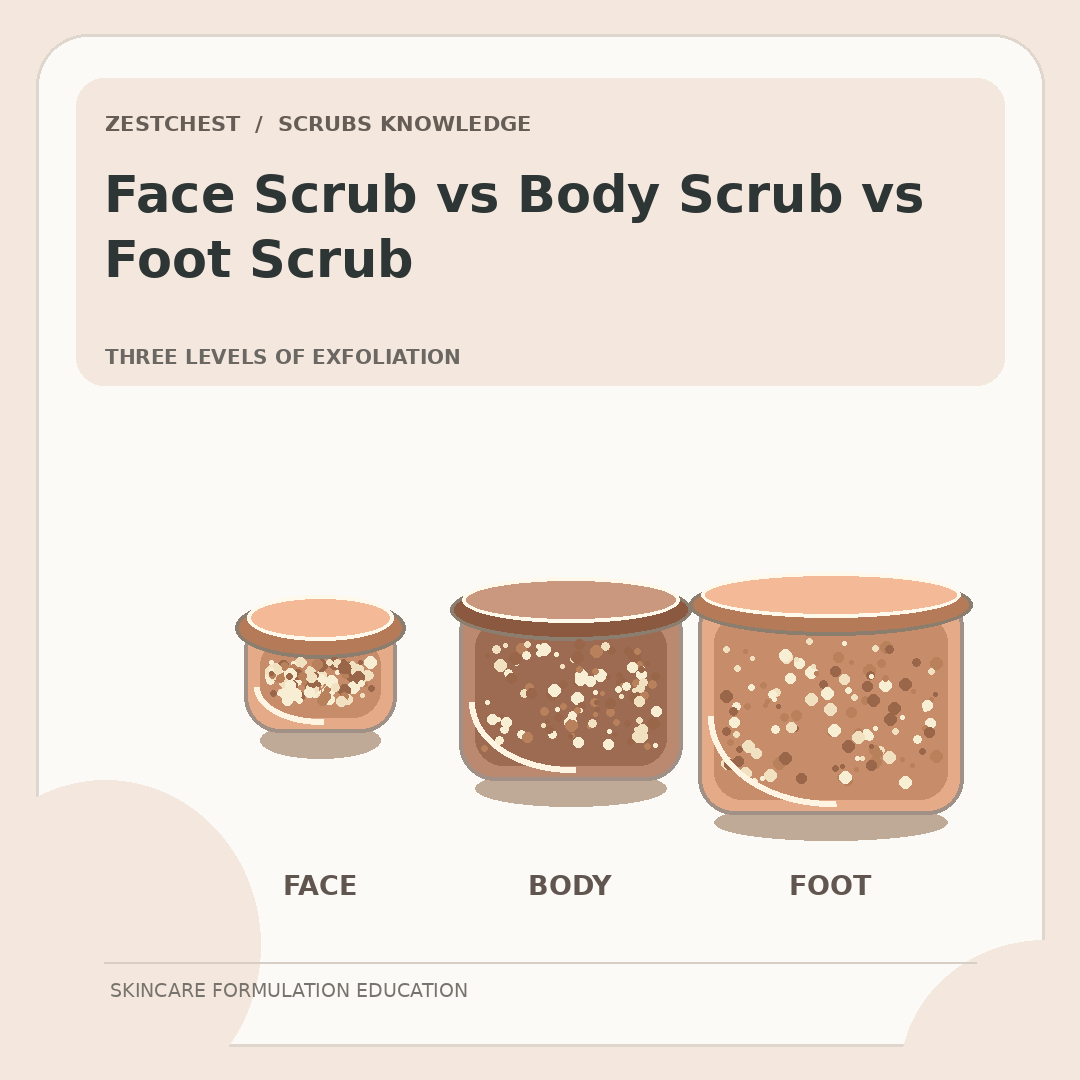
Face scrubs, body scrubs and foot scrubs all help remove accumulated dead skin cells, but they differ mainly in the size, quantity and roughness of their exfoliating particles.
Facial skin is more delicate than body skin, while the skin around the feet, particularly the heels, is usually thicker.
This is why a scrub suitable for the feet may be too harsh for the face, even when both products use a similar base.
Why Do Different Body Areas Need Different Scrubs?
The skin covering different parts of the body does not have the same characteristics.
Our face requires a gentler exfoliating approach because its surface is delicate.
The skin on the arms and legs can generally tolerate a more noticeable scrubbing action, while the heels may develop thick, rough areas that require stronger exfoliation.
The important difference is not necessarily the type of cream or oil surrounding the exfoliating particles.
It is the nature of the particles themselves.
What Makes a Facial Scrub Different?
A facial scrub should contain relatively small exfoliating particles.
The particles should also be less concentrated so that they do not create excessive friction.
Imagine rubbing large sugar crystals over delicate facial skin.
Instead of feeling smooth and comfortable, the particles may feel scratchy.
Repeated or forceful scrubbing can disturb the skin barrier.
I prefer a mild scrubbing experience for the face because the objective is to remove accumulated dead skin, not to damage the protective surface underneath.
Why Are Body Scrubs Usually Coarser?
Body skin is generally thicker than facial skin.
This allows body scrubs to provide a more noticeable exfoliating sensation.
Medium-sized sugar crystals and different types of salt are examples of exfoliating materials used in body scrubs.
Body scrubs may also contain oils and butters that leave the skin feeling nourished after rinsing.
The choice of particles and base determines whether the scrub feels grainy, creamy or rich during application.
Why Do Foot Scrubs Need Stronger Exfoliation?
The skin around the heels can become particularly thick and rough.
Some people develop significant accumulations of dead skin and may even use a foot file to remove hardened areas.
For these conditions, a stronger scrub may be useful.
However, people who do not have thick or rough heel skin may prefer a gentler foot scrub.
Not everyone requires the same intensity of exfoliation.
Can the Same Scrub Base Be Used for Face, Body and Feet?
Yes. A similar scrub base may be suitable for different products, provided the exfoliating characteristics are adjusted appropriately.
The finished product must still suit the skin area where it will be used.
A smooth cream base does not automatically make a scrub gentle if it contains large, rough particles.
Similarly, reducing the number and size of particles can produce a milder experience.
This distinction is important when choosing or evaluating a scrub.
How Should You Choose the Right Scrub?
Consider the area you want to exfoliate and the condition of your skin.
For facial skin, choose a mild scrub with fine particles.
For general body care, a more noticeable grainy texture may be suitable.
For thick, rough heels, stronger exfoliation may be appropriate.
Avoid using a coarse foot scrub on the face simply because both products are described as exfoliating scrubs.
The most important principle is that a scrub should match the thickness and sensitivity of the skin being treated. Stronger exfoliation is not automatically better exfoliation.

