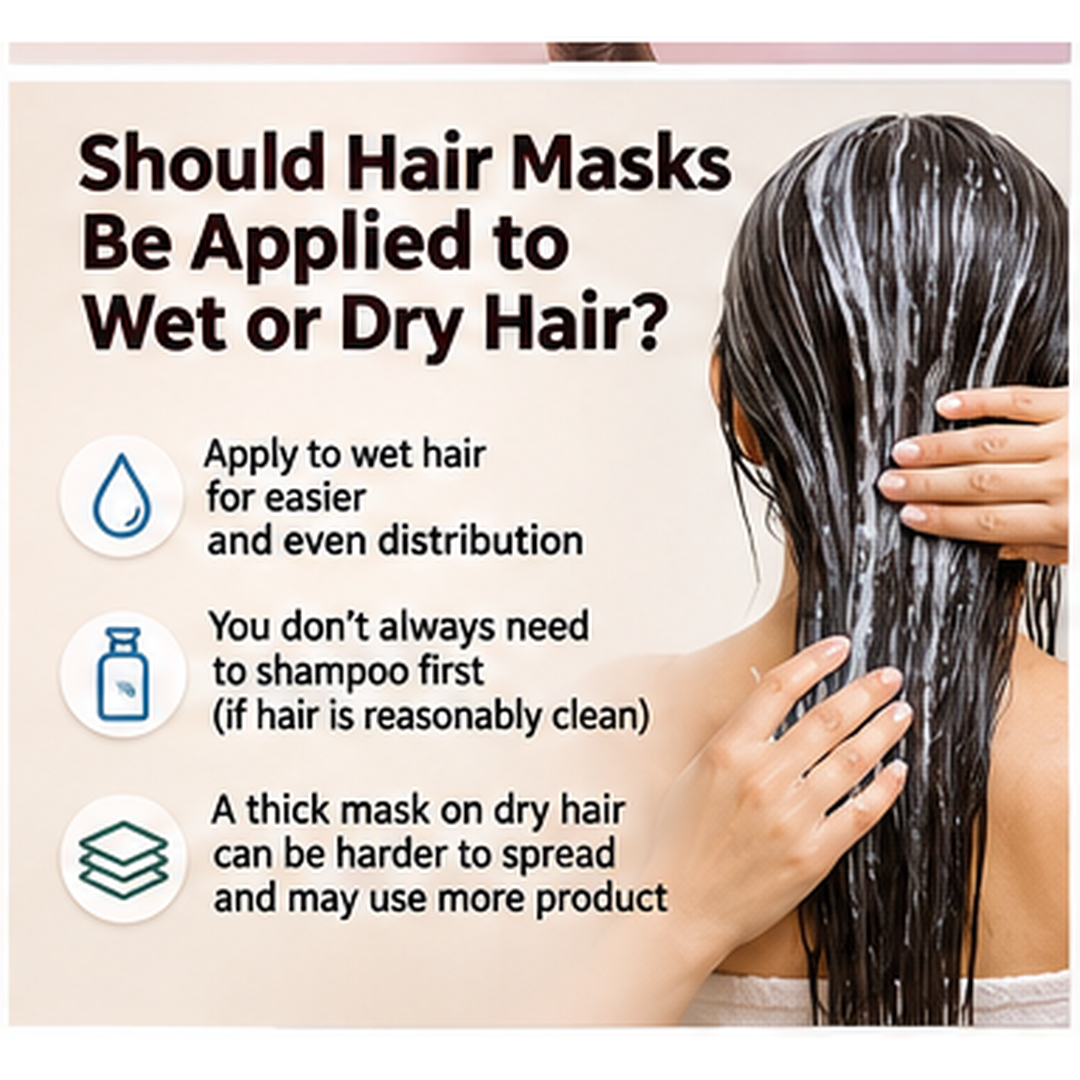
Hair masks should generally be applied to wet hair.
Wet hair makes a thick mask easier to distribute through the scalp and hair length. Applying a rich mask directly to completely dry hair can require much more product and make even application more difficult.
The hair does not necessarily have to be freshly shampooed immediately before every mask treatment, but it should be wet.
Why Is Wet Hair Better for Applying a Mask?
Hair masks are generally much thicker than ordinary conditioners.
If you put a thick cream directly onto dry strands, the product can be taken up quickly by the dry hair and become difficult to spread.
You may then keep adding more and more mask simply because the product is not distributing evenly.
Wet hair gives the mask a more workable surface.
This allows you to spread the product over a larger area without using an unnecessarily large quantity.
Does the Hair Have to Be Shampooed First?
Not always.
If the scalp and hair are dirty, shampooing before a mask is appropriate because you want to apply the treatment to clean hair.
However, if you have been indoors, your hair is reasonably clean and you do not want to shampoo again, you can still do the treatment.
Simply wet the hair with water.
You can:
- wet the hair normally;
- spray it thoroughly with water;
- or wet it and towel-dry it before application.
The important point is that the hair should be damp or wet enough for the mask to distribute properly.
How Should You Apply the Mask?
Work section by section.
This is particularly useful when the mask is intended for scalp application as well as the hair length.
Sectioning allows you to make sure the scalp and strands are actually covered rather than simply coating the outside layer of the hairstyle.
Dry or rough ends can receive additional attention where needed.
How Long Should the Mask Stay On?
The treatment should generally remain on the hair for at least about 15 minutes.
It can be left for up to approximately 30 minutes.
If you plan to keep it on for the longer end of this range, covering the hair is useful because an exposed mask can begin to dry.
Should You Shampoo After Rinsing the Mask?
No.
After the treatment time, rinse the hair thoroughly with plain water.
Do not shampoo immediately afterward because you would be washing away the conditioning and nourishing materials you have just applied.
The sequence is treatment followed by rinsing, not treatment followed by another cleansing step.
What About Leave-On Hair Masks?
Not every mask should be treated as a leave-on product.
The aloe-based aromatherapy conditioning product discussed in the workshop can also be used in a small quantity as a leave-on product.
That is a specific product concept.
It does not mean every rich cream-based rinse-off hair mask should automatically be left in the hair.
The Practical Takeaway
For a conventional hair-mask treatment, wet the hair first.
You do not always need to shampoo immediately beforehand if the hair is already reasonably clean, but applying a thick mask directly to dry hair can make distribution difficult and increase product usage.
Related Articles
Why Is a Shower Cap Used During a Hair Mask Treatment?