
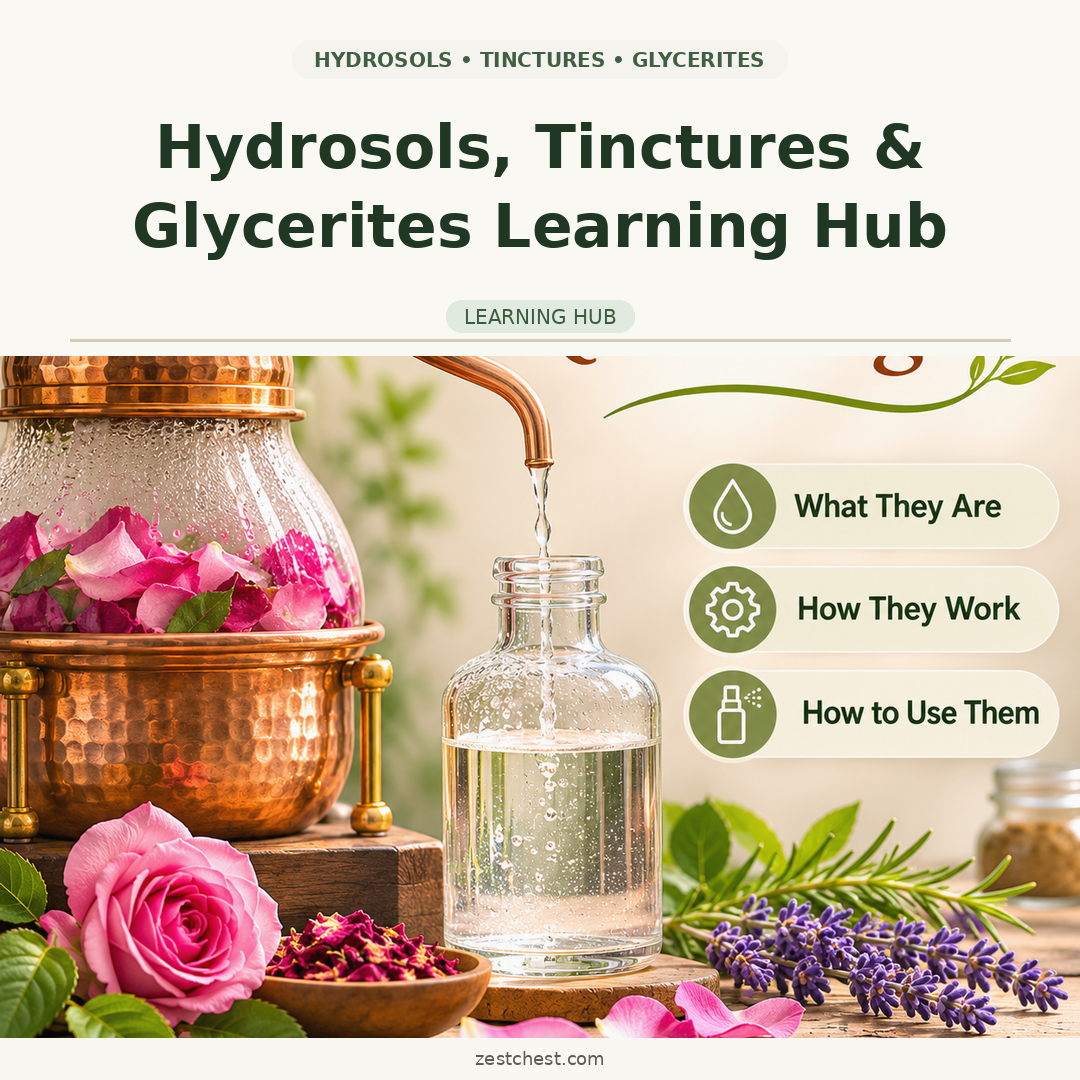
Welcome to the Hydrosols, Tinctures, Glycerites & Herbal Extracts Learning Hub.
This hub brings together focused educational guides on botanical extraction methods used in cosmetic formulation. You can learn how hydrosols, tinctures, glycerites, oil-soluble extracts and water-soluble extracts differ, how extraction strength changes between methods, and why factors such as herb freshness and maceration matter.
If you want structured training with the complete practical learning process, you can also explore the full course.
Hydrosols, Extracts, Tinctures & Glycerites Course
Learn how different botanical extraction methods can be prepared and used in cosmetic formulations.
Course:
https://www.zestchest.com/product/hydrosolsextractstinctures-glycerites-course/
Start Learning
1. What Is a Hydrosol and How Is It Different From Rose Water?
A hydrosol is a steam-distilled botanical water, while rose water can refer to a direct water-based preparation where rose material is infused in the water itself.
Learn how the two methods differ, why hydrosols are generally clear, and how their extraction process affects their characteristics.
Read the article:
https://www.zestchest.com/what-is-a-hydrosol-and-how-is-it-different-from-rose-water/
2. Hydrosol vs Tincture vs Glycerite: What’s the Difference?
Hydrosols, tinctures and glycerites can all carry botanical material, but they use different extraction media and have different levels of concentration.
This guide explains the basic differences between distilled botanical waters, alcohol extracts and glycerin-based extracts.
Read the article:
https://www.zestchest.com/hydrosol-vs-tincture-vs-glycerite/
3. What Is a Tincture in Cosmetic Formulation?
A tincture is a concentrated botanical extract made using alcohol as the extraction medium.
Learn why tinctures are considered highly concentrated herbal extracts, how they differ from hydrosols and glycerites, and where they can fit into cosmetic formulation.
Read the article:
https://www.zestchest.com/what-is-a-tincture-in-cosmetic-formulation/
4. What Is a Glycerite and Where Can It Be Used?
A glycerite is a botanical extract prepared using vegetable glycerin.
Because glycerin remains part of the extract, glycerites behave differently from tinctures and hydrosols and are particularly useful in many water-containing cosmetic products.
Read the article:
https://www.zestchest.com/what-is-a-glycerite-and-where-can-it-be-used/
5. Why Are Hydrosols Usually Clear and Mildly Scented?
A genuine hydrosol can look almost like plain water and may have only a faint botanical aroma.
This article explains why strong plant pigments do not necessarily appear in distilled hydrosols and why fragrance strength alone should not be used to judge hydrosol quality.
Read the article:
https://www.zestchest.com/why-are-hydrosols-usually-clear-and-mildly-scented/
6. Which Herbal Extraction Method Is the Most Concentrated?
Different extraction media do not pull botanical material with the same strength.
This guide compares alcohol extraction, glycerin extraction, direct water extraction, oil extraction and hydrosols to explain their relative concentration and why the strongest method is not automatically the best choice for every product.
Read the article:
https://www.zestchest.com/which-herbal-extraction-method-is-the-most-concentrated/
7. Oil-Soluble vs Water-Soluble Herbal Extracts: What’s the Difference?
The extraction medium determines where an herbal extract naturally fits in a cosmetic formulation.
Learn why oil-soluble extracts are suited to oil-based applications while water-soluble extracts belong more naturally in water-containing products.
Read the article:
https://www.zestchest.com/oil-soluble-vs-water-soluble-herbal-extracts/
8. Why Does the Freshness of Dried Herbs Matter in Herbal Extraction?
Dried herbs do not remain equally potent forever.
Their colour, aroma and useful botanical characteristics can weaken during long storage. This article explains why the quality and freshness of the starting botanical matter before extraction even begins.
Read the article:
https://www.zestchest.com/why-does-the-freshness-of-dried-herbs-matter-in-herbal-extraction/
9. What Is Maceration in Herbal Extraction and Why Does It Matter?
Maceration is the process of softening and breaking down plant material so its botanical components can move into the extraction medium.
Learn why particle size, contact with the extraction liquid and the type of menstruum all influence the extraction process.
Read the article:
https://www.zestchest.com/what-is-maceration-in-herbal-extraction-and-why-does-it-matter/
Understanding the Extraction Methods
The main idea behind herbal extraction is to transfer useful botanical material from herbs, flowers, fruits, roots or other plant materials into a suitable medium.
That medium may be:
- water;
- alcohol;
- vegetable glycerin;
- oil.
The choice of medium affects the type of extract produced, its concentration and where it can be used in a cosmetic product.
A hydrosol, for example, is very different from a tincture even if both begin with the same herb. Likewise, an oil-soluble extract and a glycerite may contain the same botanical but behave differently because their carrier media are different.
Understanding these differences makes it easier to select the right extract for the right formulation.
Explore the Complete Course
The articles in this Learning Hub are designed to explain individual concepts and common questions.
For structured learning covering hydrosols, tinctures, glycerites and herbal extracts in greater depth, explore the complete course:
Hydrosols, Extracts, Tinctures & Glycerites Course
https://www.zestchest.com/product/hydrosolsextractstinctures-glycerites-course/

