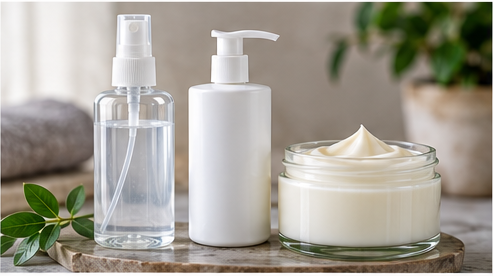
Magnesium oil, magnesium lotion and magnesium body butter can all be built around magnesium chloride, but they are very different products to use.
The biggest difference is not necessarily the magnesium itself. It is the format of the product, how rich it feels on the skin, where you use it and how easily it fits into your routine.
A magnesium spray is extremely light. A lotion combines magnesium with everyday moisturization. A body butter is deliberately much richer and is particularly useful when the skin itself needs heavier conditioning.
Understanding those differences makes choosing between them much easier.
What Is Magnesium Oil?
Despite its name, magnesium oil doesn’t have to contain any conventional oil.
The formulation demonstrated in the Zestchest workshop is primarily magnesium chloride dissolved in distilled water. The name comes from the temporarily oily or slippery sensation the solution creates when applied to the skin.
Because it has a very thin, almost water-like consistency, it works particularly well in a spray bottle.
You can spray it onto areas such as the legs, arms, shoulders or feet, rub it briefly over the skin and leave it on.
That makes magnesium oil the lightest of the three formats.
Magnesium oil may suit someone who:
- doesn’t like creams or lotions;
- wants something very light;
- wants to apply the product quickly over a larger area; or
- prefers a simple spray as part of a post-bath or evening routine.
It isn’t intended to provide the same moisturizing richness as a lotion or body butter.
What Is Magnesium Lotion?
Magnesium lotion combines magnesium chloride with a conventional moisturizing emulsion.
Unlike magnesium oil, it contains both a water phase and an oil phase. An emulsifier is used to bring those phases together into a smooth lotion.
The lotion taught in the workshop is deliberately kept relatively light, with substantially less oil and butter than the magnesium body butter.
The result is a product that can combine magnesium with the familiar experience of using a daily moisturizer.
Magnesium lotion may suit someone who:
- already uses body lotion regularly;
- wants moisturization without a very heavy finish;
- wants a product suitable for larger areas of skin; or
- simply prefers a creamier product to a spray.
Of the three formats, lotion sits in the middle: more moisturizing than the spray but considerably lighter than the butter.
What Is Magnesium Body Butter?
Magnesium body butter is the richest of the three products.
The formulation taught in the workshop contains a considerably larger oil-and-butter phase than the lotion, producing a thick product designed to leave more richness on the skin.
This makes it particularly suited to areas that need heavier moisturization, such as:
- feet;
- heels;
- hands;
- elbows; and
- knees.
Dr. Soma specifically discusses the possibility of positioning the product as a foot butter or hand butter, particularly for very dry or rough-feeling skin.
It isn’t necessarily the format someone would choose for quickly covering the whole body.
Magnesium Oil vs Lotion vs Body Butter at a Glance
| Magnesium Oil | Magnesium Lotion | Magnesium Body Butter | |
|---|---|---|---|
| Texture | Water-like | Light and creamy | Thick and rich |
| Oil phase | None in the workshop formula | Relatively low | Much higher |
| Typical packaging | Spray bottle | Pump/bottle | Jar |
| Moisturizing feel | Very light | Moderate | Rich |
| Good for larger areas | Yes | Yes | Less convenient |
| Useful for very dry areas | Limited moisturization | Some | Particularly suitable |
| Application | Spray and briefly rub in | Apply like lotion | Massage into areas needing richness |
The table highlights why asking which one is “best” isn’t particularly useful.
They solve different formulation and user-experience problems.
Should Dry Skin Use Lotion or Body Butter?
Usually the more useful question is how dry the skin is, rather than the person’s age.
Someone with relatively normal skin may prefer the lighter lotion.
Someone with extremely dry feet or hands may appreciate the richer body butter.
Dr. Soma makes this distinction explicitly in the workshop: a younger person can have very dry skin while an older person may not. Product selection should therefore respond to the condition of the skin, not simply an age category.
This is also useful when designing products commercially.
Instead of marketing a body butter simply as something “for older skin,” it may make more sense to formulate and position it around dry feet, dry hands or other areas requiring intensive moisturization.
Can You Use More Than One Type?
Yes.
Choosing one format doesn’t mean you can never use another.
For example, someone could use:
After a shower: magnesium spray over the legs.
During the day: magnesium lotion when the skin needs moisturization.
Before bed: magnesium body butter on particularly dry feet.
Dr. Soma discusses this type of flexible routine in the workshop and notes that lotion and butter can simply be reapplied according to the user’s moisturizing needs.
There is generally little practical reason, however, to apply all three products on top of one another at the same time.
They are better thought of as alternative formats for different situations.
Is the Magnesium Concentration the Same in All Three?
Not necessarily.
One particularly interesting formulation point from the workshop is that the three products don’t simply take one formula and change its thickness.
Their structures are different.
A magnesium spray is essentially a water-based system.
The lotion and body butter are emulsions containing water and oils, and the workshop formulations use different proportions and emulsification approaches to produce their different textures.
That means converting a magnesium spray into a lotion—or a lotion into a body butter—isn’t simply a matter of adding more thickener.
The entire formulation has to work as a stable product.
Why Not Just Put Magnesium Chloride Into Any Lotion?
Because magnesium chloride can make emulsification more difficult.
A conventional lotion is already balancing water and oil with an emulsifier. Introducing a relatively high concentration of salt changes that formulation environment.
In Dr. Soma’s development work, emulsifying systems that performed well in ordinary lotions did not necessarily remain stable when significant magnesium chloride was introduced.
So a successful magnesium lotion requires more than choosing the desired skin feel.
It also has to remain properly emulsified and stable over time.
Which Magnesium Body Product Should You Choose?
A simple way to decide is to start with the experience you want.
Choose magnesium oil if you want the lightest possible format and don’t particularly want moisturization.
Choose magnesium lotion if you want magnesium incorporated into something that behaves more like an everyday moisturizer.
Choose magnesium body butter if rich moisturization is important, particularly for very dry areas such as feet, hands or elbows.
The underlying lesson is broader than magnesium products:
Choose the product format according to how somebody will actually use it—not simply according to the featured ingredient.
The same ingredient can make sense in several formulations because different users want very different textures, application methods and levels of moisturization.
Related Magnesium Body Product guides
→ What Is Magnesium Oil and Why Is It Called an Oil?
→ How Do You Choose the Right Magnesium Product for Your Skin and Routine?
For a broader introduction to Fabric Conditioners, its ingredients, structure, variations and formulation principles, read our complete guide: Magnesium Oil, Lotion and Body Butter Explained: Benefits, Uses & Differences.