This is a strong first article because the name itself creates an obvious question: magnesium oil can contain no oil at all. That’s explicitly demonstrated in Soma’s workshop—the formulation is water, magnesium chloride, preservative and optional water-soluble fragrance.
WordPress setup
Title / H1:
What Is Magnesium Oil and Why Is It Called an Oil?
Slug:what-is-magnesium-oil
SEO title:
What Is Magnesium Oil & Why Is It Called an Oil?
Focus keyphrase:what is magnesium oil
Meta description:
Magnesium oil isn’t actually an oil. Learn what magnesium oil is made from, why it feels oily on the skin and how a magnesium spray is typically used.
Excerpt:
Despite its name, magnesium oil can contain no actual oil. Discover what creates its unusual skin feel and why it is commonly packaged as a spray.
What Is Magnesium Oil and Why Is It Called an Oil?
Magnesium oil has a confusing name because it isn’t necessarily an oil at all.
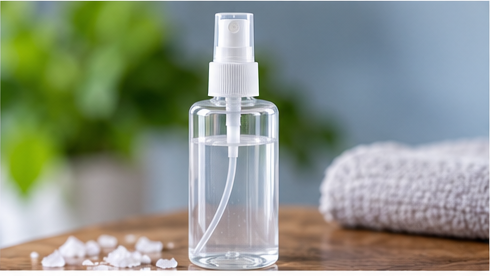
The magnesium oil taught in the Zestchest workshop is a water-based preparation made primarily by dissolving magnesium chloride flakes in distilled water. It contains no conventional carrier oil such as almond, coconut, jojoba or olive oil.
So why is it called magnesium oil?
The answer comes from what happens when magnesium chloride solution is applied to the skin.
Why Does Magnesium Oil Feel Oily?
When magnesium chloride is dissolved in water and applied to the skin, the solution can initially create an unusual oily sensation.
The skin may look shiny and the liquid can feel surprisingly similar to a very light oil.
But this effect doesn’t come from oil being present in the formulation.
In the workshop demonstration, the shiny, oily sensation gradually reduced after application. Soma explains that after several minutes the product no longer has the same oily feel because there is no actual oil remaining on the skin.
It is therefore useful to distinguish between:
what the product contains — a water-based magnesium chloride solution
and
what the product initially feels like — slightly oily or slippery.
The second characteristic is what gives magnesium oil its unusual name.
What Is Magnesium Oil Made From?
At its simplest, the magnesium oil demonstrated in the workshop is built around two main ingredients:
distilled water + magnesium chloride flakes
For a finished cosmetic product, the workshop formulation also includes a preservative and allows for an optional water-soluble fragrance.
This makes magnesium oil quite different from conventional body oils.
A normal body oil might be formulated from ingredients such as almond oil, jojoba oil, argan oil or other oil-soluble ingredients.
Magnesium chloride, by contrast, is used here in a water-based system.
Why Is Magnesium Oil Usually a Spray?
The answer is mainly practical.
Magnesium oil has a thin, water-like consistency. Putting such a product into a jar or conventional lotion bottle would make little sense.
A spray bottle allows it to be distributed easily over areas such as the:
- legs
- arms
- shoulders
- feet
Soma demonstrates spraying the product onto the body, rubbing it in briefly and then leaving it on the skin. It doesn’t require the prolonged massage that someone might associate with a massage oil.
This is one reason the same type of product can also be described as a magnesium spray, magnesium body spray or magnesium body mist.
When Can Magnesium Oil Be Used?
Soma suggests two particularly convenient times in the workshop.
One is after bathing, when it is easy to spray the product over larger areas of the body.
Another is before bed, when someone may prefer to apply it to areas such as the feet or legs.
The practical principle is simple: if it is being used as a leave-on body product, don’t apply it immediately before bathing and then rinse it away.
How Is Magnesium Oil Different From Magnesium Lotion?
The biggest difference is the cosmetic format.
A magnesium lotion contains an oil phase and an emulsifier, producing the familiar texture of a light moisturizer.
The magnesium oil discussed here doesn’t.
That creates very different experiences:
| Magnesium Oil | Magnesium Lotion |
|---|---|
| Water-like | Creamy |
| No added oil in the workshop formula | Contains oils/butter |
| Usually sprayed | Usually pumped or squeezed |
| Extremely light | Moisturizing |
| Initially feels slightly oily | Behaves more like a conventional lotion |
Someone who dislikes creams or richer body products may therefore prefer the spray.
Someone who wants magnesium incorporated into an everyday moisturizer may prefer a lotion.
The workshop specifically describes these formats as serving similar broad magnesium-related purposes while differing primarily in format, skin feel and convenience.
Does Magnesium Oil Need Fragrance?
No.
A fragrance-free magnesium spray is perfectly reasonable.
There is also a formulation reason to think carefully before adding fragrance.
Magnesium oil is a water-based product. Conventional essential oils are not water-soluble, so simply adding essential oil can cause it to float on top of the solution rather than remain uniformly dispersed.
In the workshop, Soma corrects this distinction during the demonstration and uses a water-soluble fragrance for a visually uniform scented spray. She also notes that fragrance is optional.
So, Is Magnesium Oil Really an Oil?
No—not in the conventional cosmetic sense.
The magnesium oil discussed here is essentially a magnesium chloride solution formulated as a leave-on body spray.
It gets the name “oil” from the temporary oily or slippery sensation it creates on the skin, rather than from conventional oils being present in the formula.
And that’s what makes magnesium oil such an unusual cosmetic format: it can provide an initially oil-like application experience while remaining an extremely light, water-based product.
Related Magnesium Body Product guides
→ Magnesium Oil vs Lotion vs Body Butter: What’s the Difference?
→ Why Is Magnesium Chloride Used in Magnesium Body Products?
For a broader introduction to Fabric Conditioners, its ingredients, structure, variations and formulation principles, read our complete guide: Magnesium Oil, Lotion and Body Butter Explained: Benefits, Uses & Differences.