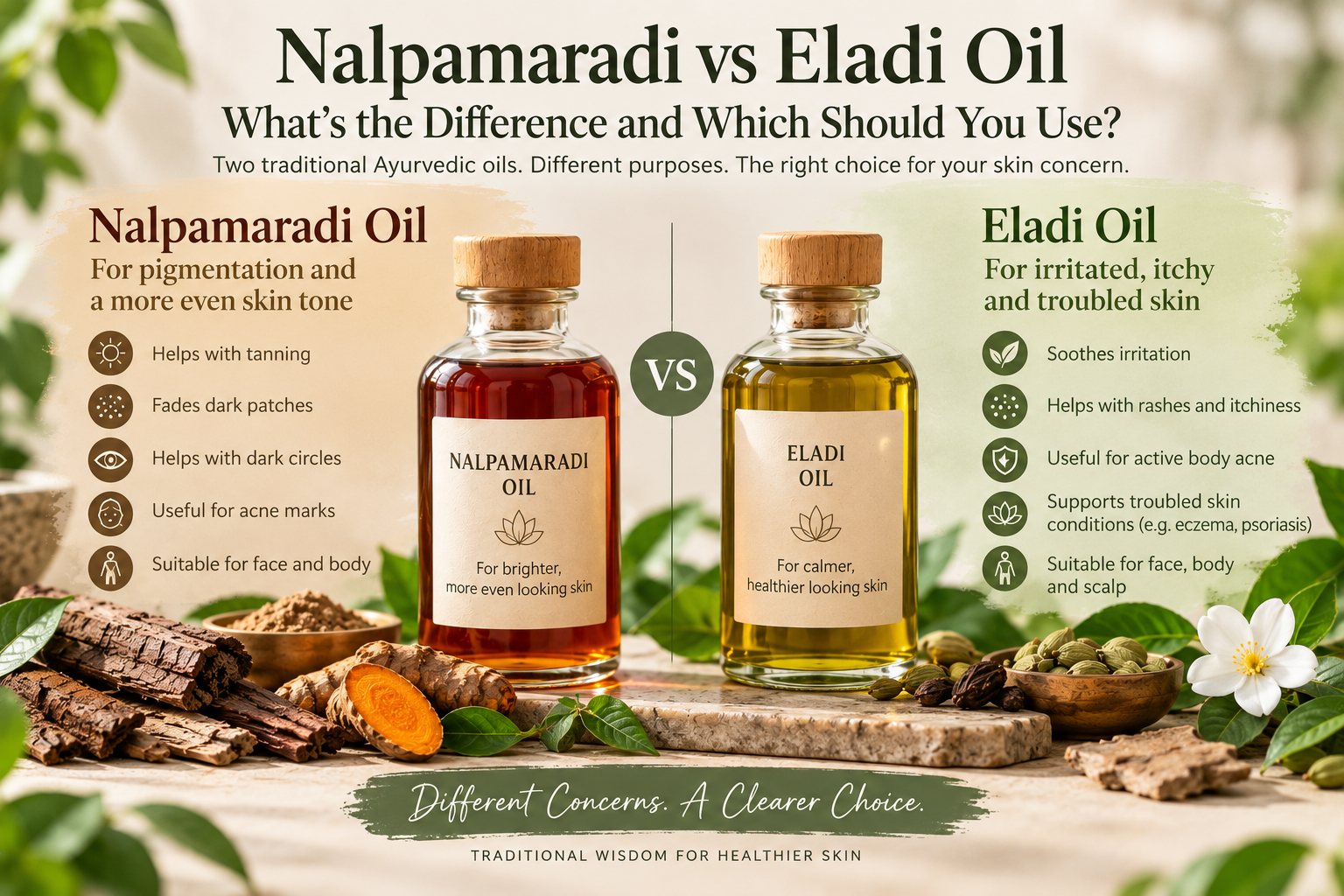
Nalpamaradi and Eladi oils overlap in some of their skin benefits, but their main purposes are different. A useful way to choose is to identify the dominant skin concern. If the main problem is tanning, pigmentation, dark patches, dark circles or marks, Nalpamaradi is the more targeted choice. If the main problem is active irritation, itchiness, rash or another troubled-skin condition, Eladi is the more relevant choice.
Why the two oils can seem similar
Both are traditional herbal oils that can be used on the face and body, and both contain herbs associated with more than one skin benefit. Nalpamaradi is primarily pigmentation-focused but also includes herbs discussed in connection with wounds, inflammation, rashes and itching. Eladi is primarily soothing and healing, but it can also help with discoloration that accompanies irritated skin. That overlap can make the two sound interchangeable if you compare them only by reading lists of ingredients or benefits.
The simplest distinction
Instead of beginning with the ingredient list, begin with what is happening to the skin right now. Nalpamaradi is the pigmentation-focused oil: tanning, dark patches, dark circles, uneven-looking areas, dark elbows and knees, darkness between the thighs and marks left after acne are examples discussed for it. Eladi is the active-skin-concern oil: itchiness, rashes, inflammation, body acne, sunburn and troubled skin conditions are the kinds of concerns discussed for it.
The back-acne example
Imagine two people who both say they have a problem with back acne. The first still has active acne and says the area is itchy and uncomfortable. Eladi fits that situation because the immediate concern is active irritation. The second person’s acne has already gone and only dark marks remain. Nalpamaradi now becomes the more relevant choice because pigmentation is the dominant concern. The same person could therefore need a different oil at a different stage of the problem.
Face, body or scalp?
The choice is not simply about where the oil is applied. Both Nalpamaradi and Eladi can be used on the face or body when the concern matches their purpose. Eladi is also discussed for an itchy scalp, dandruff, redness and psoriasis. Nalpamaradi may moisturise the scalp, but it is not presented as a hair-growth oil. Choose according to the problem rather than according to whether the application area is the face, body or scalp.
Can you mix them?
You can combine the oils, but I prefer allowing each one to do the job for which it was selected. If the skin is actively irritated, itchy or affected by active acne, use the oil targeted to that concern. If the active problem has passed and pigmentation is what remains, shift the focus accordingly. There is no need to turn every routine into a mixture of everything that sounds beneficial.
The useful takeaway
Nalpamaradi and Eladi are easiest to understand as targeted oils rather than as two competing versions of the same product. Ask whether you are mainly trying to address pigmentation or an active irritated skin condition. That one distinction usually makes the choice much clearer.
Related Nalpamaradi & Eladi Oil guides
→ What Is Nalpamaradi Oil Used For?
→ Can You Mix Nalpamaradi and Eladi Oils Together?
For a broader look at their benefits, ingredients, uses, application and how the two oils differ, read our complete guide to Nalpamaradi and Eladi oils.