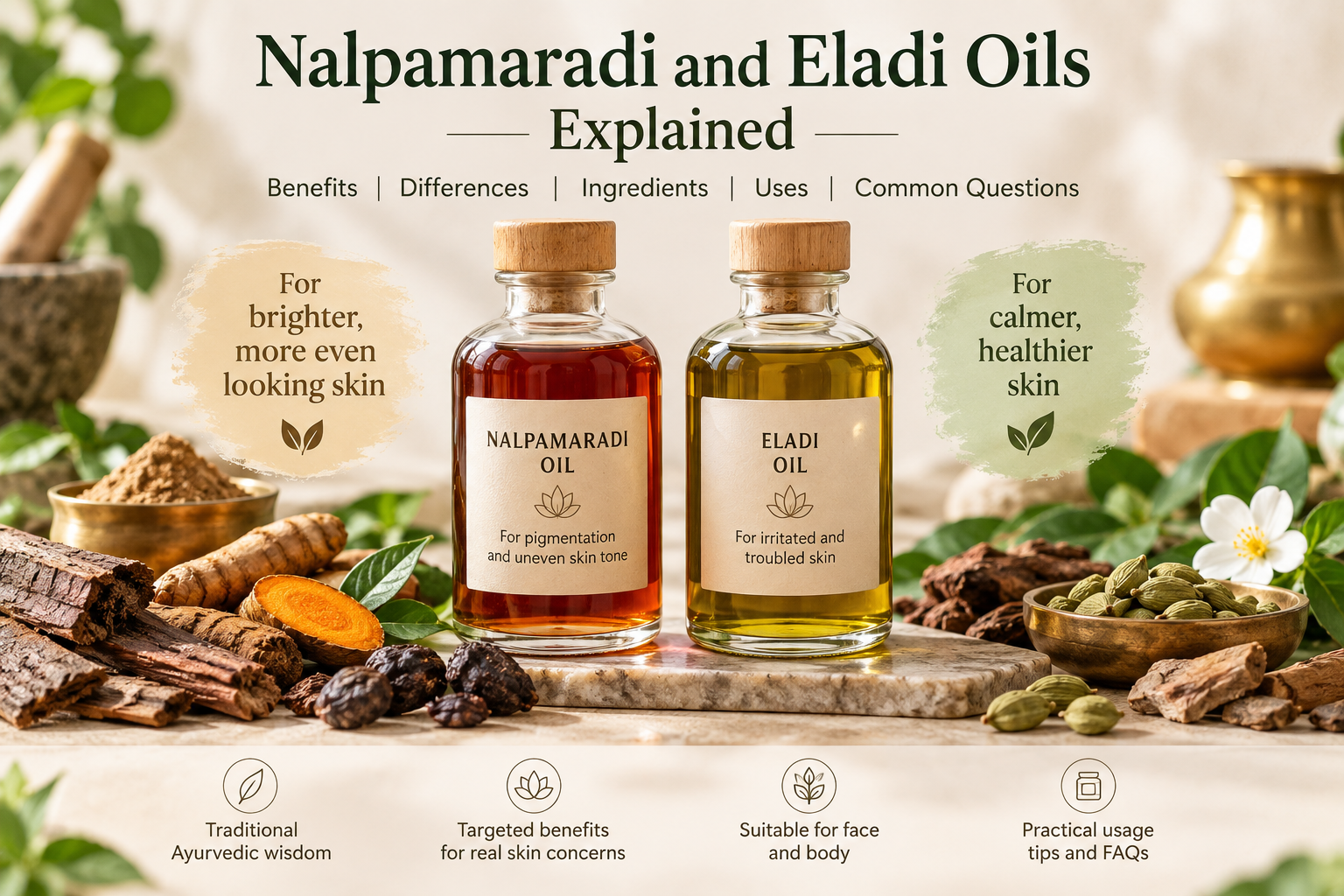
Nalpamaradi oil and Eladi oil are traditional Ayurvedic herbal oils, but they are not intended for exactly the same purpose.
The simplest way to understand the difference is this:
Nalpamaradi is primarily a pigmentation-focused oil, used for concerns such as tanning, dark patches, dark circles, uneven-looking skin and marks.
Eladi is primarily a soothing and healing oil, used when the main concern is itchiness, irritation, rashes or other troubled-skin conditions.
There is some overlap. Nalpamaradi also has skin-healing properties, while Eladi can help with the discoloration that sometimes accompanies irritated skin. But their emphasis is different.
Understanding that distinction is much more useful than simply comparing long lists of Ayurvedic herbs.
Nalpamaradi vs Eladi vs Kumkumadi: What’s the Difference?
Kumkumadi is the broadest of the three oils. I think of it as an all-rounder because it is used for concerns including tanning, pigmentation, moisturisation, fine lines and other skin problems. It is also generally positioned as a premium facial oil and commonly sold in very small bottles.
Nalpamaradi and Eladi allow us to be more specific.
| Oil | Main focus | Particularly relevant for |
| Nalpamaradi | Pigmentation and skin brightening | Tan, dark patches, dark circles, uneven-looking areas and marks |
| Eladi | Skin soothing and healing | Itchiness, rashes, irritated skin, active body acne and troubled skin conditions |
| Kumkumadi | Broader, all-round skincare | A wider range of facial concerns, usually in a more premium format |
Nalpamaradi and Eladi are also particularly useful as body oils because body application naturally requires considerably more product than facial application.
A useful rule to remember is:
If the main concern is pigmentation, think Nalpamaradi. If the main concern is active irritation, itchiness or troubled skin, think Eladi.
Read more: Nalpamaradi vs Eladi Oil: What’s the Difference and Which Should You Use?
What Is Nalpamaradi Oil Used For?
Nalpamaradi is primarily a pigmentation-focused oil. It can be used for:
- tanning;
- dark patches;
- dark circles;
- pigmentation;
- marks left after acne or other skin problems;
- dark elbows and knees;
- darkness between the thighs;
- uneven tanning on the feet and other exposed areas.
It can be used on both the face and body. This is important because pigmentation isn’t only a facial concern. Children who spend considerable time outdoors, for example, can develop tanning on exposed arms and legs. Adults may notice darker elbows, knees or repeatedly exposed areas.
Read more: What Is Nalpamaradi Oil Used For?
Fresh and older pigmentation are not the same
How long a mark has been present matters.
A newly formed mark and pigmentation that has remained for a long time should not necessarily be expected to respond at the same speed. Older marks can take considerably longer to fade than recent ones.
So rather than asking only:
“Does Nalpamaradi work on pigmentation?”
also ask:
“What kind of pigmentation am I dealing with, and how long has it been there?”
That gives you a much more realistic way of thinking about the concern.
What Gives Nalpamaradi Its Character?
Nalpamaradi is much more than simply turmeric in oil.
Its name points towards an important group of four tree barks, including banyan, peepal, plaksha and udumbara. Other Ayurvedic herbs and herbal groups used in the oil include Triphala, turmeric, sandalwood, Manjishta and vetiver.
Rather than looking at these as a long ingredient list, it is more useful to understand the functions being brought together.
The tree barks are associated with both skin appearance and concerns such as wounds, inflammation, rashes and itching. Other herbs are associated particularly with pigmentation and the appearance of marks from acne, insect bites and burns.
Triphala contains amla, Bibhitaki and Haritaki. Amla is used in connection with vitamin C, collagen production, skin lightening and a more uniform-looking skin texture.
The overall character of Nalpamaradi therefore comes from bringing several categories of herbs together around a predominantly pigmentation-focused purpose.
What Is Eladi Oil Used For?
Eladi has a different personality.
Where Nalpamaradi is primarily concerned with pigmentation, Eladi is primarily concerned with skin discomfort and active skin problems.
It is used in relation to concerns including:
- itchiness;
- rashes;
- inflammation;
- cuts and wounds;
- prickly heat;
- body acne;
- sunburn;
- eczema and psoriasis;
- discomfort during and after chicken pox.
Eladi contains a considerably larger collection of herbs than Nalpamaradi. Green and black cardamom are among those used, together with herbs such as Jatamansi, Manjishta and sandalwood. Many of these herbs have overlapping roles connected with inflammation, irritation, wounds and skin discomfort.
That overlap is worth understanding.
A traditional herbal formulation does not necessarily contain many ingredients because every ingredient has a completely different job. Several herbs may contribute towards the same overall purpose.
Why Can Eladi Also Help With the Appearance of Marks?
This is where the distinction between Nalpamaradi and Eladi can initially become confusing.
Irritated skin may not immediately return to its original appearance. Scratching, inflammation or another active skin problem can leave an area rougher or darker than the surrounding skin.
Eladi can therefore help with the active skin concern while also helping, to a lesser degree, with the associated discoloration.
That does not make Eladi and Nalpamaradi interchangeable.
A very useful example is back acne.
Imagine someone says:
“I have active acne on my back. It is itchy and uncomfortable.”
The immediate problem is the active skin condition, so Eladi is the more relevant choice.
Now imagine someone else says:
“My acne has gone. I’m only left with the dark marks.”
The problem has changed. It is now primarily pigmentation, making Nalpamaradi the more relevant choice.
The interesting point is that the same person’s needs can change over time. What starts as an Eladi-type concern can eventually become a Nalpamaradi-type concern.
Can Nalpamaradi and Eladi Be Used on the Face?
Yes. Neither oil should be thought of as exclusively a body oil.
Nalpamaradi can be used on the face when the concern is something such as facial pigmentation or dark circles.
Eladi can also be used on the face when the relevant irritation or skin concern is present. Many of the problems for which Eladi is selected simply happen to occur frequently elsewhere on the body as well.
The better question is therefore not:
“Is this a face oil or a body oil?”
but:
“What problem am I trying to address?”
Read more: Can You Use Nalpamaradi Oil on the Face?
Can Eladi Oil Be Used on the Scalp?
Yes, when the reason for using it is a scalp concern such as itchiness, dandruff, redness or psoriasis.
Nalpamaradi on the scalp is different. It may provide moisturisation, but it isn’t presented as a hair-growth oil. If you are choosing between these two specifically for an itchy or troubled scalp, Eladi is the more relevant choice.
Again, choose according to the problem rather than simply according to whether you are applying the oil to the face, body or scalp.
Read more: Can Eladi Oil Be Used for an Itchy Scalp and Dandruff?
How Much Ayurvedic Oil Should You Apply?
One of the most important things about using an oil is also one of the simplest:
More oil does not automatically mean a better result.
People have very different oiling habits. One person takes a few drops and massages them thoroughly over an area. Another repeatedly pours on more oil until the skin is drenched.
Naturally, the second person is much more likely to describe the product as heavy and greasy.
I prefer using a smaller quantity and spreading it properly. Adding more and more oil does not keep increasing absorption or moisturisation indefinitely. A small amount that is thoroughly distributed can be both more comfortable and sufficient for its intended use.
What if the oil feels too heavy in summer?
Use less.
If you dislike the oily surface feel, another option discussed is to apply the oil after bathing, rinse again with plain water and then dab the skin with a towel. This removes some of the surface oiliness.
Before deciding that an oil is simply “too greasy,” therefore, look at how much you’re applying.
Read more: How Much Ayurvedic Body Oil Should You Apply?
What About Oily or Acne-Prone Skin?
The way you use an oil should depend on the skin concern.
For body acne, Eladi is used as a pre-bath treatment rather than necessarily being left sitting on the skin throughout the day.
The concern is that excess oil remaining on oily, sweating skin may contribute to further clogging and acne. The oil can instead be massaged onto the affected area, left for a short period and then washed away during the bath.
For other concerns, such as dry, itchy or irritated skin, the oil may be left on if it feels comfortable.
The important point is that the same oil does not have to be used in exactly the same way for every skin concern.
Read more: Nalpamaradi or Eladi Oil for Acne and Acne Marks: Which Should You Use?
Sesame Oil or Coconut Oil: Does the Base Matter?
Yes.
Both sesame and coconut oil can be used as traditional choices.
In the Ayurvedic distinction used here, coconut is considered cooling while sesame is considered heating. Coconut is therefore associated more with summer and sesame with winter.
There are practical differences too.
Coconut oil can solidify in colder weather, making a bottled body oil inconvenient to dispense. It also contributes its own characteristic smell.
For oily or acne-prone facial skin, I prefer sesame over coconut. Coconut is considered more likely to cause acne for these users.
Other carrier oils can also be used, including almond, olive and sunflower. Lighter premium oils such as argan and jojoba can be considered when creating a more modern-feeling product.
This means two bottles both labelled Nalpamaradi oil or Eladi oil need not feel exactly the same.
The carrier oil influences how the finished product feels and behaves on the skin.
Read more: Sesame Oil vs Coconut Oil for Ayurvedic Skin Oils: What’s the Difference?
Does a Traditional Ayurvedic Oil Have to Feel Very Greasy?
No.
There is a tendency to associate a potent herbal oil with something very dark, thick and greasy. That isn’t necessarily how it needs to feel when used.
A finished Nalpamaradi oil can be visibly dark and reddish but still spread comfortably when an appropriate amount is applied. Put too much on a small area, however, and the experience immediately becomes much heavier.
There is also an important distinction between facial and body oils.
On the face, people naturally use very little. On the body, they tend to pour and massage much larger quantities over a much greater surface area.
The body therefore does not necessarily need the same concentration as a facial product.
A useful analogy is almonds.
If a certain amount already gives you what you need, simply multiplying the amount does not necessarily multiply the benefit.
The same principle applies here:
Concentration, quantity applied and effectiveness are not the same thing.
Should You Apply a Gel Before or After a Herbal Oil?
If you are using a water-based gel and an oil as separate products, apply the gel first.
Allow the lighter, water-based layer to absorb and then follow with the oil or a heavier cream.
Applying oil first creates a barrier that makes a subsequent water-based gel less useful, apart from perhaps changing the surface feel.
Mixing an oil directly into a gel is different. In that situation, the two are being applied together rather than placing a water-based product over an oil layer that has already formed.
So the everyday rule is straightforward:
When layering separate products, use the water-based product first and the oil afterwards.
Read more: Should You Apply a Gel Before or After Face Oil?
Can You Mix Nalpamaradi and Eladi Oils?
You can, but I prefer allowing each oil to do the job for which it was selected.
If the skin is currently inflamed, itchy or affected by active acne, Eladi is the more relevant choice.
If the active problem has passed and what remains is primarily pigmentation or marks, Nalpamaradi becomes more relevant.
There is no need to turn every skincare routine into a mixture of everything that sounds beneficial.
Identify the dominant problem first.
Read more: Can You Mix Nalpamaradi and Eladi Oils Together?
Does Darker Ayurvedic Oil Mean Better Quality?
Not necessarily.
Different processing choices can produce oils with different visual characteristics. One version may appear darker and thicker while another may look cleaner and lighter, even when their intended skin benefit remains the same.
This matters because colour, thickness and visible herbal material can influence our perception of authenticity.
Saffron provides a particularly interesting example.
Seeing saffron strands in an oil may reassure a customer that saffron was actually used. But once its useful constituents have already been released, leaving visible saffron in the bottle is largely an aesthetic choice.
That illustrates an important distinction:
What makes a product look convincing to a buyer isn’t necessarily the same as what makes the product work.
Read more: Does Darker Ayurvedic Oil Mean Better Quality?
Common Questions About Nalpamaradi and Eladi Oils
Which oil should I use for active back acne?
If the acne is active, uncomfortable or itchy, Eladi is the more relevant choice. If the acne has resolved and dark marks are now the primary concern, Nalpamaradi is the pigmentation-focused choice.
Which oil should I use for dark elbows, knees or inner thighs?
Nalpamaradi is the more relevant choice because the principal concern in these examples is pigmentation rather than active irritation.
Can I use these oils during summer?
Yes. If the oil feels sticky or heavy, use a smaller amount and spread it thoroughly. You can also rinse with plain water after application if you want to reduce the oily surface feel.
Can I use Eladi on an itchy scalp?
Yes. Eladi is used for concerns including an itchy scalp, dandruff, redness and psoriasis.
Can I use Nalpamaradi or Eladi with a gel?
Yes. When they are separate products, apply the water-based gel first, allow it to absorb and then apply the oil.
Is more oil more effective?
No. Use a modest amount and spread it properly. Excess oil mainly increases the greasy feel rather than automatically increasing the benefit.
The Simplest Way to Choose Between Nalpamaradi and Eladi
Don’t begin with the ingredient list. Begin with the purpose.
Both oils contain multiple herbs, and there is overlap in what those herbs contribute. Listing all the benefits can therefore make Nalpamaradi and Eladi sound more similar than they really are.
Instead, ask what is happening to your skin now.
Tan, dark patches, dark circles or pigmentation?
Think Nalpamaradi.
Active itchiness, irritation, rash or another troubled-skin concern?
Think Eladi.
And remember that the answer can change. An active skin problem may eventually heal but leave pigmentation behind. What began as an Eladi-type concern can therefore become a Nalpamaradi-type concern. That is the most useful way to think about these traditional herbal oils: match the oil, the amount you use and the way you use it to the actual purpose, rather than assuming that a longer ingredient list, darker colour or heavier application must be better.
Want to Learn How to Make Nalpamaradi and Eladi Oils?
This guide explains the principles behind Nalpamaradi and Eladi oils—their different purposes, the roles of important Ayurvedic herbs, how the carrier oil affects the product, and how each oil can be used for different skin concerns.
If you want to move from understanding these principles to actually learning how to formulate and make the oils, explore our Nalapamaradi & Eladi Oils Course.
The course takes the subject into the practical formulation and making process that isn’t reproduced in this public guide.
Continue learning: Explore all Nalpamaradi & Eladi Oils guides →