
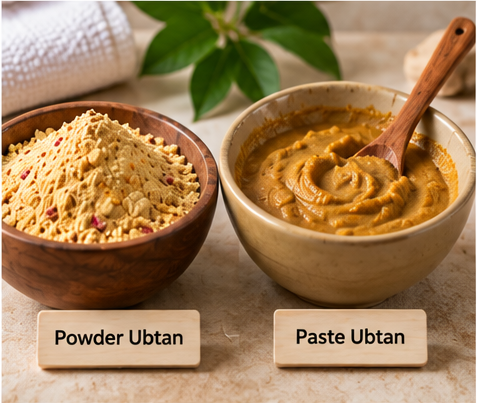
Ubtan can be supplied as a dry powder or as a ready-to-use paste.
The biggest practical difference is flexibility versus convenience—and the storage and preservation implications that come with adding moisture.
A dry powder allows you to mix a fresh paste when needed and adjust what it is mixed with. A ready-made paste is more convenient, but introducing moisture makes preservation and microbiological stability much more important.
Why Choose a Powder Ubtan?
A dry Ubtan gives the user flexibility.
You can take a small amount when you need it and mix it into a paste immediately before application.
What you mix it with can also be adjusted according to your skin.
For dry skin, a richer medium may be appropriate. For oily skin, a simpler medium may make more sense.
The powder therefore gives the consumer some control over the final application.
Why Choose a Ready-to-Use Paste Ubtan?
The main advantage is convenience.
There is no mixing before application. You open the product and it is ready to use.
But that convenience changes the technical character of the product.
Once moisture is introduced, preservation and microbiological stability become much more important.
This is one reason a ready-made herbal paste shouldn’t simply be thought of as dry Ubtan with some liquid added.
The presence of moisture changes what has to be considered.
Why Does Adding Water Make Such a Difference?
A dry blend of herbal powders and a wet herbal preparation have different storage requirements.
Once moisture becomes part of the formulation, microbiological stability and preservation need much greater consideration.
So turning a powder Ubtan into a commercially prepared paste isn’t merely a matter of making the product easier for the consumer to apply.
It changes the formulation problem itself.
This is an important consideration when deciding whether an Ubtan should be sold as a powder or as a ready-to-use product.
Even Dry Ubtan Needs Protection From Moisture
Being sold as a powder doesn’t mean moisture can be ignored.
Think about how people actually use skincare products.
A container may be kept in a bathroom. It is repeatedly opened and closed. Someone may reach into it with wet fingers.
Over time, a dry herbal powder can pick up moisture.
Ingredients such as milk powder are particularly relevant because they are more susceptible to moisture.
Packaging and usage instructions are therefore part of the product design.
Providing a dry spoon is one practical way of encouraging consumers not to introduce wet fingers into the powder.
How Is Powder Ubtan Used?
Take the amount of dry powder you need and prepare a paste immediately before use.
For facial application, the paste can be left on briefly as a mask and then gently massaged before rinsing.
There is no need to wait until the Ubtan becomes completely dry and starts pulling tightly on the skin.
This allows the same application to provide cleansing, a brief mask treatment and gentle physical exfoliation.
Powder vs Paste Ubtan: Which Is More Convenient?
Paste wins on immediate convenience.
You don’t need to measure out powder or prepare a paste before using it.
Powder requires an additional step, but that step also gives the user flexibility. You prepare only the quantity needed and can adjust what the powder is mixed with.
So convenience isn’t the only consideration.
The question is whether you value a ready-to-use product or the flexibility of preparing the paste when you need it.
Which Format Is Better?
Neither is universally better.
It depends on what you value.
Powder Ubtan provides flexibility and avoids storing the product as a permanently wet herbal preparation.
Paste Ubtan provides convenience because it is already ready to use.
But the decision has implications beyond convenience.
Moisture changes the storage and preservation requirements, while even a dry product has to be protected from moisture during consumer use.
Packaging and Storage Are Part of the Product
One of the broader lessons from comparing powder and paste Ubtan is that formulation doesn’t end when the ingredients have been selected.
You also need to think about how the consumer will actually use the product.
Will the container be kept in a humid bathroom?
Will wet fingers be introduced into the product?
Does the packaging help keep a powder dry?
If the product is supplied wet, have its preservation and microbiological stability been properly considered?
These aren’t secondary details.
Packaging, storage and the way a consumer handles an Ubtan are part of the product itself—not afterthoughts once the ingredients have been chosen.
The Important Difference Between Powder and Paste Ubtan
At first glance, the difference may appear simple: one is dry and the other is ready to use.
But adding moisture changes much more than convenience.
A powder gives the consumer flexibility to prepare a fresh paste when required. A ready-made paste removes that step but introduces greater preservation and microbiological considerations.
And even powder needs thoughtful packaging and handling to prevent moisture from being introduced during use.
So when choosing—or formulating—an Ubtan, don’t consider only the ingredients.
The physical format of the product is part of its formulation too.
Related Ubtan guides
→ How Do You Choose an Ubtan for Oily, Dry or Mature Skin?
→ What Is Ubtan and How Is It Used?
For a broader introduction to Ubtan ingredients, skin types, uses and formulation principles, read our main guide: Ubtan for Skin: Benefits, Ingredients & Choosing the Right One.