Choose an Ubtan according to what your skin needs rather than simply choosing ingredients because they have a reputation for being “good for skin.”
Oily skin generally benefits from greater emphasis on cleansing and oil absorption. Dry and mature skin need a different balance, with greater attention to a moisturising skin feel and less reliance on strongly drying ingredients.
This is one of the most important principles behind choosing—or formulating—an Ubtan.
Ubtan for Oily Skin
With oily skin, excess sebum is an obvious consideration.
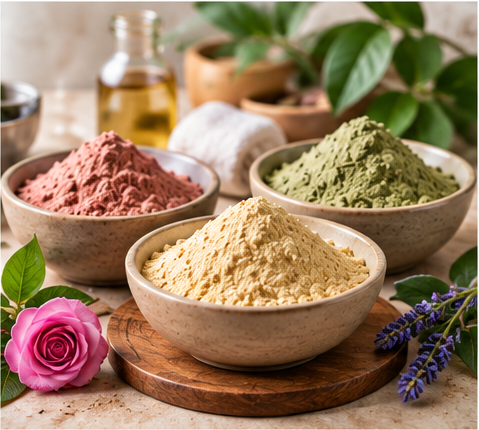
Multani Mitti is particularly useful when oil absorption is desirable because it absorbs sebum and can leave the skin feeling relatively dry or matte.
Kaolin is another clay used for cleansing, while activated charcoal can be useful in products intended for deeper cleansing and oily or acne-prone skin.
Besan is also traditionally used for gentle cleansing and exfoliation and when some excess-oil absorption is desirable.
The important point is not that every oily-skin Ubtan must contain all these ingredients.
It is that their properties fit the objective of an oily-skin product.
Ubtan for Dry Skin
Very dry skin changes the formulation logic.
If you build the product primarily around ingredients that absorb oil, you risk creating an Ubtan that feels excessively drying.
Instead, ingredients discussed for a more moisturising skin feel include oatmeal, milk powder, honey powder, cocoa powder and yogurt powder.
Oatmeal is particularly useful when you want a gentler, more moisturising character and can help balance ingredients with stronger oil-absorbing properties.
Milk powder also contributes a more moisturising character through its milk fats and lactic acid.
This doesn’t mean that an Ubtan for dry skin cannot contain cleansing ingredients.
The issue is balance.
What About Mature Skin?
The same broad principle applies.
For mature skin, the emphasis is more on ingredients associated with moisturisation and improved skin feel rather than creating a highly drying, clay-based product.
Age alone isn’t the important formulation concept here.
What matters is what you want the finished product to feel like on the skin.
Why Multani Mitti Isn’t Automatically Right for Everyone
Multani Mitti is an excellent example of why ingredient selection needs context.
Its ability to absorb sebum can be very useful for oily skin.
But that same property means it has to be used thoughtfully for someone whose skin is already very dry.
An ingredient doesn’t become universally suitable simply because it has useful skincare properties.
This is why asking whether an ingredient is “good” or “bad” for skin isn’t always the most useful question.
A better question is:
Does this ingredient’s function suit the skin type and the purpose of this particular Ubtan?
Think About the Finished Experience
When evaluating an Ubtan, don’t simply read the ingredient list and count how many attractive herbal ingredients it contains.
Ask what each ingredient is doing.
Is the product supposed to absorb oil?
Is it intended to feel gentle and moisturising?
Is it meant for oily, dry or mature skin?
Those questions tell you much more than whether an individual ingredient sounds impressive.
The principle is simple:
Don’t select an ingredient simply because it is “good for skin.” Select it because its properties fit the purpose of the product you are trying to create.
Choosing Ubtan Is About Balance
There isn’t one universally “best” Ubtan.
An ingredient that is useful for one skin type can require much more careful use for another. Strong oil absorption can be an advantage when excess sebum is the problem but may be undesirable when the skin is already very dry.
The better approach is to understand what each ingredient contributes to the finished product and then choose an Ubtan whose overall formulation suits the skin.
Related Ubtan guides
→ Multani Mitti vs Kaolin Clay
→ Activated Charcoal in Ubtan
For a broader introduction to Ubtan, its ingredients, uses, powder and paste formats and formulation principles, read our main guide: Ubtan for Skin: Benefits, Ingredients & Choosing the Right One.