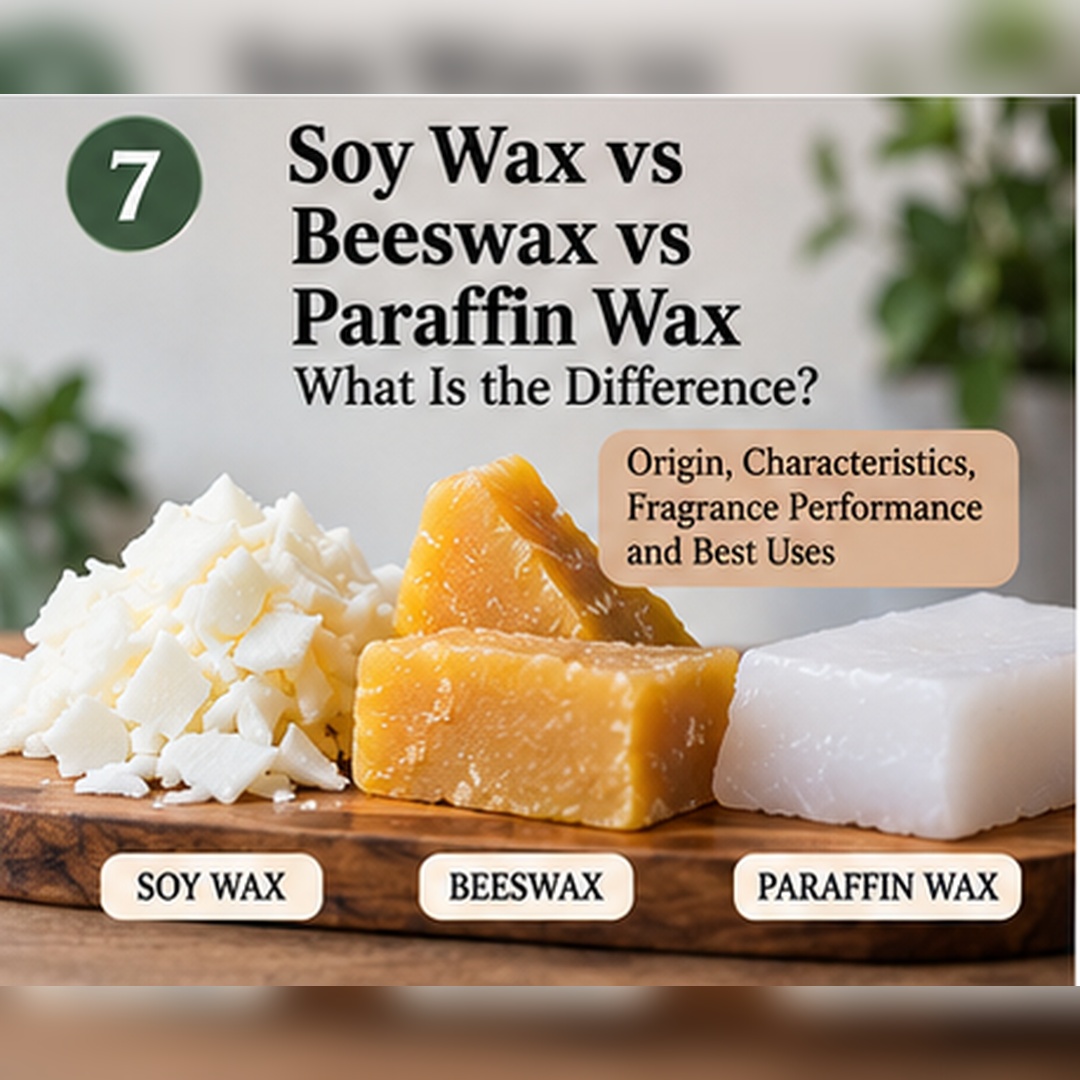
Soy wax, beeswax and paraffin wax can all be used in candle making, but they are not identical.
They differ in origin, firmness, fragrance performance and the way they are positioned for different candle concepts.
What Is Paraffin Wax?
Paraffin wax is described as a mineral-based, petroleum-derived wax and is one of the traditional common choices for candle making.
One of its practical advantages is fragrance throw.
In the workshop, paraffin is described as releasing aroma more strongly than soy wax or beeswax.
It is also described as a sturdy wax, which becomes relevant when considering candles that need to stand independently rather than remaining supported by a container.
What Is Soy Wax?
Soy wax is plant-based and derived from soy.
It is commonly chosen when a plant-based candle is desired.
The workshop describes soy as having a pleasant appearance and also discusses it as softer than beeswax.
That softness matters particularly when thinking about whether the candle will remain in a container or needs to stand independently.
What Is Beeswax?
Beeswax is a natural wax obtained from bees.
Because it is derived from bees, it is not considered vegan in the workshop.
Beeswax is somewhat firmer than soy and is used for ordinary candles as well as the specialised body-serum or massage-candle concept taught in the class.
The workshop also associates beeswax with nourishing properties when it is being used in that skin-contact product category.
Which Wax Gives Better Fragrance Throw?
Of these three, paraffin is described as giving the strongest fragrance throw.
Soy wax and beeswax can still be used for scented candles, but their aroma performance is described as more moderate.
This means wax choice can influence how a scented candle performs; fragrance alone does not determine the final aroma experience.
Container vs Standalone Candle Matters
Another useful distinction is whether the wax remains supported inside a container or has to stand on its own.
A container provides physical support to the wax.
A pillar or standalone candle does not have that surrounding support.
The workshop therefore treats wax choice differently depending on the intended candle format.
The important point for a public reader is not a particular recipe, but the principle: a wax that performs well inside a container may need different structural consideration when the finished candle must stand independently.
Which Wax Is Best?
There is no single answer in the workshop that makes one wax universally best.
Paraffin is valued for fragrance throw and sturdiness.
Soy is valued as a plant-based option.
Beeswax is natural, non-vegan and is also useful in specialised body-serum candle concepts.
A better question than “Which wax is best?” is:
What characteristics do I need from the candle I am trying to create?