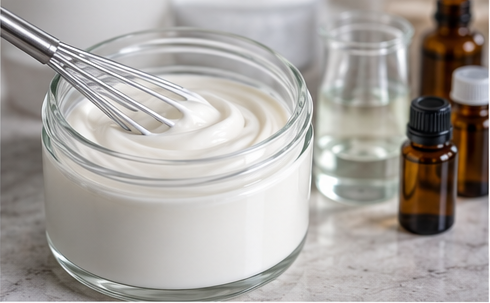
Magnesium lotion may look much like an ordinary body lotion, but it can be considerably more difficult to formulate successfully.
The reason is magnesium chloride.
A lotion already has to keep water and oil together in a stable emulsion. When a relatively high concentration of magnesium chloride is added, the resulting high-salt environment can interfere with emulsification. An emulsifier that works perfectly well in a conventional lotion may therefore fail in a magnesium lotion.
This is why making magnesium lotion isn’t simply a matter of taking a favourite lotion recipe and adding magnesium chloride.
What Makes a Lotion an Emulsion?
Most lotions contain two basic components that naturally don’t remain mixed:
a water phase and an oil phase.
An emulsifier helps bring these phases together and maintain them as a uniform product.
Without an effective emulsification system, the oil and water can eventually separate.
In an ordinary lotion, the formulator chooses an emulsifier that works with the oils, water and other ingredients in the formula.
A high-magnesium lotion introduces another complication: a large amount of dissolved salt.
Why Does Magnesium Chloride Make Emulsification More Difficult?
Magnesium chloride dissolves into the water phase of the lotion.
When a substantial amount is used, the water phase becomes a high-salt environment. Not every emulsifier performs well under those conditions.
An emulsifier may create a beautiful, stable conventional lotion but struggle when the same formula contains a high concentration of magnesium chloride.
The result can be an emulsion that:
- initially appears successful;
- gradually becomes unstable;
- develops visible separation; or
- eventually splits into different phases.
This means the emulsifier has to be chosen not simply because it can make lotion, but because it can tolerate the conditions created by the magnesium salt.
Why Can’t You Just Add Magnesium Chloride to an Existing Lotion Recipe?
Suppose you already have a lotion formula that works beautifully.
It is tempting to think:
I’ll keep the formula exactly the same and just add magnesium chloride.
But adding a large quantity of magnesium chloride changes the formulation environment.
The original emulsifier was selected for the original formula. Once the composition of the water phase changes substantially, the emulsification system may no longer perform in the same way.
So an ordinary lotion recipe shouldn’t automatically be assumed to become a magnesium lotion simply by adding magnesium chloride.
The revised formulation needs to be developed and evaluated as a new system.
Why Can a Magnesium Lotion Look Stable at First?
One of the more deceptive aspects of emulsion stability is that failure doesn’t necessarily happen immediately.
A freshly made magnesium lotion can look:
- smooth;
- creamy;
- uniform; and
- perfectly emulsified.
That only tells you what the product looks like at that moment.
It doesn’t establish that the formulation will remain stable during storage.
A poorly suited emulsification system can produce something that looks convincing when freshly made but separates later. The source material specifically describes high-magnesium formulation trials where separation became apparent after storage rather than immediately after production.
That’s why appearance immediately after manufacture isn’t enough to establish emulsion stability.
Why Doesn’t Beeswax Alone Solve the Problem?
Beeswax can add structure and thickness to a cosmetic formulation, but thickness and emulsion stability are not the same thing.
Magnesium chloride isn’t oil-soluble. It requires a water phase.
If a formulation also contains oils, you now have water and oil that need to remain together.
A mixture containing:
magnesium chloride + water + oil + beeswax
might appear creamy when freshly made.
But that doesn’t automatically mean the water and oil have been held together in a sufficiently stable emulsion.
The product can still separate during storage.
This is an important general formulation principle:
A product being thick doesn’t necessarily mean it is stable.
Why Can Different Magnesium Products Need Different Emulsifiers?
Magnesium lotion and magnesium body butter illustrate another useful principle.
Both are emulsified magnesium products, but their structures are very different.
The lotion is designed to be relatively fluid and contains a large water-and-magnesium phase with only a small oil-and-butter phase.
The body butter contains substantially more oils and butter and is intended to become much thicker.
An emulsifier suitable for one texture isn’t necessarily ideal for the other.
In the source formulations, the thinner high-salt lotion uses a different emulsification approach from the rich body butter specifically because the two systems have different structural requirements.
So emulsifier selection isn’t simply:
Which emulsifier can combine oil and water?
It is also:
Which emulsification system works with this particular composition and produces the texture and stability I need?
Does More Emulsifier Automatically Make the Lotion More Stable?
Not necessarily.
When an emulsion is unstable because the emulsifier isn’t well suited to the formulation, simply increasing its percentage isn’t automatically the solution.
Changing the amount of emulsifier can also change:
- viscosity;
- texture;
- spreadability; and
- skin feel.
The objective is therefore not to use as much emulsifier as possible.
It is to develop an appropriate emulsification system for the complete formula.
Why Does the Manufacturing Process Matter?
Even a well-designed formula needs to be manufactured correctly.
For the magnesium emulsions in the source material, the water and oil phases are heated before being combined, followed by proper blending during emulsification and cooling.
The material emphasizes continued blending during cooling rather than simply mixing the phases once and leaving them. It also cautions against deliberately force-cooling the emulsion during normal production.
For larger batches, adequate mixing becomes particularly important. The source describes repeated blending cycles during cooling to help produce a smoother and more stable emulsion.
So stability depends on more than the ingredient list.
Formula design and manufacturing technique work together.
Why Should You Wait Before Judging a Magnesium Lotion?
A freshly made lotion hasn’t necessarily reached its final texture.
As an emulsion cools and settles, its viscosity can change. The magnesium lotion described in the source remains relatively fluid immediately after manufacture and becomes somewhat thicker after resting for approximately 24 hours.
That means there are two different reasons not to judge a magnesium lotion immediately:
Texture: the final viscosity may not have developed yet.
Stability: a freshly uniform emulsion may still separate later.
These are different questions.
A product can become beautifully thick and still be unstable, just as a relatively fluid lotion can be perfectly stable.
What Does a Stable Magnesium Lotion Require?
There isn’t one ingredient that guarantees stability.
A successful magnesium lotion requires the entire formulation to work together, including:
- the concentration of magnesium chloride;
- the water phase;
- the oil phase;
- an appropriate emulsification system;
- the desired final viscosity;
- correct processing and blending; and
- observation of the finished product after manufacture.
The key is to evaluate the whole formulation, rather than treating magnesium chloride as an ingredient that can simply be added to any existing lotion.
The Key Formulation Lesson
Magnesium lotions are difficult to stabilize because they combine two challenges:
creating a stable oil-and-water emulsion
+
working with a relatively high concentration of dissolved magnesium salt.
That is why a conventional lotion formula can work perfectly until magnesium chloride is introduced.
And it is why a freshly made lotion that looks smooth and creamy hasn’t necessarily proved anything about its long-term stability.
For a magnesium lotion, the real test isn’t simply:
“Did it emulsify?”
It is:
“Does this formulation produce the texture we want and remain properly emulsified over time?”
Related Magnesium Body Product guides
→ Why Can a Freshly Made Lotion or Body Butter Change Texture Later?
→ Magnesium Chloride vs Epsom Salt: What’s the Difference in Topical Products?
For a broader introduction to Fabric Conditioners, its ingredients, structure, variations and formulation principles, read our complete guide: Magnesium Oil, Lotion and Body Butter Explained: Benefits, Uses & Differences.