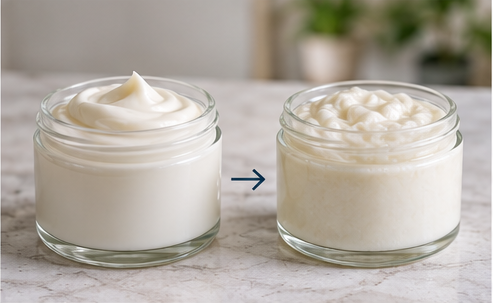
A freshly made lotion or body butter does not necessarily have its final texture.
As an emulsified cosmetic cools, settles and develops its internal structure, it can become noticeably thicker than it appeared immediately after manufacture. A body butter that initially seems surprisingly soft or fluid may develop into a much richer, thicker product after resting.
This is why formulators should avoid judging the final consistency of a lotion or body butter too soon. In the magnesium formulations discussed here, both products continue to change after manufacture, with the body butter showing the more dramatic increase in thickness.
Why Does the Texture Change After Making the Product?
Lotions and body butters are emulsions containing both water and oil phases.
During manufacture, the phases are heated, combined and emulsified. At that stage, many of the ingredients are still warm and the product has not yet reached its final physical state.
As the emulsion cools, its structure continues to develop.
Ingredients that contribute body and thickness begin producing the consistency expected from the finished formulation.
The product you see immediately after blending can therefore be quite different from the product you see later.
What Happens to Magnesium Body Butter as It Cools?
The change is particularly noticeable with body butter.
The magnesium body butter formulation contains a substantial oil-and-butter phase and is deliberately designed to become a thick, rich product.
During manufacture, however, the oils and butter have been heated. The freshly emulsified product can consequently appear much softer and more fluid than the finished butter will eventually become.
As it cools, it becomes progressively thicker. The source formulation continues developing after reaching room temperature and becomes considerably thicker after approximately 24 hours.
This creates an easy formulation mistake.
You make the butter, look at it while it is still fresh and think:
“This is far too thin.”
You then modify the formula to make it thicker.
By the following day, the original formulation might already have developed the rich consistency you wanted—and your modified version may now be excessively thick.
Does Magnesium Lotion Change Too?
Yes, although the change is less dramatic.
Magnesium lotion is intentionally formulated to remain much lighter than body butter. When freshly made, it can appear fairly fluid.
After resting, it becomes somewhat thicker while retaining its lotion-like consistency. The source specifically notes a difference between a freshly made batch and a sample that had been allowed to rest for a couple of days.
So the principle applies to both products:
fresh texture ≠ final texture
The difference is mainly the degree of change.
How Long Should You Wait Before Evaluating the Texture?
For these formulations, approximately 24 hours is a useful first evaluation point.
That allows the freshly manufactured emulsion to cool completely and gives the texture time to develop.
This doesn’t mean that 24 hours proves that the formulation is stable over its entire shelf life. It simply gives you a much better indication of the product’s developed texture than judging it while it is still warm or freshly emulsified.
That distinction matters:
Texture evaluation asks:
Has the product reached the consistency I want?
Stability evaluation asks:
Will the product remain properly emulsified and acceptable over time?
Those are related but separate formulation questions.
Why Shouldn’t You Force-Cool the Product?
It can be tempting to speed up the process by placing a freshly made lotion or butter somewhere very cold.
But deliberately force-cooling the emulsion isn’t the preferred manufacturing method described in the source.
During the live demonstration, a cold-water bath was used only to speed up the process for the class. For normal production, the product is allowed to cool naturally while being blended periodically.
This gives the emulsion time to develop as it cools rather than simply trying to reach room temperature as quickly as possible.
Does Blending During Cooling Matter?
Yes.
Emulsification isn’t necessarily finished the instant the heated oil and water phases first come together.
The source process calls for blending immediately after combining the phases and then blending again periodically as the product cools.
For larger batches, the guidance becomes even more important: adequate blending over several cycles during cooling helps produce a smoother, more uniform emulsion.
So making an emulsified product isn’t simply:
heat → combine → blend once → finished
The cooling stage is part of the manufacturing process.
Can Skin Feel Change After Application Too?
Yes—and this is a different kind of change.
A magnesium lotion can initially appear glossy and feel slightly oily when first applied. After several minutes, that shiny sensation reduces.
The magnesium spray demonstrates the effect even more clearly: it can initially feel surprisingly oily despite containing no conventional oil.
So there are actually two time-dependent experiences worth evaluating:
In the container
How does the lotion or butter change during the hours after manufacture?
On the skin
How does the product feel immediately after application compared with several minutes later?
Both matter when evaluating a cosmetic formulation.
A lotion shouldn’t necessarily be rejected because its initial application feels slightly glossy if that sensation disappears quickly and leaves the desired final skin feel.
What Should You Evaluate After 24 Hours?
Once the product has rested, look at it again rather than relying on your impression during manufacture.
Consider:
- Thickness: Is it as light or rich as intended?
- Spreadability: Does it distribute easily over the skin?
- Appearance: Is the product smooth and uniform?
- Skin feel: How does it feel immediately after application?
- After-feel: How does the skin feel several minutes later?
- Packaging: Is the developed texture appropriate for the bottle, pump or jar you intended to use?
That last question can easily be overlooked.
A lotion that becomes considerably thicker after resting may no longer work well in the packaging originally selected for it. Likewise, a butter needs enough structure to behave appropriately as a jarred product.
Does a Good Final Texture Mean the Product Is Stable?
No.
This is an important distinction.
A body butter can develop a beautiful thick texture after 24 hours and still experience stability problems later.
Similarly, a relatively fluid lotion isn’t necessarily unstable simply because it isn’t very thick.
Viscosity and emulsion stability are not the same thing.
A product needs to achieve the desired texture and remain properly emulsified during storage.
That’s why formulation evaluation shouldn’t end simply because a freshly made sample looks and feels good.
The Practical Lesson
When making a lotion or body butter, don’t rush to modify the formulation because the freshly made product looks too thin.
Allow it to cool naturally, follow the appropriate blending process and give the emulsion time to develop.
Then evaluate it again.
For the magnesium formulations discussed here, the difference can be particularly obvious with body butter: what initially looks like a relatively soft emulsion can develop into a substantially thicker butter after about 24 hours.
So one of the simplest formulation rules is also one of the most useful:
Don’t judge tomorrow’s texture by what you see immediately after making the product.
Related Magnesium Body Product guides
→ Why Are Magnesium Lotions Difficult to Keep Stable?
→ Magnesium Oil vs Lotion vs Body Butter: What’s the Difference?
For a broader introduction to Fabric Conditioners, its ingredients, structure, variations and formulation principles, read our complete guide: Magnesium Oil, Lotion and Body Butter Explained: Benefits, Uses & Differences.