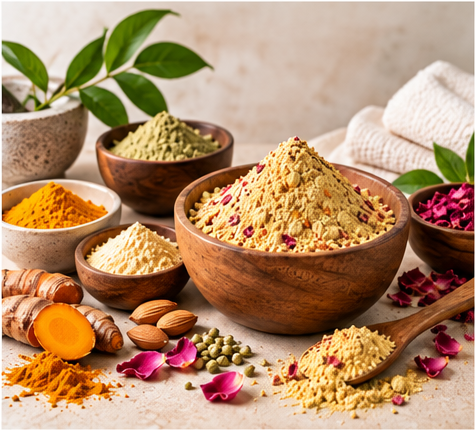
Ubtan is a blend of finely powdered ingredients selected for their skincare properties. Although traditionally associated with bridal skincare in India, Ubtan can be used much more broadly as a face cleanser, face pack or body-cleansing powder.
What makes Ubtan particularly interesting is that it isn’t one fixed recipe. The ingredients can change according to what you want the product to do and the type of skin it is intended for.
More Than a Traditional Bridal Treatment
Traditional Ubtan is strongly associated with the Indian bridal ritual. Ingredients such as milk, saffron, sandalwood, Multani Mitti and turmeric have been used in preparations applied during the days leading up to a wedding.
But there is no reason to think of Ubtan only as a wedding product.
Different Ubtans can be designed for everyday cleansing, exfoliation, oily or dry skin, tanning, pigmentation, acne-prone skin, mature skin or general body care.
It is therefore more useful to think of Ubtan as a skincare format rather than a single recipe.
How Does Ubtan Differ From an Ordinary Face Wash?
A conventional foaming cleanser is primarily intended to clean the skin.
Ubtan can combine cleansing with gentle physical exfoliation. Depending on the powders selected, it can also help absorb excess oil and leave the skin feeling smoother and brighter.
It can also be used in different ways.
The same general product format can function as a facial cleansing powder, a face pack or a herbal body-cleansing powder.
That versatility is one of Ubtan’s most useful characteristics.
Why Are There So Many Types of Ubtan?
Because different ingredients do different jobs.
An ingredient that is useful when you want to absorb excess sebum may be less suitable when creating an Ubtan for very dry skin.
For oily skin, you may want to emphasise cleansing and oil absorption.
For dry or mature skin, the objective changes. You need to balance cleansing with ingredients that contribute a gentler, more moisturising skin feel.
There are also Ubtans designed around concerns such as tanning, pigmentation or acne-prone skin.
The purpose of the product should therefore determine the type of ingredients selected.
How Do You Use a Dry Ubtan?
A dry Ubtan can be mixed into a paste immediately before use.
What you mix it with can be adjusted according to the skin type. A richer medium may suit dry skin, while a simpler medium may be more appropriate for oily skin.
For facial use, the paste can be left on briefly like a mask and then gently massaged before rinsing.
There is no need to leave it until it becomes completely dry and begins pulling tightly on the skin.
This combination of cleansing, masking and gentle exfoliation is part of what makes Ubtan different from an ordinary face wash.
Can Ubtan Be Used on the Body?
Yes.
Ubtan is not restricted to facial skincare. Herbal bath powders can be designed specifically as body-cleansing products rather than facial masks.
This is another reason it is useful to think of Ubtan as a broad product category rather than one particular recipe.
How Often Should You Use Ubtan?
That depends on both the Ubtan and your skin.
Normal-to-oily skin may tolerate an appropriately designed Ubtan quite frequently.
With very dry skin, less frequent use—perhaps on alternate days or a couple of times a week—may be more appropriate depending on how the skin responds.
The important point is that “Ubtan” by itself doesn’t tell you how frequently a product should be used.
You first need to understand what is in that particular Ubtan and what type of skin it was designed for.
The Most Important Thing to Understand About Ubtan
Ubtan isn’t one universal formulation.
Its character depends on the ingredients selected and what those ingredients are intended to achieve.
A product designed to absorb excess oil will naturally be formulated differently from one intended to create a gentler, more moisturising skin feel.
Understanding that principle makes it easier to choose an Ubtan—and also explains why simply asking for the “best Ubtan” isn’t particularly useful without considering the skin type and purpose.
Related Ubtan guides
→ How Do You Choose an Ubtan for Oily, Dry or Mature Skin?
→ Powder Ubtan vs Paste Ubtan: What’s the Difference?
For a more complete introduction to Ubtan ingredients, skin types, powder and paste formulations and product considerations, read our main guide: Ubtan for Skin: Benefits, Ingredients & Choosing the Right One.