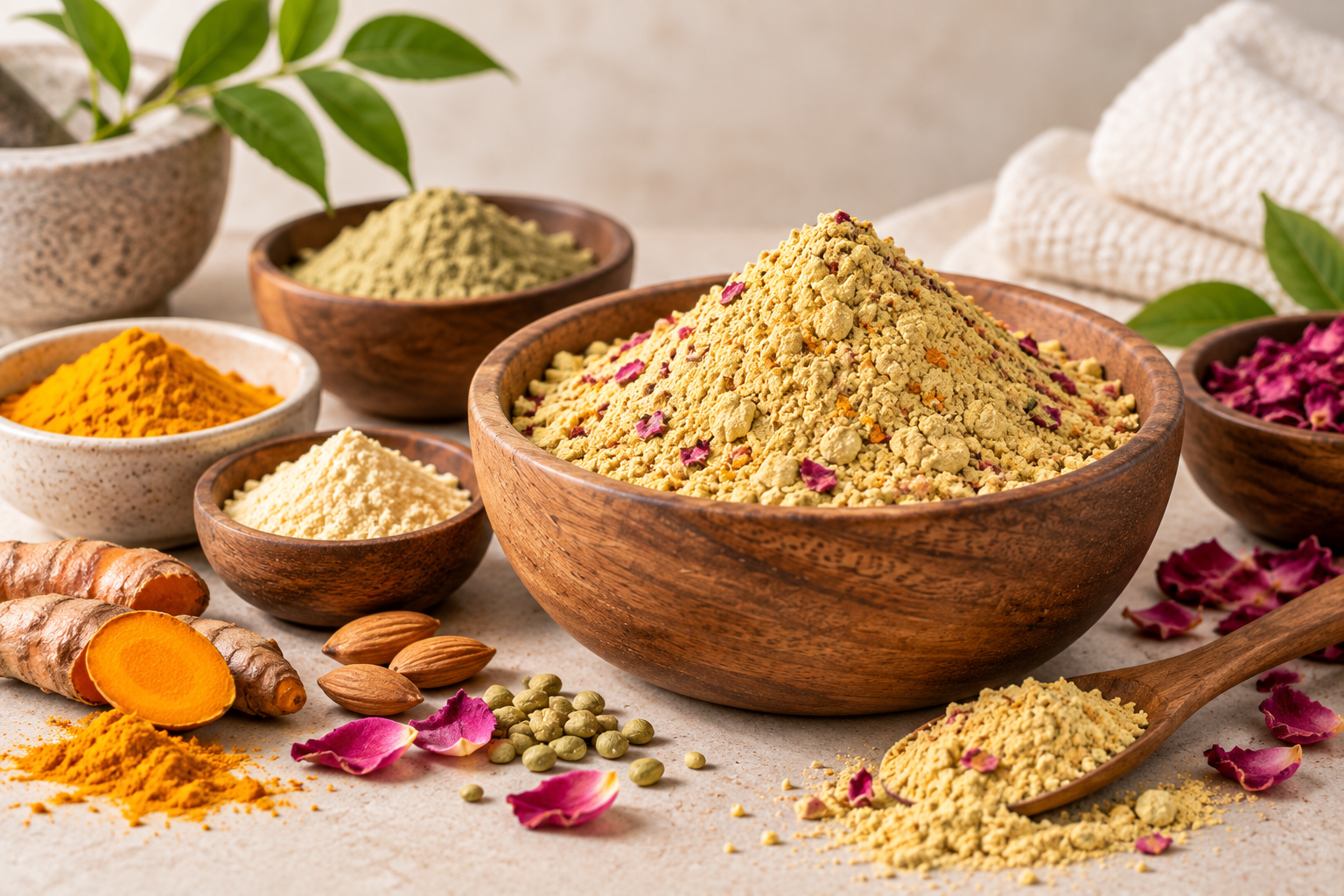
Ubtan is one of India’s oldest forms of herbal skincare. Traditionally associated with bridal rituals, it has been made with ingredients such as milk, saffron, sandalwood, Multani Mitti and turmeric and applied in the days leading up to a wedding.
But Ubtan is much more versatile than a traditional bridal treatment.
Depending on the ingredients used, an Ubtan can be designed for everyday cleansing, gentle exfoliation, oily or dry skin, mature skin, tanning, pigmentation, acne-prone skin or even body care.
The important thing to understand is that Ubtan is not one fixed recipe.
It is better thought of as a skincare format: a combination of finely powdered ingredients chosen according to what you want the product to do and the type of skin it is intended for.
That makes understanding the ingredients far more useful than simply looking for a single “best Ubtan recipe.”
What Is Ubtan?
At its simplest, Ubtan is a blend of finely powdered ingredients selected for their skincare properties.
Unlike a conventional foaming cleanser, Ubtan can combine cleansing with gentle physical exfoliation. Depending on the ingredients chosen, it may also absorb excess oil and leave the skin feeling smoother and brighter.
The same basic format can be used as a facial cleansing powder, face pack or mask, herbal body-cleansing powder, or a more specialised product designed around a particular skin type or concern.
This versatility is one of the things that makes Ubtan interesting.
Want to understand the basics in more detail?
→ What Is Ubtan and How Is It Used?
What Are the Benefits of Ubtan?
The benefits of an Ubtan depend on its formulation.
It doesn’t make much sense to talk about the benefits of “Ubtan” without first asking what is actually in the product.
An Ubtan designed for oily skin may place greater emphasis on cleansing and absorbing excess sebum. A product for dry or mature skin may instead use ingredients that contribute a gentler, more moisturising skin feel.
Other formulations may be designed around exfoliation, skin brightening, tanning, pigmentation, acne-prone skin or general body cleansing.
So rather than asking only “What are the benefits of Ubtan?”, a more useful question is:
What is this particular Ubtan designed to do, and do its ingredients support that purpose?
That principle runs through everything from ingredient selection to skin type and even the way the product is packaged.
Common Ubtan Ingredients and What They Do
One of the most useful ways to understand Ubtan is to look at why different ingredients are included.
Multani Mitti
Multani Mitti, or Fuller’s Earth, is particularly useful when oil absorption is desirable.
It absorbs sebum and can leave the skin feeling relatively dry or matte. That makes it useful in products designed for oily skin.
But the same property means Multani Mitti needs to be used thoughtfully in an Ubtan intended for very dry skin.
Kaolin Clay
Kaolin is another commonly used clay, but it creates a different skin experience.
It can provide clay and cleansing characteristics without necessarily making the product feel as drying as Multani Mitti. This can make kaolin useful when developing Ubtans for normal, dry or more sensitive-feeling skin.
Explore the difference:
→ Multani Mitti vs Kaolin Clay: What’s the Difference in Ubtan?
Activated Charcoal
Activated charcoal is valued in cleansing products for its adsorptive properties and can be incorporated into Ubtans intended for deeper cleansing and oily or acne-prone skin.
But this is a good example of why more isn’t necessarily better.
Too much charcoal can make an Ubtan extremely dark and difficult to rinse completely from the skin. Residual charcoal around the pores can even make the skin appear temporarily darker.
Learn more:
→ Activated Charcoal in Ubtan: Why More Isn’t Always Better
Oatmeal
Finely powdered oatmeal is useful when a gentler and more moisturising skin feel is desired.
This makes it particularly interesting in Ubtans for dry and mature skin and in formulations where strongly oil-absorbing ingredients need to be balanced.
Rice Powder
Rice powder is traditionally used in skincare products intended for exfoliation and skin brightening.
Its fine texture also makes it useful in powdered cleansing products.
Gram Flour or Besan
Besan is another traditional Ubtan ingredient.
It can provide gentle cleansing and exfoliation and is also used when some excess-oil absorption is desirable.
Milk Powder
Milk powder contributes milk fats and lactic acid and is used when a more moisturising product is desired.
However, there is another consideration: storage.
Ingredients such as milk powder are more susceptible to moisture, so including them affects how a dry herbal product needs to be stored and handled.
Neem
Neem is traditionally included in herbal skincare for its antibacterial properties, making it particularly relevant to cleansing products intended for oily or acne-prone skin.
Amla
Amla is used as a botanical source associated with vitamin C and is commonly included in products intended for skin brightening and general skincare.
Turmeric, Amba Haldi and Kasturi Manjal
These ingredients are related, but they aren’t necessarily interchangeable when you consider the experience of using the finished product.
One important issue is staining.
Ordinary cooking turmeric can leave a strong yellow colour on the skin. Amba Haldi and Kasturi Manjal provide alternatives when turmeric-associated skincare properties are desired with less staining.
This illustrates an important formulation principle: the benefit of an ingredient isn’t the only consideration. The consumer’s experience of using it matters too.
Explore this in detail:
→ Turmeric, Amba Haldi and Kasturi Manjal in Ubtan: What’s the Difference?
How Do You Choose an Ubtan for Your Skin Type?
The basic principle is straightforward:
Choose ingredients according to what the skin needs rather than simply because an ingredient has a reputation for being “good for skin.”
Ubtan for Oily Skin
For oily skin, ingredients with cleansing and oil-absorbing properties become more important.
Multani Mitti is particularly useful when sebum absorption is desirable. Kaolin provides clay and cleansing properties, while activated charcoal can be incorporated into products intended for deeper cleansing and oily or acne-prone skin.
Besan can also contribute gentle cleansing, exfoliation and some excess-oil absorption.
That doesn’t mean every oily-skin Ubtan should contain all of these ingredients. It means their properties can fit the objectives of an oily-skin formulation.
Ubtan for Dry Skin
Very dry skin requires a different formulation approach.
If an Ubtan is built primarily around strongly oil-absorbing ingredients, it may feel excessively drying.
Ingredients discussed for creating a more moisturising skin feel include oatmeal, milk powder, honey powder, cocoa powder and yogurt powder.
Oatmeal can be particularly useful when you want a gentler character or need to balance ingredients with stronger oil-absorbing properties.
The issue isn’t eliminating cleansing ingredients. It is balance.
Ubtan for Mature Skin
The same broad principle applies to mature skin.
The emphasis shifts towards ingredients associated with moisturisation and improved skin feel rather than creating a highly drying clay-based product.
The important formulation question isn’t simply age. It is what you want the finished product to feel like on the skin.
Read the complete skin-type guide:
→ How Do You Choose an Ubtan for Oily, Dry or Mature Skin?
Powder Ubtan vs Paste Ubtan
Ubtan can be supplied either as a dry powder or as a ready-to-use paste.
The difference is more significant than it may initially appear.
Powder Ubtan
A dry Ubtan gives the user flexibility.
You can take the quantity you need and mix it into a paste immediately before application. What it is mixed with can also be adjusted according to the skin type—a richer medium may suit dry skin, while a simpler medium may be more appropriate for oily skin.
Keeping the product dry also avoids storing it permanently as a wet herbal preparation.
Paste Ubtan
A ready-made paste offers convenience because there is no mixing required before application.
But introducing moisture changes the technical character of the product.
Once moisture is present, preservation and microbiological stability become much more important. A ready-made paste therefore shouldn’t simply be thought of as dry Ubtan with some liquid added.
Even a dry Ubtan needs protection from moisture. Repeated opening, bathroom storage or reaching into the container with wet fingers can introduce moisture into the powder.
Packaging, storage and usage instructions are therefore part of product design, not afterthoughts.
Compare the two formats:
→ Powder Ubtan vs Paste Ubtan: What’s the Difference?
How Should You Use Ubtan?
A dry Ubtan can be mixed into a paste immediately before use.
What you mix it with can be adjusted according to your skin type. A richer medium may suit dry skin, while a simpler medium may be more appropriate for oily skin.
For facial use, the paste can be left on briefly like a mask and then gently massaged before rinsing.
There is no need to wait until the Ubtan becomes completely dry and begins pulling tightly on the skin.
This combination of cleansing, brief masking and gentle physical exfoliation is one of the things that distinguishes Ubtan from an ordinary face wash.
Can Ubtan Be Used on the Body?
Yes.
Ubtan isn’t restricted to facial skincare.
Herbal bath powders can be designed specifically as body-cleansing products rather than facial masks. This is another reason it is useful to think of Ubtan as a broad skincare format rather than one particular face-pack recipe.
How Often Can You Use Ubtan?
There isn’t one frequency that applies to every Ubtan or every skin type.
Normal-to-oily skin may tolerate frequent use of an appropriately designed Ubtan.
For very dry skin, less frequent use—perhaps on alternate days or a couple of times a week—may be more appropriate depending on how the skin responds.
The important point is that the word “Ubtan” alone doesn’t tell you how frequently a product should be used. You need to consider what is in that particular Ubtan and the type of skin it was designed for.
Can Ubtan Be Used for Pigmentation and Tanning?
The workshop includes skin-brightening Ubtans designed around concerns such as tanning, dark patches and pigmentation.
When asked how quickly somebody should expect visible changes, I would not present herbal products as instant treatments. With regular use, changes may begin earlier, but I would give a customer a longer expectation—around a month—for noticeable fading.
What Makes a Good Ubtan Formulation?
At first glance, an Ubtan can look like one of the simplest cosmetic products: a collection of herbal powders mixed together.
But good formulation requires considerably more thought.
You need to ask:
- Why is this particular ingredient being used?
- Is the product intended for oily, dry or mature skin?
- Is an ingredient likely to make the product excessively drying?
- Will it stain the skin?
- Will the finished product rinse easily?
- How will the consumer store and handle it?
- What happens if moisture enters the product?
The central principle is simple:
Don’t select an ingredient simply because it is “good for skin.” Select it because its properties fit the purpose of the product you are trying to create.
That is the difference between merely combining attractive herbal ingredients and actually designing an Ubtan as a cosmetic product.
Frequently Asked Questions About Ubtan
Is Ubtan only for brides?
No. Although Ubtan has a strong association with Indian bridal skincare, it can be designed for everyday facial cleansing, exfoliation, different skin types, body cleansing and a variety of skincare purposes.
Is Ubtan the same as a face wash?
Not exactly. A conventional foaming cleanser is primarily designed to cleanse. An Ubtan can combine cleansing with gentle physical exfoliation and can also be used briefly as a mask, depending on the formulation.
Is Multani Mitti suitable for every skin type?
Not necessarily. Its ability to absorb sebum makes it useful for oily skin, but the same property means it needs to be considered more carefully in products intended for very dry skin.
Is more activated charcoal better?
No. Too much activated charcoal can make an Ubtan very dark and difficult to rinse completely. Good formulation considers appearance, application and rinsability as well as the intended function of the ingredient.
Is powder Ubtan better than paste Ubtan?
Neither is universally better.
Powder offers flexibility and avoids storing a permanently wet herbal preparation. Paste offers convenience but requires greater attention to preservation and microbiological stability because moisture has already been introduced.
Understanding Ubtan Is Really About Understanding Ingredients
Ubtan may have centuries of tradition behind it, but the most useful way to understand it is not as a single traditional recipe.
Think of it as a versatile cosmetic product format.
Once you understand what each ingredient contributes, you can begin to see why an Ubtan for oily skin should be different from one for dry skin, why two clays aren’t necessarily interchangeable, why more charcoal isn’t necessarily better, why the type of turmeric matters, and why turning a dry powder into a paste changes more than just convenience.
That is when Ubtan becomes more than a collection of herbal powders: the ingredients, proportions, skin type, application, rinsability, packaging and storage all become part of designing the finished product.
Want to learn how to learn 10 different types of Ubtan Packs. Check out our Herbal Ubtan Course https://www.zestchest.com/product/herbal-ubtan-course