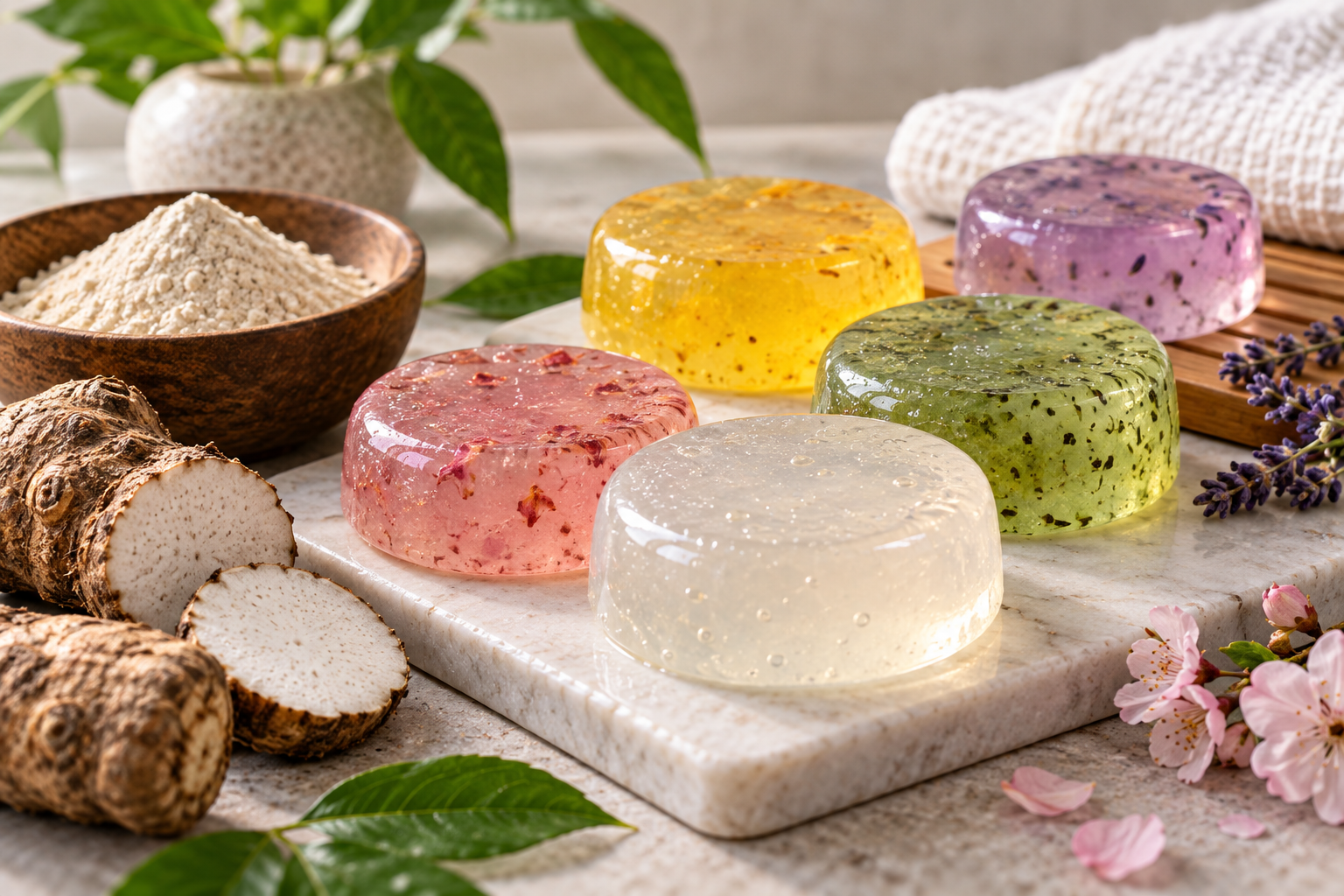
Japanese konjac jelly soap is quite different from an ordinary bar of soap. It has a soft, wobbly, squishy texture, produces a good lather and can be designed for different skin-care purposes. It is also a particularly fun format for children because of the unusual jelly-like feel.
The interesting part of this product is that its character comes from more than simply turning a cleanser into a gel. The cleansing system, moisturising ingredients, konjac, the ingredients responsible for the jelly structure and the skin-focused actives all have different jobs to do.
Once you understand those roles, it becomes much easier to understand why one jelly soap may be designed for moisturising and brightening while another may be intended for oily or acne-prone skin.
What is Japanese Konjac Jelly Soap
A Japanese konjac jelly soap is a cleansing product with an independent jelly-like structure rather than the conventional solid structure of a soap bar.
The jelly soaps taught here are designed to be:
- wobbly and squishy;
- highly lathering;
- moisturising;
- gentle on the skin; and
- adaptable for different skin-care purposes.
Konjac root powder is an important part of the concept, but it is not the only ingredient responsible for the unusual texture. A jelly soap needs both an effective cleansing system and ingredients capable of creating and supporting the jelly structure.
That distinction is important: konjac contributes useful skin and gelling properties, but the finished product is an intentionally designed cleansing and jelly system.
Why use Konjac in a Jelly Soap?
Konjac root powder comes from the konjac vegetable, which is commonly used in Japan for cooking, soups and other purposes.
For skin care, I describe konjac as an extremely hydrating ingredient. It absorbs a great deal of water and is used here particularly with dry and aged skin in mind, because these are situations where retaining moisture is useful.
Konjac also has another interesting role: gentle exfoliation.
When we hear the word exfoliation, we often imagine a scrub containing particles that can be felt rubbing against the skin. Konjac is different. It does not provide that gritty scrub sensation. It is used to help remove dead skin without creating the feeling of a conventional physical scrub.
I also use it for its gelling properties. When konjac is mixed with water, it absorbs water and thickens.
So within this type of product, konjac is interesting because it contributes to both the skin-care concept and the physical character of the product.
What actually makes the soap jelly like?
One of the most important structural ingredients discussed in this product is kappa carrageenan.
Carrageenan comes in different forms, and the distinction matters. The form used for this application is specifically kappa carrageenan.
“Kappa” is not a brand name. It identifies the form of carrageenan being used.
Its purpose here is to help create the independent jelly structure that allows the finished soap to behave as a soft solid rather than simply as a thick liquid.
Konjac and gum acacia, also called gum arabic, contribute additional gelling and thickening properties. Gum acacia may be available in powder or chunk form and can vary in colour from white to yellowish or brownish.
This gives us a useful way to understand the product: several ingredients may thicken or contribute body, but they do not necessarily perform exactly the same structural job.
Cleansing Without Depending on a Conventional Soap Base
Before considering the skin-focused variations, it helps to understand the cleansing side of the product.
The cleansing system taught in the workshop uses mild surfactants rather than relying on what we would normally think of as a conventional soap.
SCI
SCI, or sodium cocoyl isethionate, is the primary cleansing and lathering ingredient discussed here. It is coconut-derived, sulfate-free and very mild. I use it for the abundant foam and soft, velvety lather it creates.
It is important to call SCI a surfactant or lathering agent, rather than a soap.
Cocamidopropyl Betaine
Cocamidopropyl betaine, usually shortened to CAPB, acts as a co-surfactant. Rather than being the main lathering ingredient, it supports the cleansing system, contributes additional lather and also helps with the character and thickness of the liquid cleanser.
Other Texture and Foam-Supporting Ingredients
Xanthan gum is used as a thickening ingredient, while CMEA supports both foam and viscosity.
Glycerin plays a different role. It is included for moisturising properties and contributes to the highly moisturising character intended for these jelly soaps.
Together, these different ingredient categories illustrate an important formulation principle without needing to know the actual recipe: cleansing, foam, moisturisation, viscosity and jelly structure are separate functions.
An ingredient that produces excellent foam does not necessarily create the desired jelly texture, and an excellent gelling ingredient does not replace the cleansing system.
The Liquid Cleanser Has Uses Beyond Jelly Soap
An interesting part of this workshop is that the cleansing base is useful independently of the jelly-soap format.
It is deliberately made as a very thick liquid cleanser. With suitable extracts, herbal ingredients and fragrance, it can also be adapted for use as a hand wash, face wash or body wash.
When freshly prepared, this type of base can appear frothy and cloudy because of the amount of trapped air. That does not necessarily represent its settled appearance.
After resting, the demonstrated base became much clearer and extremely thick, falling very slowly from the container—almost like a liquid jelly.
This is a useful practical observation whenever you are evaluating texture: a freshly mixed cleansing product containing a great deal of foam may look quite different after it has had time to settle.
Why Glycerin Matters
Glycerin is primarily included here for moisturising properties, but it also has a useful practical relationship with some of the thickening ingredients.
Gums can be difficult to distribute uniformly when introduced directly into water. They may form visible particles or take time to hydrate.
The workshop demonstrates the principle of first dispersing a gum in glycerin so that it can subsequently distribute more readily through the water-containing system.
The useful lesson for a general reader is not the manufacturing procedure itself, but the reason behind it: the way an ingredient is introduced can affect whether it distributes smoothly or forms lumps.
Four Different Jelly Soaps Can Have Four Different Purposes
The workshop demonstrates four variations rather than treating “konjac jelly soap” as one universal product.
The underlying idea is that the jelly format can become a platform for different skin-care purposes.
The examples include:
- a skin-brightening jelly soap;
- an anti-acne jelly soap;
- a de-tan/skin-brightening jelly soap; and
- a saffron jelly soap.
The differences come primarily from the skin-focused ingredients chosen for each variation.
This is a more useful way to think about cosmetic ingredients than simply asking whether an ingredient is “good for skin.” The better question is: what job is this particular version of the product intended to do?
Niacinamide for Brightening and De-Tanning
Niacinamide is used in the workshop primarily as a skin-brightening and de-tanning active.
I discuss it in relation to:
- tan;
- pigmentation;
- freckles;
- dark circles;
- uneven areas of darkness;
- moisturising;
- anti-aging; and
- acne control.
Its principal purpose in these jelly-soap variations, however, is brightening and reducing the appearance associated with melanin so that the skin looks lighter and brighter.
That distinction between an ingredient’s possible benefits and its main reason for being in a particular product is worth remembering.
Arbutin for Pigmentation and Uneven Darkness
Arbutin is another ingredient used for skin brightening.
Alpha arbutin is used in the demonstrated concept, although beta arbutin is also discussed. I use arbutin in relation to pigmentation, freckles, tan, dark patches and other areas of skin darkness.
In the de-tan variation, niacinamide and alpha arbutin are paired conceptually around the same broad goal: reducing tan and creating a brighter-looking skin appearance.
Neem and Activated Charcoal for an Anti-Acne Variation
The anti-acne jelly soap takes a different approach.
Neem
Neem extract is used for its anti-acne and antibacterial benefits. I also refer to the traditional use of neem for soothing skin during itching and chicken pox.
Within this particular jelly-soap concept, neem is chosen specifically for the anti-acne direction of the product.
Activated Charcoal
Activated charcoal is used as a detoxifying and deep-cleansing ingredient.
I discuss it in relation to absorbing impurities, helping with pore cleansing and reducing the pore clogging associated with blackheads and whiteheads.
There is an important qualification here.
Activated charcoal should not be understood as something that simply removes an already tightly formed blackhead or whitehead. The distinction I make is that it can help prevent the clogging that contributes to their formation.
It is also discussed in relation to acne prevention, tanning and skin lightening.
Saffron and Liquorice for a Different Brightening Approach
Saffron provides another way of creating a skin-brightening jelly-soap concept.
As taught here, saffron is associated with brightening and lightening the appearance of the skin, acne, the appearance of acne scars and an anti-aging or tightening effect.
Liquorice extract is another brightening ingredient. I discuss it in relation to acne marks, acne scars, dark spots, pigmentation and tan.
In the saffron variation, concentrated ready-made liquorice extract is used alongside the saffron concept.
There is also a useful practical point about saffron itself: I treat it as heat-sensitive. When preparing saffron-infused water, the strands are soaked in water for several hours rather than heated. Leaving them overnight is described as even better. Once the colour has moved into the water, the strands can be filtered out.
Do Saffron Strands Need to Be Visible in the Soap?
Not necessarily.
Saffron strands can be included for visual effect, but whether that makes sense depends partly on the packaging.
If the product is in opaque packaging, there is little point adding saffron strands purely for their appearance because the customer cannot see them.
With transparent packaging, visible strands can create a more attractive impression.
This is a small but useful product-design lesson: an ingredient used for visual presentation only adds value when the packaging allows that presentation to be seen.
The Same Jelly Format Can Support Many Variations
The four versions in the workshop are examples rather than the only possible types of jelly soap.
Other concepts discussed include rose, neem and green tea versions, as well as soaps incorporating different clays or herbal powders.
Red clay, green clay and kaolin are examples mentioned for clay-based variations.
The broader idea is that once the jelly-soap format is understood, the skin-care concept can be changed by selecting appropriate extracts, powders and actives.
That does not mean every ingredient can simply be added without considering the product as a whole. The workshop repeatedly demonstrates that structure, texture, solubility and the intended skin benefit all matter.
Why Water-Soluble Fragrance Matters
These jelly soaps are described as completely water-based products.
For that reason, the fragrance used in the demonstrated jelly system is water-soluble. Water-soluble cosmetic colour can also be used where colour is desired.
This is another example of matching an ingredient to the environment in which it has to function rather than selecting it purely because you like the ingredient.
The fragrance choice also gives considerable freedom to differentiate the variations—for example, different jelly soaps can have different fragrances rather than all inheriting the same fragrance from the underlying cleanser.
Why Measurement Matters to Jelly Structure
Jelly products may look playful, but their structure is not arbitrary.
One of the strongest practical messages in the workshop is that the amount of the structural gelling ingredient matters. Simply adding more because you want a firmer product, or less because you want something softer, does not necessarily produce the intended result.
The product’s acidity is also discussed as important to formation of the desired structure.
This is why very small measurements can matter disproportionately in a product like this. A tiny ingredient may look insignificant when compared with the whole product, yet have an important effect on whether the desired jelly structure develops.
For a consumer, the interesting lesson is that the wobble and firmness of a jelly soap are not merely decorative qualities. They are the result of a deliberately balanced product structure.
Why Jelly Soaps become difficult to handle as they cool
Another repeated observation in the workshop is that the jelly mixture behaves differently when hot and when cool.
While sufficiently warm, it remains much more fluid. As it cools, it starts developing its jelly structure and becomes progressively harder to handle uniformly.
The practical principle is simple: jelly formation is part of the cooling behaviour of the product.
This also explains why the soap should not be judged or removed from its mould while it is still warm.
During the demonstrations, the soaps began looking jelly-like relatively quickly but were still soft because they had not completely cooled. For final unmoulding, I prefer allowing enough time for the soap to reach room temperature—potentially several hours, half a day or even overnight.
Why Bubbles Can Affect the Appearance
Foam is desirable when the soap is being used, but bubbles are not necessarily desirable while you are trying to create a smooth-looking jelly.
The workshop therefore distinguishes between stages where vigorous mixing may be useful and stages where creating additional lather becomes undesirable.
Surface bubbles can also affect the appearance of the finished jelly. In the demonstrations, rubbing alcohol is used on the poured surface to help settle those bubbles.
The broader lesson is that excellent lather during use and excessive trapped air during production are two different things.
Why Preservation Matters
Jelly soap contains a substantial amount of water, so preservation is necessary.
The workshop discusses the finished jelly soaps as having a shorter expected shelf life than the separately prepared preserved liquid cleanser. For products being sold, I prefer taking a conservative approach to the stated shelf life of the jelly soap.
The important public takeaway is not the particular preservation system or how to reproduce it. It is that a soft, water-rich jelly cleanser should not be treated like a dry or water-free product simply because it looks like a solid.
Its jelly structure does not mean it is free of the preservation considerations associated with water-containing cosmetics.
Hygiene Still Matters for a Fun-Looking Product
Because jelly soaps are colourful, soft and playful, it is easy to think of them as less technical than other cosmetic products.
They are not.
The workshop places considerable emphasis on clean working conditions. The work surface, containers, utensils and hands or gloves are all treated with attention to hygiene before the product is handled.
This becomes particularly relevant when working with water-rich products.
So while the final soap may look like a colourful piece of jelly, it should still be treated as a properly prepared cosmetic product.
Jelly Soap is more than a novelty
The squishy texture is what immediately attracts attention, especially for children, but the format becomes more interesting when you look beyond the novelty.
A well-designed jelly soap can combine several different objectives:
- cleansing and lather;
- moisturising skin feel;
- gentle exfoliation;
- a distinctive tactile experience;
- skin-focused ingredients;
- colour and fragrance; and
- a visually interesting product format.
Different versions can then emphasise different skin-care purposes.
That is what makes the format versatile. You are not limited to asking, “How do I make a soap wobble?” The more useful question is, “What kind of cleansing and skin-care experience should this particular jelly soap provide?”
The Most Useful Way to Think About Japanese Konjac Jelly Soap
Japanese konjac jelly soap sits at the intersection of cleansing, skin care and product experience.
Konjac contributes hydration, gentle exfoliation and gelling properties. A mild surfactant system provides cleansing and lather. Structural ingredients create the characteristic wobble. Ingredients such as niacinamide, arbutin, neem, activated charcoal, saffron and liquorice can then give individual variations their particular skin-care direction.
But none of those elements should be considered in isolation.
A jelly soap has to cleanse effectively, feel pleasant, maintain the desired structure and deliver an experience appropriate to its intended user. That is the most useful lesson from this product: the jelly texture may be what catches your attention, but the real product is the complete experience—how it cleanses, how it feels on the skin, what purpose it is designed for and how all of those elements work together.
Explore all Japanese Konjac Jelly Soap guides →
Ready to Make Your Own Japanese Konjac Jelly Soaps?
Go beyond the theory and learn how to make 5 different types of Japanese Konjac Jelly Soap with step-by-step instructions and tested formulations used by students throughout the world.
The Japanese Konjac Jelly Soap Course takes you through the complete making process, with detailed formulation and supplier details to help you source the ingredients you need.
Whether you’re making products for yourself or developing a range to sell, the course is designed to help you move from understanding the formulation to creating finished, market-ready products.