
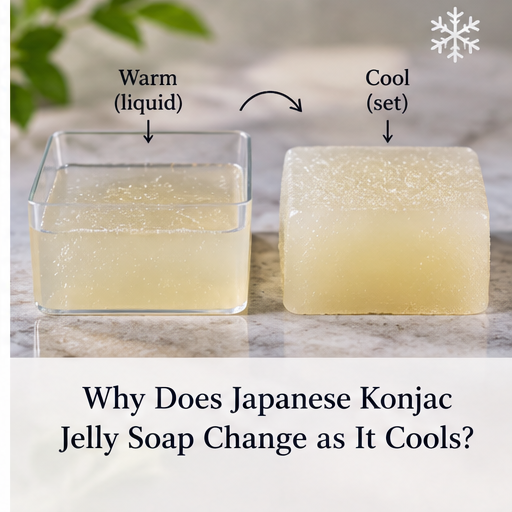
Japanese konjac jelly soap becomes progressively firmer as it cools.
While warm, the product remains much more fluid. As the temperature falls, the jelly structure develops and the soap becomes increasingly difficult to move or handle uniformly.
This means the texture you see while the product is still warm is not its final texture.
Warm Jelly Soap Can Still Look Very Soft
During the demonstrations, the soaps began developing a jelly-like structure relatively quickly.
However, they were still soft while warm.
This is an important observation because a product can already look like jelly without being firm enough to judge or handle as the finished soap.
The final structure should therefore be assessed only after the product has cooled completely.
Cooling Is Part of Jelly Formation
The transition from fluid to jelly is part of the product’s cooling behaviour.
While sufficiently warm, the system remains easier to move and distribute.
Once cooling begins, the mixture thickens and starts setting.
If it cools too early while the product is still being worked with, it can become difficult to maintain a uniform texture.
This is why temperature and timing matter conceptually even without knowing the manufacturing procedure.
Why You Shouldn’t Judge the Soap Too Early
A warm soap may appear softer than expected.
That does not necessarily mean there is something wrong with the finished structure.
During the workshop, soaps that were already visibly jelly-like were still too soft because they had not reached room temperature.
The more useful test is what the soap feels like after complete cooling.
How Long Should You Wait Before Handling It?
The demonstrations show that jelly formation begins relatively quickly, but I recommend giving the soap enough time to cool fully before removing it from its mould.
Depending on the situation, this may mean allowing several hours, half a day or even leaving it overnight.
The important condition is not the clock alone.
The soap should be completely cooled to room temperature.
Why This Matters for the Finished Product
Jelly soap is a good example of why a cosmetic product should not always be judged at the moment it is first prepared.
Its appearance and handling properties continue to develop as it cools.
Something that looks too fluid while warm may become appropriately structured later.
Something that already looks like jelly may still be too soft to handle properly.
The Practical Takeaway
Cooling is not simply what happens after the jelly soap is finished.
It is part of the development of the final product structure.
The most useful rule is therefore simple: judge the jelly only after it has completely cooled. A warm jelly soap does not yet tell you what the finished texture will be.
Related Jelly Soap guides
→ Why Are There Different Types?
→ What Makes Japanese Konjac Jelly Soap Jelly-Like?
For a broader introduction to Japanese konjac jelly soap, its ingredients, structure, variations and formulation principles, read our complete guide: Japanese Konjac Jelly Soap: Benefits, Ingredients & How It Works.