We spend a lot of time thinking about how well a detergent cleans our clothes, but much less time thinking about what repeated washing does to the fabric itself.
If you have used the same cotton T-shirt or towel for several months, you may have noticed a change. The towel that was wonderfully soft when new gradually becomes harder. A T-shirt may begin to feel rougher, and some fabrics develop fuzziness or pilling on the surface.
This is where a fabric conditioner—or fabric softener—comes in.
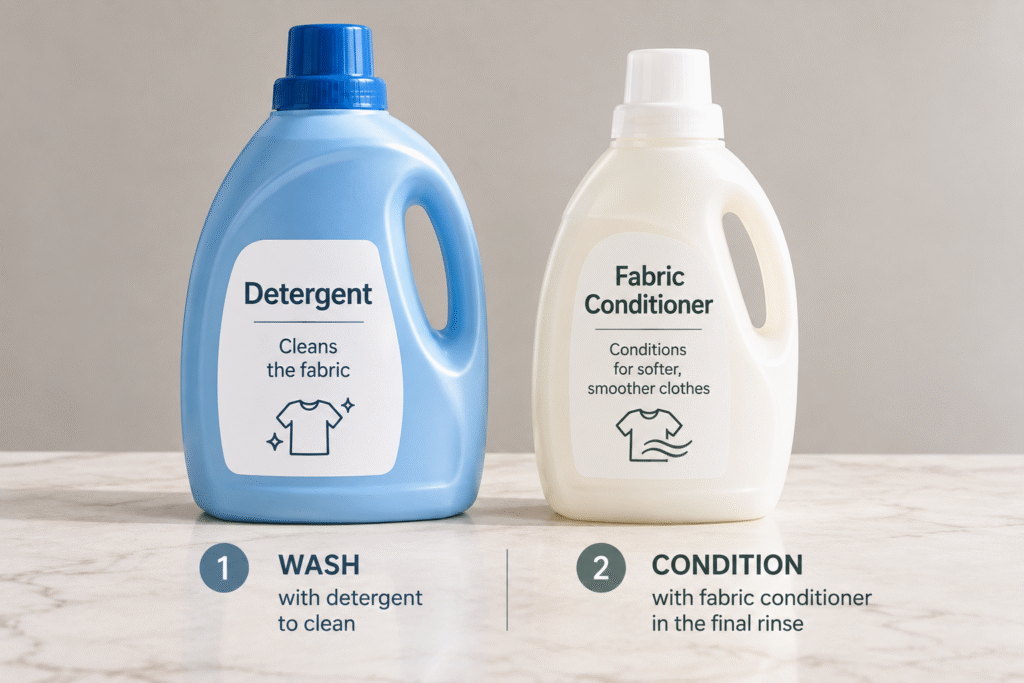
A detergent’s primary job is to clean the fabric. A fabric conditioner’s job is different: it is designed to condition the fabric after cleaning, leaving it softer, smoother and more pleasantly fragranced.
Why do fabrics become rough after repeated washing?
Think about what happens to clothes during a normal wash.
They are exposed to detergent and water and then moved, rubbed or agitated during washing. When washing by hand, we may scrub them even more vigorously.
Detergents need to be effective enough to remove dirt from the fabric. But repeated washing and friction can also leave the surface of certain fabrics feeling increasingly dry and rough. This is particularly noticeable with cotton fabrics and towels.
One simple analogy is hair.
Hair can become rough or frizzy after washing and friction, which is why we use a conditioner after shampooing. Fabric conditioner performs a broadly similar conditioning role for clothes: it leaves a conditioning deposit on the fibres that helps the surface feel smoother.
What are the benefits of using fabric conditioner?
1. Softer clothes
This is its most obvious purpose.
Fabric conditioner helps reduce the rough and stiff feel that can develop after repeated washing. You will probably notice the difference most clearly with things such as towels, cotton T-shirts and bedsheets.
2. A smoother feel
Conditioning reduces the friction you feel between fibres, giving the fabric a smoother sensory character.
This isn’t only about appearance. Think about the difference between drying yourself with a hard, rough towel and a soft one. The experience of using the fabric changes.
3. Longer-lasting fragrance
Fabric conditioner can also be used to introduce fragrance.
There is an interesting reason why its fragrance may be particularly noticeable. Detergent is part of the washing process and is subsequently rinsed away. Fabric conditioner, by contrast, is introduced during the final conditioning stage.
That allows its fragrance to remain more noticeable on the finished laundry.
4. Clothes can retain a fresher feel
Repeated washing can make fabrics look and feel older. Surface fuzziness, pilling and increasing stiffness all contribute to this impression.
Conditioning cannot make a genuinely worn-out garment new again, but keeping the fabric softer and smoother can help it retain a more pleasant feel over repeated washes.
Want to understand the conditioning effect in more detail?
[What Does Fabric Conditioner Actually Do? →]
How does fabric conditioner actually work?
This is where fabric conditioner becomes particularly interesting.
The principal conditioning materials discussed in the workshop are cationic conditioning ingredients. These materials deposit onto the fabric surface during conditioning and help create the smoother, softer feel we associate with a conditioned garment.
You don’t need to understand the chemistry to use the product, but there is an important practical consequence:
Fabric conditioner and detergent perform different jobs.
A detergent cleans.
A fabric conditioner conditions.
And that means they shouldn’t simply be mixed together.
The biggest fabric-conditioner mistake: adding it with detergent
This is probably the most important practical point.
Don’t mix fabric conditioner directly with your detergent.
Complete the normal detergent wash first. The clothes should be properly cleaned and rinsed. Fabric conditioner is then introduced as part of the final rinse.
Putting detergent and conditioner together interferes with what each product is supposed to do. The detergent is there to clean; the conditioner is intended to deposit conditioning material on already-clean fabric.
So remember the sequence:
Wash → rinse out the detergent → condition → final rinse → dry.
Read more: Why Shouldn’t You Mix Fabric Conditioner with Detergent?
Read more: Why Does Fabric Conditioner Need to Be Added During the Rinse Cycle?
How do I use fabric conditioner when washing clothes by hand?
After washing your clothes normally, rinse them thoroughly so that the detergent has been removed.
Prepare your final rinse water and disperse the fabric conditioner in it rather than pouring concentrated conditioner directly onto the clothes.
Place the washed clothes into the conditioned water. In the workshop, I recommend allowing them to soak for around five minutes where practical. Then give them their final rinse and allow them to dry normally.
There’s no need to scrub the clothes again—the cleaning stage is already over.
Read more: How Do You Use Fabric Conditioner When Washing Clothes by Hand?
Can I use more conditioner to make clothes extra soft?
More isn’t necessarily better.
It is tempting to think:
“If one cap makes my towel soft, three or four caps will make it incredibly soft.”
That’s not how it works.
Too much conditioner can leave fabric feeling sticky or as though it hasn’t been properly cleaned.
There is also a limit to what conditioning can achieve.
If an old towel has become extremely hard and its fibres are badly worn, conditioning can improve its feel, but it cannot necessarily restore the towel to exactly the softness it had when it was brand new.
Read more: Can Using Too Much Fabric Conditioner Make Clothes Feel Worse?
Can fabric conditioner be used on every fabric?
Not necessarily.
Always check the garment or textile manufacturer’s care instructions.
Some special fabrics and technical textiles may have specific instructions regarding conditioning products. If the care label tells you not to use fabric conditioner, follow that instruction.
This is an important principle with laundry products generally: the fabric manufacturer’s care instructions should take priority over a generic recommendation.
What about silk?
Silk already has a naturally smooth character, so it may not require the same type of conditioning as fabrics that tend to become rougher.
Again, the safest approach is to check the care instructions for the particular garment rather than assuming every fabric needs conditioner.
Can I use fabric conditioner for baby clothes?
Baby clothes present an interesting case because they are often made from cotton and can be washed extremely frequently.
Frequent washing can make cotton feel progressively stiffer, while we generally want clothing that touches a baby’s skin to remain soft.
The workshop therefore discusses conditioning baby clothes, but with one important consideration: fragrance.
For newborns and babies under one year, I prefer to avoid fragrance where possible. If fragrance is used, keep it very gentle and at a low level rather than trying to create a strongly perfumed product.
Read more: Can Fabric Conditioner Be Used on Every Type of Fabric?
Why does the consistency of fabric conditioner matter?
A good fabric conditioner shouldn’t necessarily be extremely thick.
If it is too thick, it may not disperse properly in the rinse water and could instead remain concentrated in particular areas.
At the same time, consumers often associate an extremely watery product with poor quality even when thinness itself isn’t necessarily a functional problem.
For the formulation discussed in the workshop, the desired appearance is similar to a thin lotion—thicker than milk, but thinner than an ordinary body lotion.
This is an interesting example of the difference between functional performance and consumer perception. A product needs to work, but if you’re making it commercially, it also needs to look and feel like something customers consider well made.
Why do hotels use so much fabric conditioner?
Think about hotel laundry.
Bedsheets and towels may be washed every single day. Yet when a guest checks into a good hotel, they expect fresh sheets and soft towels—not textiles that feel as though they’ve been through hundreds of wash cycles.
This makes conditioning particularly relevant to hospitality, where both the sensory experience of the guest and repeated laundering of textiles matter.
The same principle applies at home, just on a smaller scale.
Fabric conditioner isn’t just about fragrance
It is easy to think of fabric conditioner as something you add simply to make laundry smell good.
Fragrance is certainly part of the experience, but it isn’t the fundamental purpose of the product.
Detergent and conditioner have two distinct roles:
Detergent removes what you don’t want from the fabric.
Conditioner improves how the clean fabric feels afterwards. Understanding that distinction also explains the most important rule for using fabric conditioner correctly: don’t ask it to clean your clothes, and don’t ask your detergent to condition them. Use each product at the appropriate stage of the wash.
Explore all Fabric Conditioner guides →
Ready to Make Your Own Fabric Conditioners?
Go beyond the articles and learn how to make soft, smooth and beautifully fragranced fabric conditioners using safe, natural and biodegradable ingredients with Dr. Soma Datta in the Zestchest Fabric Conditioner Course.
The course takes you through the complete making process, with detailed formulation as well as supplier details to help you source the ingredients you need.
Whether you’re making products for yourself or developing a range to sell, the course is designed to help you move from understanding the formulation to creating finished, market-ready products.