
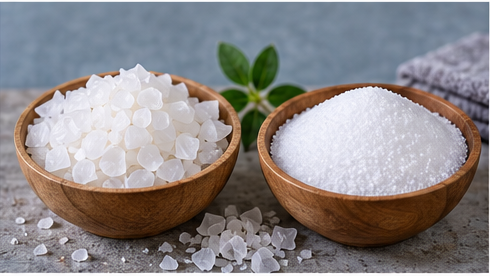
Magnesium chloride and magnesium sulfate are both magnesium salts, but they are not the same ingredient.
Magnesium sulfate is commonly known as Epsom salt and is widely associated with baths and soaking products. Magnesium chloride is another form of magnesium salt and is commonly supplied as flakes.
Both can be used in topical product concepts, but their properties, common uses and formulation considerations differ.
What Is Magnesium Chloride?
Magnesium chloride is a magnesium salt that can be supplied in flake form.
The flakes dissolve readily in water, which makes magnesium chloride suitable for water-based products such as magnesium sprays as well as formulations containing a water phase, including lotions and body butters.
One important characteristic of magnesium chloride is that it is hygroscopic. This means it readily attracts and absorbs moisture from the surrounding environment.
If the flakes are left exposed, they can quickly become damp and lumpy. They should therefore be stored tightly sealed and protected from moisture.
What Is Magnesium Sulfate?
Magnesium sulfate is another magnesium salt.
It is much more familiar to many consumers under the name Epsom salt.
Epsom salt is commonly used in bath salts and soaking products, where it can simply be dissolved into bath or foot-soak water.
So although magnesium chloride and Epsom salt both provide forms of magnesium, the terms should not be used interchangeably.
Magnesium chloride ≠ magnesium sulfate.
Why Is Magnesium Chloride Used in Magnesium Oil?
A typical magnesium oil is essentially a concentrated solution of magnesium chloride in water.
Despite being called an oil, it does not need to contain conventional oil. Magnesium chloride dissolved in water produces the characteristic temporarily slippery or oily skin feel from which the product gets its name.
Because magnesium chloride is water-soluble, it can be dissolved directly into distilled water to create this type of spray.
That makes magnesium chloride particularly convenient when creating products such as:
- magnesium oil
- magnesium spray
- magnesium body mist
Can Magnesium Chloride Be Used in Lotions and Body Butters?
Yes, but this is more technically challenging than making a simple magnesium spray.
A lotion or body butter contains both water and oil.
Magnesium chloride dissolves in the water phase rather than the oil phase. The water phase then has to be combined successfully with the oils using an appropriate emulsification system.
The relatively high salt concentration can make that emulsion harder to stabilize. An emulsifier that performs well in an ordinary lotion may not necessarily remain stable when a substantial amount of magnesium chloride is introduced.
This is an important difference between putting magnesium chloride into a simple water-based spray and incorporating it into an emulsified cosmetic product.
Can Epsom Salt Be Used Instead?
Magnesium sulfate can technically be used in topical preparations.
However, simply substituting one magnesium salt for another shouldn’t be treated as though the ingredients are identical.
The source formulations use magnesium chloride for the sprays, lotions and body butters, while magnesium sulfate is discussed primarily in connection with Epsom salts and soaking products.
If you are following a tested formulation, changing the type of magnesium salt means you are changing one of its raw materials. The resulting product should therefore be evaluated rather than assuming that it will behave identically.
Is Magnesium Chloride Better Absorbed Through the Skin?
This is where an important distinction is necessary.
Magnesium chloride is sometimes promoted as being better suited to transdermal or topical magnesium products than magnesium sulfate. The course source also prefers magnesium chloride on this basis.
However, evidence that meaningful quantities of magnesium are absorbed systemically through healthy, intact human skin remains limited.
So it is better not to present claims such as “magnesium chloride is better absorbed through the skin” as an established reason that one ingredient is universally superior to the other.
From a formulation perspective, we can make a much clearer statement:
Magnesium chloride is the magnesium salt used in the magnesium oil, lotion and body-butter formulations discussed here, while magnesium sulfate is the familiar Epsom salt commonly used for baths and soaking products.
Does Cost Make a Difference?
Magnesium sulfate is generally the less expensive option in the source material.
However, the quantity of magnesium salt used in an individual finished product means that the raw-material saving per unit can be relatively small.
The source therefore treats the choice of magnesium salt as a formulation decision rather than simply choosing whichever raw material costs less.
For anyone developing products commercially, this is a useful principle: ingredient cost matters, but so do the intended formulation, product format and performance.
How Should Magnesium Chloride Flakes Be Stored?
Storage deserves particular attention because of magnesium chloride’s tendency to attract moisture.
Keep magnesium chloride flakes:
- tightly sealed;
- away from moisture;
- in a dry storage environment; and
- closed when they are not being weighed or used.
Free-flowing flakes are a useful practical indication that the material has remained dry. If exposed to humid air, the flakes can absorb water and become lumpy.
This characteristic matters not only when storing the raw material but also when formulating with it.
Magnesium Chloride vs Epsom Salt at a Glance
| Magnesium Chloride | Magnesium Sulfate | |
|---|---|---|
| Also known as | Magnesium chloride flakes | Epsom salt |
| Type | Magnesium salt | Magnesium salt |
| Water soluble | Yes | Yes |
| Common format discussed here | Sprays, lotions and body butters | Baths and soaking products |
| Used in the magnesium formulations covered here | Yes | Not as the primary salt |
| Storage consideration | Strongly attracts moisture | Different raw-material behaviour |
| Interchangeable ingredient? | No | No |
The Key Difference
Magnesium chloride and Epsom salt shouldn’t be confused simply because both contain magnesium.
Epsom salt is magnesium sulfate. Magnesium chloride is a different magnesium salt.
Epsom salt is particularly familiar in baths and soaking products, while magnesium chloride is used in the magnesium sprays, lotions and body butters covered in this collection.
And when developing a formulation, changing from one magnesium salt to another should be treated as an ingredient substitution that needs evaluation, rather than assuming the finished product will behave exactly the same way.
Related Magnesium Body Product guides
→ What Is Magnesium Oil and Why Is It Called an Oil?
→ Why Are Magnesium Lotions Difficult to Keep Stable?
For a broader introduction to Fabric Conditioners, its ingredients, structure, variations and formulation principles, read our complete guide: Magnesium Oil, Lotion and Body Butter Explained: Benefits, Uses & Differences.