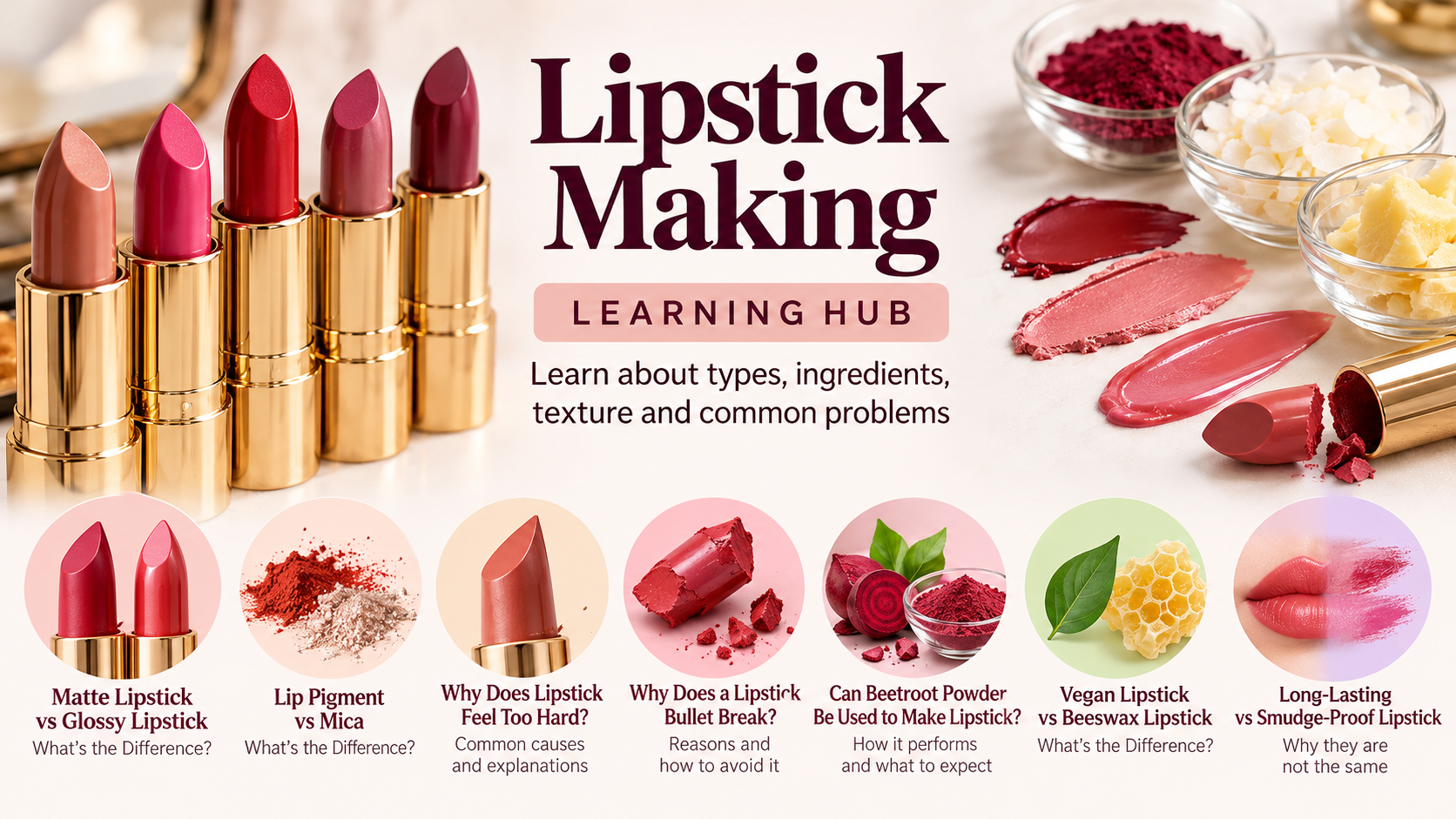
Lipstick may look like a simple colour cosmetic, but its final texture, appearance, glide, strength and wear depend on how different components work together.
A lipstick needs enough structure to hold its shape while still feeling comfortable during application. Colour needs to spread evenly, the bullet should not break easily, and the finished product should suit the type of lipstick being created—whether matte, glossy, vegan or long-lasting.
This Lipstick Learning Hub brings together our educational guides on lipstick types, colour ingredients, texture, breakage and other commonly asked questions.
Use the guides below to understand each topic individually.
Start With Lipstick Types and Finishes
Lipsticks can have very different textures and finishes even when they belong to the same general product category.
Matte Lipstick vs Glossy Lipstick: What’s the Difference?
Matte lipsticks are generally firmer and have less shine, while glossy lipsticks contain a softer, more emollient character and provide more shine.
The difference is not simply about colour. Texture, softness, glide and wear also change depending on the type of lipstick.
Read: Matte Lipstick vs Glossy Lipstick
Understand Lipstick Colour: Pigment vs Mica
Colour ingredients do not all perform the same function.
Pigments are primarily responsible for giving lipstick strong colour, while mica is generally used to create shine, pearliness and special visual effects.
Understanding this distinction makes it easier to understand why two lipsticks can have similar colours but completely different finishes.
Read: Lip Pigment vs Mica: What’s the Difference in Lipstick?
Why Does Lipstick Sometimes Feel Too Hard?
A lipstick bullet needs structure so that it can remain solid inside the tube.
However, hardness and good application are not the same thing.
If a lipstick becomes excessively hard, it may drag during application or fail to transfer colour smoothly onto the lips. Oils, butters and other emollient ingredients contribute to the creaminess and slip of the product, while waxes provide structure.
A good lipstick needs a suitable balance between the two.
Read: Why Does Lipstick Feel Too Hard or Not Glide Properly?
Why Does a Lipstick Bullet Break?
A lipstick should be firm enough to retain its shape but also have enough flexibility to withstand normal application.
Breakage can happen when a lipstick is excessively brittle, but application technique also matters. Twisting too much of the lipstick bullet out of the tube creates more leverage and can make even a well-made lipstick easier to break.
During application, only a small portion of the lipstick needs to be exposed.
Read: Why Does a Lipstick Bullet Break During Application?
Can Beetroot Powder Replace Lip Pigment?
Beetroot is frequently associated with naturally coloured lip products.
However, beetroot powder and conventional lip-safe pigments do not give the same colour performance.
Beetroot can provide a mild tint, but its colour is much softer than the strong colour normally expected from lipstick. Depending on how it is incorporated, the powder may also contribute to a grainy feel.
This is why a product called a beetroot lip balm or beetroot lipstick does not necessarily mean that all of its visible colour comes from beetroot alone.
Read: Can Beetroot Powder Be Used to Make Lipstick?
Vegan Lipstick vs Beeswax Lipstick
Wax is one of the ingredients responsible for giving a lipstick bullet its structure.
Beeswax is commonly used because it contributes both firmness and some flexibility. However, because beeswax comes from bees, it is not suitable for a vegan lipstick.
Plant-based waxes such as carnauba wax and candelilla wax can be used in vegan lipstick systems, but they behave differently.
This means that creating a vegan lipstick is not simply a matter of removing beeswax. The complete structure and texture of the lipstick need to be considered.
Read: Vegan Lipstick vs Beeswax Lipstick: What’s the Difference?
Long-Lasting Does Not Always Mean Smudge-Proof
These two terms are often treated as if they mean the same thing, but they describe different characteristics.
A lipstick may remain visible on the lips for a long period and still transfer when the lips touch another surface.
Pigment contributes colour, but increasing pigment alone does not automatically make a lipstick transfer-proof.
Oils and emollients help create softness and glide, but they can also influence how easily the product transfers.
Highly transfer-resistant lip products generally behave differently from traditional oil-and-wax lipstick systems.
Read: Why Is Long-Lasting Lipstick Not Always Smudge-Proof?
What Makes a Good Lipstick?
When I evaluate a lipstick, I do not look only at its colour.
A good lipstick should also have an appropriate balance of:
- Structure
- Glide
- Creaminess
- Colour transfer
- Uniform application
- Strength
- Flexibility
- Comfortable feel
- Suitable shine or matte finish
For example, a lipstick can look beautiful inside the tube but perform poorly if it drags across the lips.
Another lipstick may glide very easily but become too soft or greasy.
This is why lipstick formulation is about balancing different properties rather than maximizing only one characteristic.
Waxes Give Lipstick Its Structure
Waxes help a lipstick maintain its bullet shape.
Different waxes behave differently.
Beeswax provides structure while also contributing some flexibility. Plant-derived waxes such as carnauba and candelilla are comparatively hard waxes and can be used when creating vegan products.
The wax system therefore affects much more than whether the lipstick remains solid. It also influences how the bullet behaves during application.
Oils and Butters Affect Glide and Creaminess
Oils and butters provide emolliency.
They influence how easily the lipstick spreads across the lips and how creamy or soft the finished product feels.
Ingredients discussed in lipstick making can include oils and butters such as:
- Castor oil
- Almond oil
- Olive oil
- Shea butter
- Ghee
- Jojoba oil
- Argan oil
- Grapeseed oil
Different choices can influence the final sensory character of the lipstick.
Castor oil, for example, has a thicker character and can contribute differently depending on whether the desired lipstick is more matte or more glossy.
Colour Is Only One Part of Lipstick Performance
A strong colour does not automatically mean that a lipstick has a good texture.
Similarly, a beautifully creamy lipstick may still have poor colour distribution if the pigment is not dispersed uniformly.
Patchy lipstick application can indicate that the colour is not distributed properly throughout the product.
When evaluating lipstick, colour, texture, glide and structural stability should therefore be considered separately.
Explore the Lipstick Knowledge Guides
If you are learning about lipstick formulation, these guides are a good place to continue:
- Matte Lipstick vs Glossy Lipstick: What’s the Difference?
- Lip Pigment vs Mica: What’s the Difference in Lipstick?
- Why Does Lipstick Feel Too Hard or Not Glide Properly?
- Why Does a Lipstick Bullet Break During Application?
- Can Beetroot Powder Be Used to Make Lipstick?
- Vegan Lipstick vs Beeswax Lipstick: What’s the Difference?
- Why Is Long-Lasting Lipstick Not Always Smudge-Proof?
Learn Lipstick Making
If you want to move beyond understanding the concepts and learn lipstick making in a structured course, you can explore the ZestChest Institute Lipstick Making Course.
The course covers different lipstick styles and the practical formulation concepts involved in creating lip products.
Explore the Lipstick Making Course
Continue Learning
Lipstick formulation becomes much easier to understand when you stop looking at it as only a mixture of wax, oil and colour.
Each component has a purpose.
Waxes create structure.
Oils and butters influence glide and creaminess.
Pigments provide colour.
Mica can modify shine and visual effect.
Changing one part of this balance can change the way the entire lipstick looks, feels and performs.
Use the individual guides in this Lipstick Learning Hub whenever you want to understand a particular lipstick problem or formulation concept in more detail.