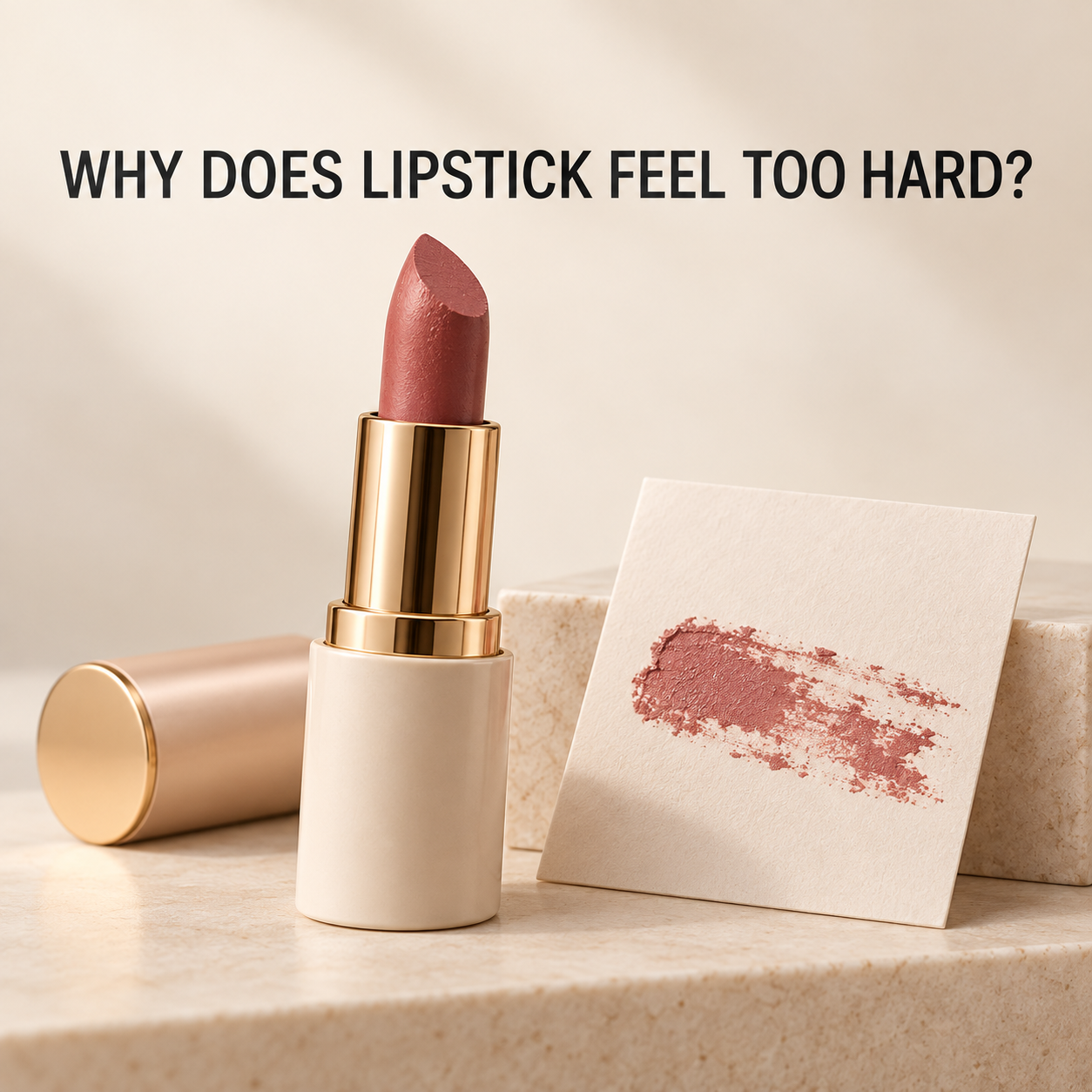
A lipstick needs to be firm enough to hold its shape, but it also needs to glide comfortably over the lips.
Getting both qualities at the same time is one of the central challenges in lipstick texture.
Why Does Lipstick Need to Be Hard?
A conventional lipstick is formed into a solid bullet.
Without enough structure, the lipstick would become too soft to remain inside a twist-up tube.
Waxes are largely responsible for creating this structure.
Can Lipstick Become Too Hard?
Yes.
More hardness is not always better.
If a lipstick is excessively firm, several problems can appear:
- it may drag across the lips
- colour may not transfer easily
- repeated rubbing may be required
- application may feel uncomfortable
The product needs a balance between structural waxes and emollient ingredients such as oils and butters.
What Creates Slip?
Oils and butters provide emolliency.
They help create:
- creaminess
- spreadability
- softness
- comfortable glide
But excessive oiliness can create the opposite problem.
The lipstick may become too soft, too greasy or easier to wipe away.
What If the Lipstick Has Colour but Does Not Transfer?
This is an important distinction.
A lipstick can contain enough pigment and still transfer poorly if the bullet itself is excessively hard.
Adding more pigment does not automatically solve a texture problem.
Colour and texture have to be evaluated separately.
What Should Good Lipstick Feel Like?
A well-balanced lipstick should:
- glide without excessive pressure
- deposit colour evenly
- feel creamy without feeling greasy
- remain firm enough to hold its shape
- feel comfortable during application
Key Takeaway
A good lipstick is neither extremely hard nor excessively oily.
Its performance depends on the balance between the ingredients that create structure and those that create slip.