
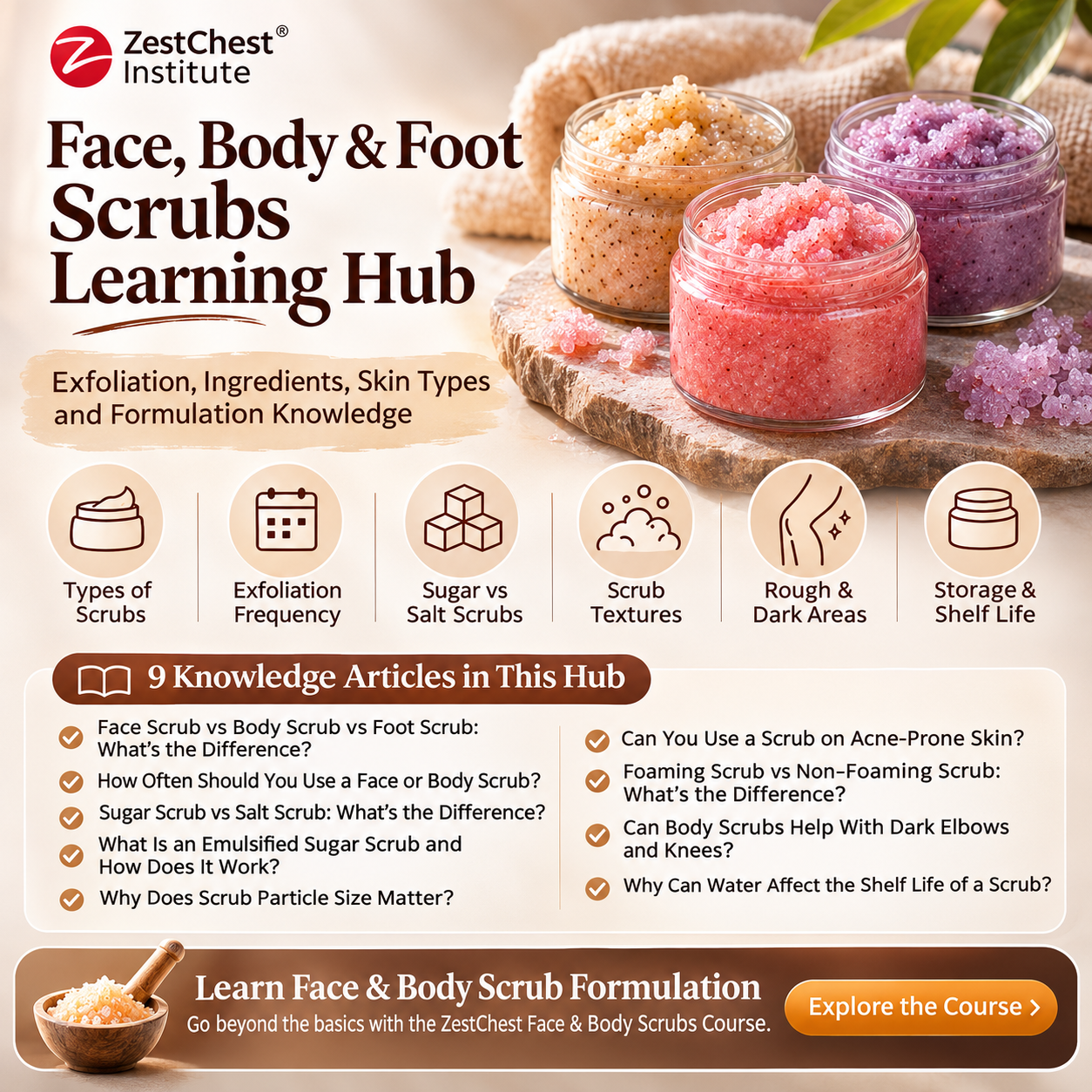
Scrubs are an important part of skincare because they help remove accumulated dead skin cells and improve the appearance and texture of the skin.
However, not all scrubs work in the same way.
Facial scrubs, body scrubs and foot scrubs differ in their exfoliating particles, texture and intensity. Sugar scrubs, salt scrubs, creamy scrubs, emulsified scrubs and foaming scrubs also provide different experiences.
Understanding these differences helps when choosing a suitable exfoliating product for the face, body or feet.
This learning hub brings together nine educational articles covering exfoliation, ingredient functions, skin suitability, scrub textures, product storage and common skincare questions.
1. Understanding Different Types of Scrubs
The first step in choosing a scrub is understanding how exfoliating products differ according to the area of the body where they are used.
Face Scrub vs Body Scrub vs Foot Scrub: What’s the Difference?
Learn why facial, body and foot scrubs require different levels of exfoliation.
Understand how skin thickness, particle size and particle quantity influence the scrubbing experience, and why a coarse foot scrub may be too harsh for delicate facial skin.
Why Does Scrub Particle Size Matter?
Discover how fine and coarse exfoliating particles affect skin comfort and exfoliation intensity.
Learn why smaller particles are generally preferred for facial scrubs, how sugar crystals dissolve during use and why walnut shell powder provides a different scrubbing experience.
2. Exfoliation Frequency and Skin Suitability
Exfoliation should be gentle and controlled.
Scrubbing too frequently or using an unsuitable product can disturb the skin barrier, particularly when the skin is sensitive or affected by active acne.
How Often Should You Use a Face or Body Scrub?
Learn why exfoliating scrubs are generally used once or twice a week rather than every day.
Understand how excessive scrubbing can affect the skin barrier, why consistent exfoliation is preferable to aggressive rubbing and what to consider after a chemical peel.
Can You Use a Scrub on Acne-Prone Skin?
Understand why fresh, painful or pus-filled pimples should not be scrubbed aggressively.
Learn the difference between active acne and dried acne marks, how gentle exfoliation may be approached and why improvements in the appearance of marks take time.
3. Sugar Scrubs, Salt Scrubs and Emulsified Scrubs
Different exfoliating ingredients provide different textures and body-care experiences.
Sugar and salt both offer physical exfoliation, while the scrub base determines how the product spreads, feels and rinses away.
Sugar Scrub vs Salt Scrub: What’s the Difference?
Explore the differences between sugar scrubs and mineralising salt scrubs.
Learn how sugar and salt crystals behave during exfoliation, why crystal size matters and how sugar scrubs and salt scrubs are associated with different body-care characteristics.
What Is an Emulsified Sugar Scrub and How Does It Work?
Discover why an emulsified sugar scrub becomes creamy when it comes into contact with water.
Understand how the scrub combines physical exfoliation with the richness of oils and butters, and why it rinses differently from an ordinary oil-based sugar scrub.
4. Foaming Scrubs and Cleansing Experience
The texture of a scrub influences how it feels during application.
Some scrubs produce rich bubbles, while others remain creamy or oily. These differences affect the washing experience but do not automatically determine exfoliating effectiveness.
Foaming Scrub vs Non-Foaming Scrub: What’s the Difference?
Learn why foaming scrubs produce lather and how surfactants contribute to the cleansing experience.
Understand how non-foaming and emulsified scrubs behave with water, why more foam does not necessarily mean better exfoliation and how to choose between different scrub textures.
5. Body Scrubs for Rough and Dark Skin Areas
Some areas of the body experience more friction, pressure and dryness than others.
Elbows and knees are common examples where accumulated dead skin and dryness can contribute to a rough or darker appearance.
Can Body Scrubs Help With Dark Elbows and Knees?
Discover why elbows and knees can become dry, rough and darker in appearance.
Learn how gentle body exfoliation helps remove accumulated dead skin and why moisturisation is an important part of caring for these areas.
6. Scrub Storage, Water Exposure and Shelf Life
The way a scrub is stored and handled can affect its condition over time.
This is particularly relevant for body scrubs kept in jars and used in bathrooms, where water may enter the container during repeated use.
Why Can Water Affect the Shelf Life of a Scrub?
Learn why introducing water into a scrub jar can increase contamination risks.
Understand the difference between water-free and water-containing scrubs, why using a clean, dry spatula matters and how microbial deterioration differs from oil rancidity.
7. Bringing the Concepts Together
Understanding scrub products involves more than choosing an exfoliating ingredient.
Skin Type and Exfoliation Strength
Facial skin generally requires gentler exfoliation, while thicker body and heel skin may tolerate coarser particles.
Exfoliation Frequency
Using an intensive scrub too frequently may disturb the skin barrier. Consistent, controlled exfoliation is preferable to aggressive daily scrubbing.
Exfoliating Ingredients
Sugar, salt and walnut shell powder provide different physical exfoliating characteristics.
Scrub Texture and Skin Feel
Emulsified scrubs develop a creamy texture when exposed to water, while foaming scrubs produce lather during application.
Moisturisation and Body Care
Oils, butters and other moisturising ingredients contribute to a comfortable after-wash experience, particularly for dry areas such as elbows and knees.
Storage and Product Quality
Water exposure, handling practices and changes in oils can affect the condition of a scrub during storage.
These characteristics are connected, but each plays a different role.
A scrub should be evaluated according to its exfoliating particles, suitability for the intended skin area, application experience and after-wash skin feel.
8. Learn Face & Body Scrub Formulation
Want to go beyond the concepts and learn face and body scrub formulation in a structured way?
Explore the complete ZestChest Face & Body Scrubs Course to understand ingredient functions, exfoliating materials, different scrub textures, formulation principles and practical demonstrations.

