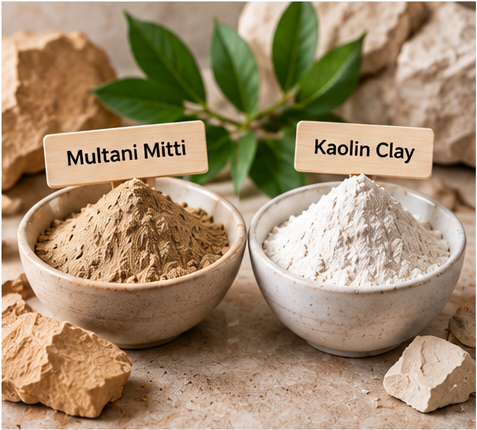
Multani Mitti and kaolin are both clays used in Ubtan, but they don’t necessarily create the same skin experience.
Multani Mitti is particularly useful when you want stronger oil absorption and a relatively dry or matte skin feel. Kaolin can provide clay and cleansing characteristics without necessarily making the product feel as drying.
That difference becomes important when choosing an Ubtan for different skin types.
What Does Multani Mitti Do in Ubtan?
Multani Mitti, also known as Fuller’s Earth, is particularly useful for absorbing sebum.
That makes it a logical ingredient when you’re creating or choosing an Ubtan for oily skin.
After use, the skin can feel relatively dry or matte because of this oil-absorbing property.
But every useful property has to be considered in context.
If someone’s skin is already very dry, strong oil absorption may not be what you want to emphasise.
That doesn’t make Multani Mitti a bad ingredient. It means you need to match the ingredient to the purpose.
What Does Kaolin Clay Do in Ubtan?
Kaolin is also a clay and is used for its cleansing characteristics.
However, it can be used when you want the benefits of a clay without making the product excessively drying.
This makes it particularly useful when developing Ubtans for normal, dry or more sensitive-feeling skin.
The difference isn’t that one clay cleans while the other doesn’t. The more useful distinction is the skin experience you are trying to create.
Multani Mitti vs Kaolin: Which Is Better for Oily Skin?
If oil absorption is an important objective, the properties of Multani Mitti are particularly useful.
Its ability to absorb sebum can help create the relatively dry or matte skin feel that may be desirable in an Ubtan intended for oily skin.
Kaolin can also contribute cleansing and clay characteristics, but Multani Mitti has a clearer role when stronger oil absorption is the objective.
Which Clay Is Better for Dry Skin?
For dry skin, the formulation objective changes.
If the skin is already very dry, strong oil absorption may not be desirable. Kaolin can provide the characteristics of a clay while being less likely to make the product feel excessively drying.
But this doesn’t mean that choosing an Ubtan for dry skin is simply a matter of replacing Multani Mitti with kaolin.
The whole formulation matters. Other ingredients in the Ubtan also influence how cleansing, drying, gentle or moisturising the finished product feels.
So Which Clay Is Better?
Neither is universally “better.”
The better question is:
What do you want the clay to do in this particular Ubtan?
If oil absorption is an important objective, the properties of Multani Mitti are useful.
If you want a clay-based cleansing character while being more cautious about excessive dryness, kaolin may make more sense.
Why This Difference Matters
Natural skincare ingredients are often discussed as though an ingredient simply has a list of “benefits.”
That can be misleading when you’re actually choosing a product.
An ingredient’s effect on the overall skin experience matters just as much as its reputation.
The fact that Multani Mitti absorbs oil is an advantage when excess oil is the problem. The same characteristic requires more thought when dryness is the problem.
Understanding that relationship between ingredient function and skin type is much more useful than asking which clay is best in isolation.
Choosing the Right Clay for an Ubtan
The Multani Mitti-versus-kaolin comparison illustrates a broader principle of Ubtan formulation.
Don’t choose an ingredient simply because it is traditionally used in skincare or because it has a long list of supposed benefits.
Instead, ask:
What function does this ingredient perform, and does that function suit the product and skin type I am designing for?
Multani Mitti’s stronger oil-absorbing character can be an advantage in one formulation and something that needs to be moderated in another.
Kaolin may make more sense when clay and cleansing properties are desired without creating an excessively drying skin feel.
Neither ingredient is inherently superior. The right choice depends on the purpose of the Ubtan.
Related Ubtan guides
→ How Do You Choose an Ubtan for Oily, Dry or Mature Skin?
→ Activated Charcoal in Ubtan
For a broader introduction to Ubtan ingredients, skin types, uses and formulation principles, read our main guide: Ubtan for Skin: Benefits, Ingredients & Choosing the Right One.