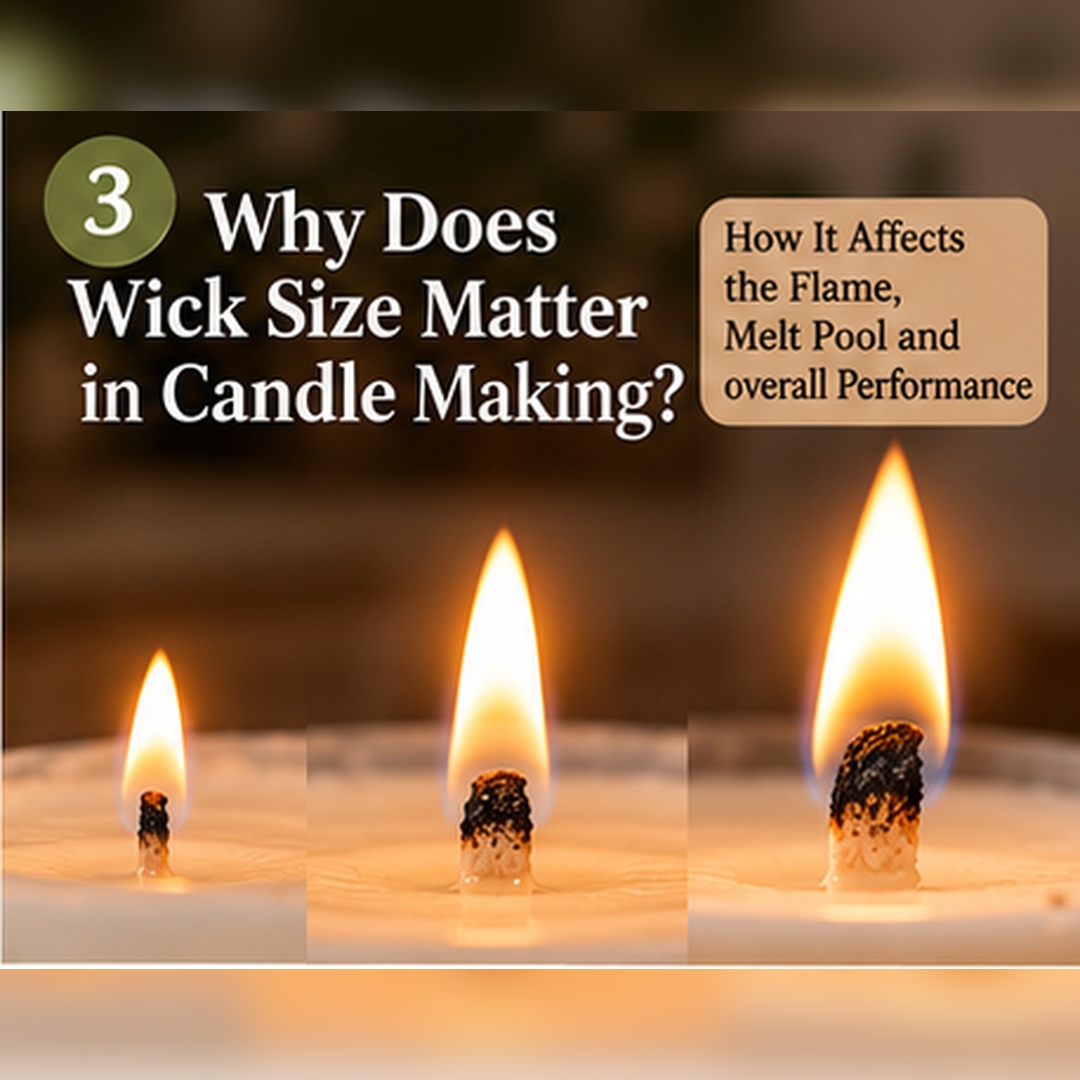
Wick size matters because the wick controls the flame, and the flame determines how much wax around it melts.
A wick that is too small for the candle can leave a deep hollow through the centre. A wick that is too large can create an excessively large flame and melt too much wax.
A Wick Is Not Just a Piece of Thread
The purpose of the wick is not simply to remain lit.
It has to support the way the candle burns.
A thin wick produces a smaller flame and therefore heats a smaller area. That may work for a narrow candle but become inadequate in a much broader candle.
A thicker or broader wick creates a larger flame and a larger melt area.
This is why the same wick cannot automatically be used for every mould or container.
What Happens When the Wick Is Too Small?
Imagine a broad candle with one thin wick in the centre.
The wick continues burning, but only a small circle around it melts.
The sides remain untouched.
After repeated burns, the candle becomes hollow through the centre. The candle also develops a small wax pool, which can reduce the fragrance performance of a scented candle.
What Happens When the Wick Is Too Large?
Going to the other extreme is not the solution.
A very thick wick can create a much bigger flame.
That means more heat and more melted wax.
The workshop specifically treats this as another condition that needs to be controlled rather than assuming that a bigger flame is always better.
The goal is an appropriate flame for the candle, not the biggest possible flame.
Why Wooden Wicks Are Used in Larger Candles
Wooden wicks are discussed as a useful option for broader candles.
Because they are wider, they can create a larger flame and therefore a larger melt pool.
For a broad candle where a small single cotton wick would only melt the centre, a wooden wick can provide a different burning profile. Wooden wicks are not positioned in the same way for very small candles because their larger flame would be unnecessary there.
Candle Width Should Guide Wick Selection
The important principle is to look at the actual candle.
A narrow candle does not have the same wick requirement as a broad container candle.
The wick should be chosen with the candle’s width and the desired melt area in mind.
A useful way to judge the result is not simply to ask, “Is the wick burning?”
Ask instead:
Is this wick helping the candle melt appropriately across its surface without producing an excessive flame?
That is a much better measure of wick suitability.