
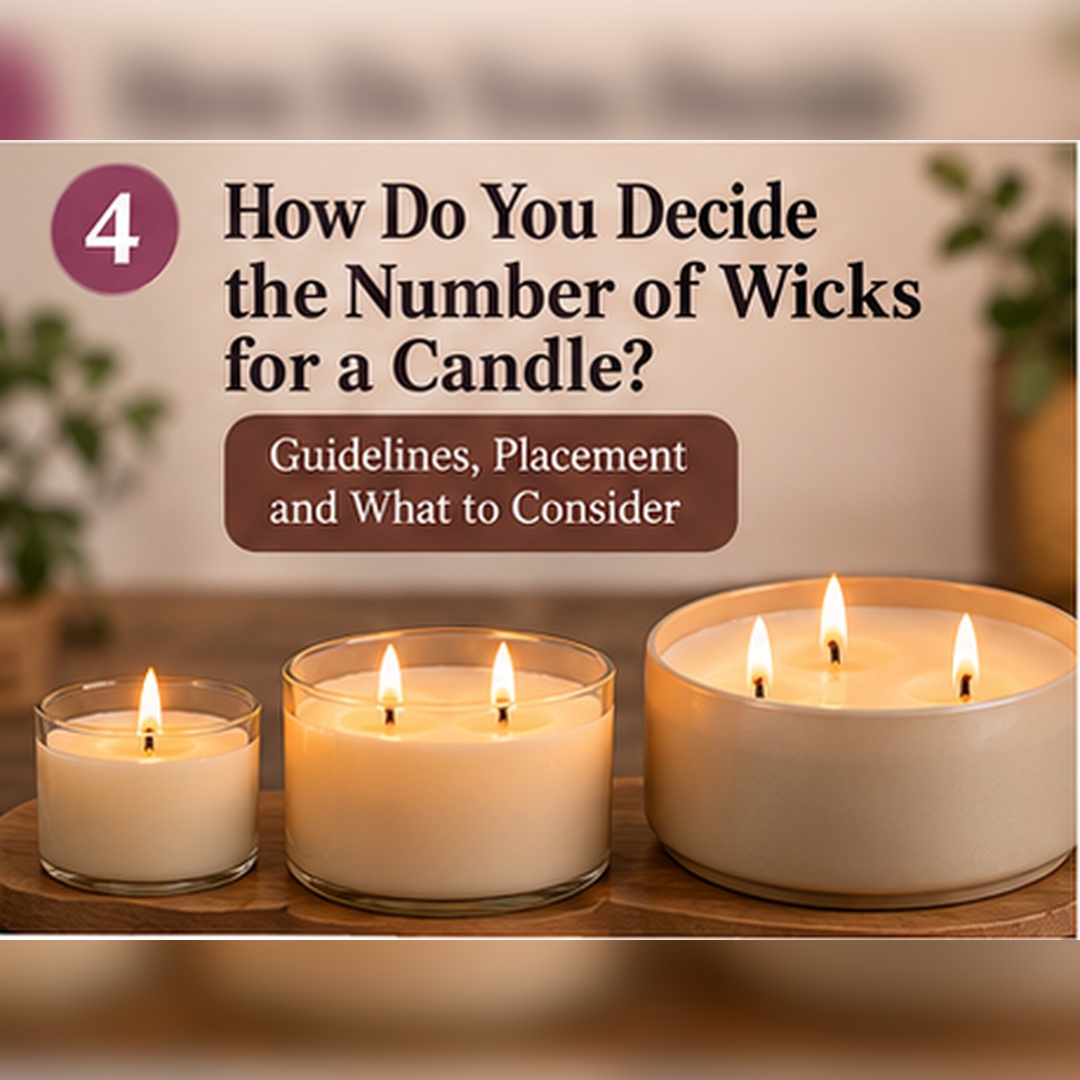
The number of wicks depends mainly on how wide the candle or container is and whether the wicks can create melt areas that eventually cover the surface effectively.
A small candle may work with one wick. As the candle becomes wider, one wick may no longer be enough.
Why One Wick May Not Be Enough
A flame can only heat a limited area around itself.
Put one small wick in the middle of a very broad candle and the centre may melt beautifully while the outer wax stays completely solid.
This creates two problems.
First, the candle can become hollow through the middle.
Second, a scented candle may develop weaker fragrance throw because only a small amount of wax is becoming liquid.
What Multiple Wicks Are Trying to Achieve
Each wick produces its own melted area.
When several wicks are positioned appropriately, those areas can grow and eventually merge.
Instead of having one small pool in the centre, you create a broader melted surface across the candle.
That is the real purpose of adding wicks.
It is not simply to make the candle look more decorative.
Wick Placement Matters as Much as Wick Count
Adding more wicks does not automatically solve the problem.
If the wicks are positioned too far apart, each one may create its own isolated melt area while leaving solid wax between them.
If they are too close together, the flames can combine into an excessively hot central area.
This means wick count and wick spacing need to be considered together.
Wider Candles Need a Different Arrangement
For a candle that needs more than one wick, the arrangement can change with the shape and width of the container.
Two wicks may be positioned across the candle.
A broader round candle may require the wicks to be distributed differently so that heat is not concentrated in only one line.
The principle remains the same: create enough properly distributed melt areas for the candle surface.
Do Not Choose Wick Count by Copying Another Candle
Two containers can look similar in a photograph but have different widths and burning behaviour.
That is why wick count should not be copied blindly from another product.
Observe your own candle.
If the centre repeatedly burns downward while the sides remain solid, the current wick arrangement is not giving sufficient surface coverage.
If the candle is generating an unusually large flame and excessive melted wax, the wick arrangement may be too aggressive.
The useful question is therefore not simply, “How many wicks should a candle have?”
It is: “How many appropriately sized and positioned wicks does this particular candle need to develop a useful melt pool?”