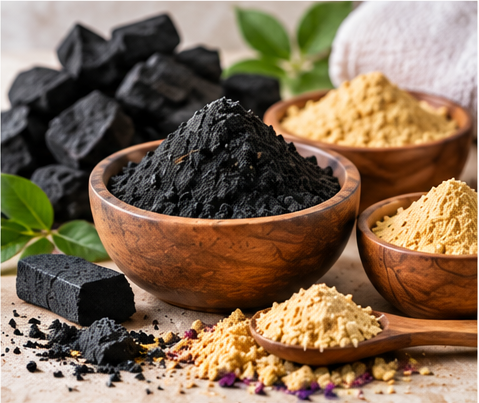
Activated charcoal can be useful in Ubtans intended for deeper cleansing and oily or acne-prone skin because of its adsorptive properties.
But increasing the amount of charcoal does not automatically make the Ubtan better.
Too much can make the product extremely dark, harder to rinse cleanly and more likely to leave visible charcoal around the pores.
It is a good example of an important formulation principle: more of a useful ingredient isn’t necessarily better.
Why Use Activated Charcoal in Ubtan?
Activated charcoal is valued in cleansing products for its adsorptive properties.
That makes it particularly relevant when designing an Ubtan around deeper cleansing, oily skin or acne-prone skin.
It can therefore have a clear purpose within the product.
The mistake is assuming that if some activated charcoal is useful, much more must be even more effective.
What Happens If You Use Too Much Activated Charcoal?
Cosmetic products aren’t judged only by what an ingredient theoretically contributes.
They also have to be pleasant and practical to use.
A large amount of activated charcoal dramatically affects the appearance of an Ubtan.
More importantly, it can make the product difficult to rinse completely from the skin.
Residual charcoal can remain around the pores.
That can make the skin appear temporarily dark even though the skin itself hasn’t actually darkened.
A cleansing ingredient that leaves the user worrying that their face looks darker after washing has created a new problem.
Rinsability Is Part of Product Performance
A product needs to work during application and afterwards.
You have to think about:
- how it looks;
- how it feels during application;
- how easily it spreads;
- how easily it rinses away; and
- how the skin looks after rinsing.
A theoretically useful ingredient can reduce the quality of the finished product if it makes one of these other characteristics unacceptable.
This is why rinsability shouldn’t be treated as an afterthought. It is part of the performance of the cosmetic product itself.
Does More Activated Charcoal Mean Better Cleansing?
Not necessarily.
The useful question isn’t how much activated charcoal you can put into an Ubtan.
The better question is:
Why is the activated charcoal there?
If its role is to contribute adsorptive and cleansing properties to an oily or acne-prone product, it should fulfil that role without overwhelming the rest of the product experience.
Increasing the amount simply because charcoal is perceived as a useful cleansing ingredient can create other problems without necessarily creating a better finished product.
The Better Way to Think About Activated Charcoal
Don’t evaluate activated charcoal by asking how much you can put into an Ubtan.
Ask what function it needs to perform.
If its purpose is to contribute adsorptive and cleansing properties, it should do that while allowing the finished Ubtan to remain practical and pleasant to use.
This leads to a useful rule that applies well beyond activated charcoal:
More isn’t necessarily better.
Good formulation balances performance, appearance, application and rinsability rather than trying to maximise every active-looking ingredient.
What Activated Charcoal Teaches Us About Ubtan Formulation
Activated charcoal illustrates something important about natural cosmetic formulation.
It is easy to focus on individual ingredients and ask what benefits each one provides.
But a finished cosmetic is a complete product.
An ingredient affects not only the intended function of the formulation but potentially its appearance, texture, application, rinsability and the consumer’s experience after using it.
So the goal isn’t to include as much as possible of every ingredient that sounds beneficial.
The goal is to use ingredients in a way that allows them to perform their intended role without compromising the finished product.
Related Ubtan guides
→ How Do You Choose an Ubtan for Oily, Dry or Mature Skin?
→ Multani Mitti vs Kaolin Clay
For a broader introduction to Ubtan ingredients, skin types, uses and formulation principles, read our main guide: Ubtan for Skin: Benefits, Ingredients & Choosing the Right One.