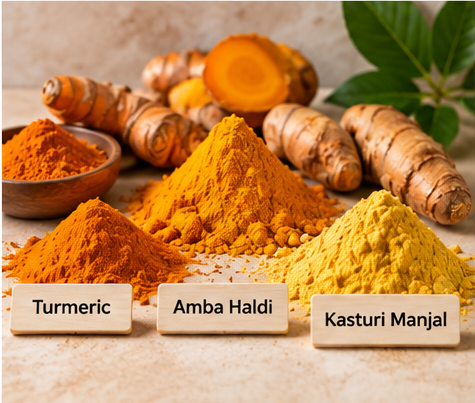
Turmeric, Amba Haldi and Kasturi Manjal are related ingredients used in traditional skincare, but an important practical difference is what happens to the skin after you use them.
Ordinary cooking turmeric can leave a strong yellow colour on the skin. Amba Haldi and Kasturi Manjal are useful alternatives when you want turmeric-associated skincare properties with less staining.
It is a simple example of an important cosmetic principle: an ingredient has to be evaluated not only for its intended benefit but also for the experience it creates.
Why Is Ordinary Turmeric Potentially a Problem in Ubtan?
Turmeric has a long association with Ubtan and traditional skincare.
But the turmeric you use for cooking can leave a noticeable yellow stain on the skin.
That may not be the experience somebody wants from a cosmetic product.
An ingredient can therefore make perfect sense from a traditional skincare perspective and still create a practical problem in the finished product.
This is particularly important when thinking about Ubtan as a product somebody will use regularly rather than only as a traditional preparation.
Where Do Amba Haldi and Kasturi Manjal Fit?
For the skincare purposes discussed here, Amba Haldi and Kasturi Manjal have similar intended roles.
One of the practical reasons for choosing these types over ordinary cooking turmeric is their lower tendency to leave an unpleasant yellow stain behind.
That difference matters particularly when you’re thinking about Ubtan as a cosmetic product rather than simply a homemade mixture.
Is Amba Haldi the Same as Kasturi Manjal?
For the purposes discussed in this Ubtan workshop, their intended skincare roles are similar.
The important practical point isn’t to treat all turmeric-associated ingredients as automatically interchangeable. It is to consider the experience you want from the finished Ubtan.
If reducing the yellow staining associated with ordinary cooking turmeric is important, Amba Haldi and Kasturi Manjal provide alternatives.
Ingredient Benefits Aren’t the Whole Story
When people choose natural skincare ingredients, they often focus almost entirely on what each ingredient is supposed to do for the skin.
But a well-designed product also needs to consider what happens while and after the consumer uses it.
Does it stain?
Is it pleasant to apply?
Does it rinse away properly?
How does the skin look immediately afterwards?
These practical characteristics are part of product performance too.
Choosing Turmeric for an Ubtan
The question therefore shouldn’t simply be:
“Is turmeric good for an Ubtan?”
A more useful question is:
“Which turmeric-associated ingredient gives me the skincare role and the consumer experience I want?”
Ordinary turmeric may bring the traditional association you are looking for, but its stronger staining has to be considered.
Amba Haldi and Kasturi Manjal offer alternatives where reducing that staining is important.
What This Teaches Us About Ubtan Formulation
The turmeric example illustrates a principle that applies to many ingredients used in Ubtan.
A cosmetic ingredient shouldn’t be judged only by the benefits associated with it.
You also need to consider how the finished product behaves during and after use.
An ingredient may have an attractive traditional or skincare role, but if it stains badly, is unpleasant to apply or doesn’t rinse away satisfactorily, those characteristics affect the quality of the finished product.
The best ingredient isn’t simply the one with the most attractive list of benefits. It also needs to work well in the experience of using the finished product.
Related Ubtan guides
→ How Do You Choose an Ubtan for Oily, Dry or Mature Skin?
→ What Is Ubtan and How Is It Used?
For a broader introduction to Ubtan ingredients, skin types, uses and formulation principles, read our main guide: Ubtan for Skin: Benefits, Ingredients & Choosing the Right One.