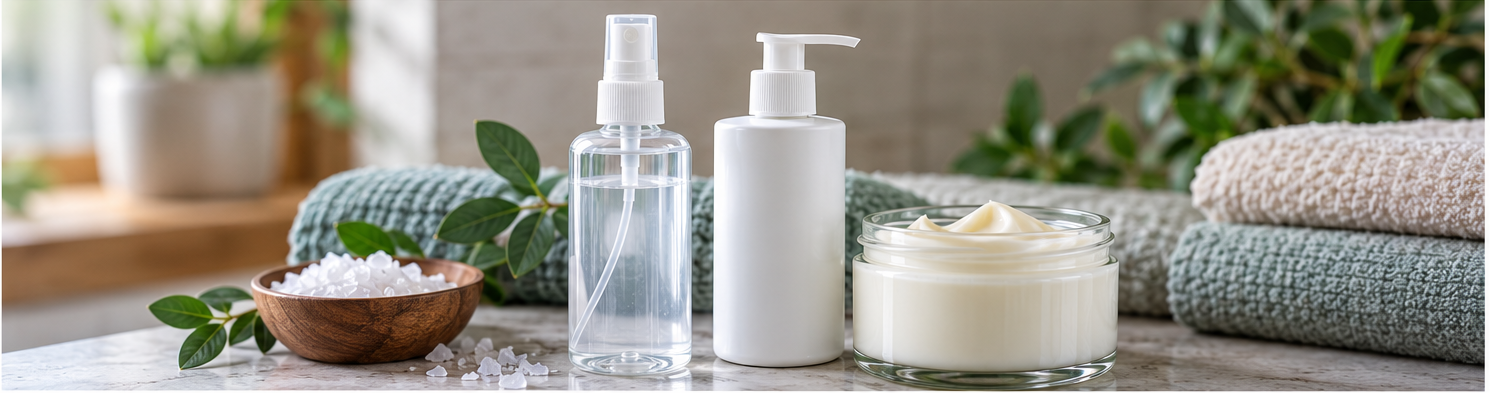
Magnesium body products can look surprisingly different from one another.
A magnesium oil can be a light, water-like spray containing no actual oil. A magnesium lotion can feel like an everyday moisturizer. A magnesium body butter can be thick, rich and designed particularly for very dry areas.
All three can be built around the same basic ingredient—magnesium chloride—but the experience of using them is completely different.
So rather than asking “Which magnesium product is best?”, it is more useful to understand what each format does, how it feels on the skin and where it fits into a body-care routine.
What Are Topical Magnesium Products?
Topical magnesium products are formulations containing a magnesium salt that are applied directly to the skin.
In this guide, we are looking specifically at three formats:
- Magnesium oil or spray — an extremely light, water-based product
- Magnesium body lotion — a lighter moisturizing emulsion
- Magnesium body butter — a much richer product for dry areas
Magnesium is an essential mineral involved in many functions in the body. Topical magnesium products are commonly used and marketed around experiences such as relaxation, tired muscles and general body care, particularly among active people.
In the Zestchest workshop, Soma discusses magnesium products in relation to runners, gym users, active children and others who regularly experience tired muscles. She also discusses their use as part of a relaxation or bedtime routine.
It is worth making an important distinction, however: applying magnesium to the skin should not be treated as equivalent to medically treating a magnesium deficiency, and evidence for significant magnesium absorption through healthy skin remains limited.
From a cosmetic-formulation perspective, what makes these products particularly interesting is how magnesium chloride can be incorporated into very different products—from an almost water-like spray to a rich body butter.
Magnesium Products Are Not Pain Balms
One of the most useful distinctions Soma makes in the workshop is between a magnesium body product and a pain-relief product.
Magnesium oil, lotion and body butter are not intended to behave like instant pain balms.
If somebody applies a magnesium spray to tired legs after exercise, the expectation should not be that it acts like an immediate painkiller.
Within the workshop, Soma instead teaches regular use as part of a routine and recommends evaluating the experience over roughly two to three weeks rather than after a single application.
This distinction becomes particularly important when marketing magnesium cosmetics. A body-care product can be positioned around relaxation, massage, moisturization or post-exercise routines without presenting it as a treatment for pain or a medical condition.
Magnesium Oil Isn’t Actually an Oil
The name magnesium oil is slightly misleading.
The version demonstrated in the workshop contains magnesium chloride dissolved in water. There is no actual oil in the basic formula.
So why call it an oil?
Because of what happens when you put it on your skin.
The freshly applied magnesium solution can feel surprisingly oily and make the skin look shiny. After several minutes, that sensation diminishes even though no conventional oil has been applied.
Because the product has approximately the consistency of water, a spray bottle is a particularly convenient format.
It can be sprayed over larger areas of the body or applied to specific areas such as:
- shoulders
- arms
- legs
- feet
It doesn’t require prolonged massage. Spray it on, rub it briefly over the area and allow it to remain on the skin.
For people who dislike creams and rich moisturizers, this can be the most convenient of the three formats.
Learn more: What Is Magnesium Oil and Why Is It Called an Oil?
When Should You Apply Magnesium Oil?
A particularly convenient time is after bathing.
You can spray it over the body when the skin is clean and simply leave it on.
Another option is to keep the spray near the bed and incorporate it into an evening body-care routine—for example, applying it to the feet or legs.
The important practical point is that there is little sense in applying a leave-on magnesium spray immediately before bathing and then washing it away. Soma’s workshop therefore recommends applying it at a time when it can remain on the skin.
Magnesium Oil vs Magnesium Lotion vs Magnesium Body Butter
The three products share the same broad magnesium theme, but they are designed to provide very different cosmetic experiences.
Magnesium Oil: For the Lightest Experience
Choose a magnesium spray when you want something extremely light.
It contains no added oil in the workshop formulation, so once the initial magnesium-related skin feel disappears, you don’t have the persistent richness associated with an actual body oil.
This can make it particularly appealing to someone who:
- dislikes creams and lotions
- doesn’t want a greasy finish
- wants something quick to apply
- wants to spray larger areas such as the legs
Magnesium Lotion: For Everyday Moisturizing
Magnesium lotion combines magnesium chloride with the familiar experience of a light moisturizer.
Compared with body butter, it contains far less oil and butter and is intended to absorb relatively quickly. The workshop formulation is designed for use over larger areas and can also be used as a moisturizer for the face or body.
That makes lotion perhaps the most versatile of the three formats.
It makes sense for someone who wants magnesium incorporated into a product that behaves much more like an everyday moisturizer.
Magnesium Body Butter: For Very Dry Areas
Body butter sits at the other end of the spectrum.
It is deliberately thick, rich and oily.
The workshop formula contains a substantial oil-and-butter phase, which is why it remains considerably richer on the skin than the lotion.
That richness can be particularly useful on areas such as:
- dry feet
- hands
- elbows
- knees
- other areas that need heavier moisturization
This also means a magnesium body butter can be positioned more specifically as a foot butter, hand butter or dry-area butter rather than simply as an all-over moisturizer. Soma discusses this positioning specifically for very dry and cracked-feeling feet.
And this has little to do with age.
A young person can have extremely dry feet while an older person may not. Choose the texture according to the condition of the skin, not simply the person’s age.
Compare them in detail: Magnesium Oil vs Lotion vs Body Butter: What’s the Difference?
Which Magnesium Product Should You Choose?
A simple way to think about the three is:
| If you want… | Consider… |
|---|---|
| Almost no greasiness | Magnesium oil/spray |
| Light everyday moisturization | Magnesium lotion |
| Rich moisturization for very dry areas | Magnesium body butter |
This is one of the most useful formulation lessons from the entire range.
The active concept doesn’t necessarily determine the product format.
Two customers can be interested in exactly the same ingredient but want completely different products. One may happily spray something onto their legs after a shower. Another wants a conventional lotion. Someone else loves applying a rich butter to dry feet before bed.
The formulation needs to fit the user, not merely the ingredient.
Why Is Magnesium Chloride Used?
There are several forms of magnesium salts.
Two discussed in the workshop are magnesium chloride and magnesium sulfate.
Magnesium sulfate is better known as Epsom salt and is commonly associated with baths and soaking products.
For the magnesium oil, lotion and butter formulations taught in the workshop, Soma uses magnesium chloride flakes.
There is also an important practical characteristic formulators need to know about magnesium chloride:
It is hygroscopic.
That means it readily attracts moisture from the surrounding environment.
Leave magnesium chloride flakes exposed and they can absorb moisture and become lumpy surprisingly quickly. Keep the raw material tightly sealed and dry.
Learn more: Magnesium Chloride vs Epsom Salt: What’s the Difference in Topical Products?
Why Is Magnesium Lotion Harder to Formulate Than It Looks?
At first glance, making magnesium lotion might seem straightforward:
Take a lotion formula and add magnesium chloride.
Unfortunately, formulation doesn’t necessarily work that way.
A lotion is an emulsion—a system in which oil and water are held together with the help of an emulsifier.
Magnesium chloride introduces a high concentration of salt into that system, and that can make the emulsion substantially more difficult to stabilize.
In Soma’s formulation trials, emulsifying systems that worked perfectly well for ordinary lotions could separate when a large quantity of magnesium chloride was introduced. The workshop therefore uses an emulsifier selected specifically for the thinner, high-salt lotion.
This leads to an important formulation principle:
A successful ordinary lotion formula isn’t automatically a successful magnesium lotion formula.
Learn more: Why Are Magnesium Lotions Difficult to Keep Stable?
A Cream That Looks Fine Today Can Still Separate Later
This is another important lesson for anyone developing products for sale.
An emulsion can look beautiful immediately after you make it and still be unstable.
Magnesium chloride isn’t oil-soluble, so a magnesium cream containing oils requires a water phase. Once oil and water are present, they need an appropriate emulsification system to keep them together.
A freshly made mixture may appear smooth and stable only to separate during storage.
Soma therefore emphasizes testing the product after storage, rather than deciding that an emulsion works simply because it looks good immediately after production.
This is particularly relevant when experimenting with ingredients such as beeswax or substituting one emulsifier for another.
Formulation isn’t simply about getting ingredients to mix once.
It’s about creating the intended texture, skin feel and stability over time.
Don’t Judge the Final Texture While the Product Is Still Fresh
Emulsified cosmetics can also change considerably as they cool and settle.
A freshly made magnesium body butter can look much softer than expected. That doesn’t necessarily mean the formula has failed.
During the workshop demonstration, the butter progressively thickens as it cools and continues developing its final texture over approximately the next 24 hours.
The lotion changes too, although it remains considerably lighter.
So when developing either product, don’t make immediate formulation changes simply because the freshly manufactured batch looks thinner than you expected.
Give the product time to reach its final texture before evaluating it.
Learn more: Why Can a Freshly Made Lotion or Body Butter Change Texture Later?
Can You Use More Than One Magnesium Product?
You can incorporate different formats into the same routine, but there is little practical reason to layer several high-magnesium products one immediately after another.
For example, someone might use:
After bathing: magnesium spray
Later in the day: magnesium lotion on dry skin
Before bed: magnesium body butter on particularly dry feet
The lotion and butter can also simply be reapplied whenever moisturization is needed.
Think of the products as different tools within a routine rather than three products that must be layered together.
Learn more: How Do You Choose the Right Magnesium Product for Your Skin and Routine?
What About Fragrance?
Fragrance doesn’t have to change the primary purpose of the formulation, but it can completely change the character of the product.
For products intended to create a relaxing body-care experience, the workshop discusses fragrances such as:
- lavender
- chamomile
- rose
- sage
But there is no rule saying magnesium products have to smell relaxing.
Lemon can create a fresher character. Peppermint can feel uplifting. Rosemary can give the product a more stimulating personality.
Think about fragrance almost like colour or packaging: it should support the experience you want the finished product to communicate.
There is one additional formulation consideration with magnesium oil.
A simple magnesium spray is water-based, while essential oils are not water-soluble. Adding essential oil directly can therefore leave it floating on the surface rather than uniformly dispersed through the product.
A fragrance-free magnesium spray is perfectly reasonable.
Common Questions About Magnesium Body Products
Is magnesium oil really an oil?
No. The magnesium oil formulation discussed here is primarily magnesium chloride dissolved in water. Its name comes from the temporarily oily sensation the solution creates on the skin.
What’s the difference between magnesium oil and magnesium lotion?
Magnesium oil is an extremely light water-based spray. Magnesium lotion contains an oil phase and behaves more like a conventional moisturizer.
What’s the difference between magnesium lotion and body butter?
The biggest practical difference is richness. Lotion is designed to be lighter and easier to spread over larger areas. Body butter contains considerably more oils and butter and is intended for areas needing heavier moisturization.
Is magnesium body butter only for mature skin?
No. Dryness is more relevant than age.
Someone of any age can have extremely dry hands, feet or elbows and prefer the richer texture of a butter.
Is magnesium sulfate the same as magnesium chloride?
No.
Magnesium sulfate is commonly known as Epsom salt. Magnesium chloride is the magnesium salt used in the spray, lotion and butter formulations discussed in this guide.
Can I make a magnesium cream simply with beeswax?
Don’t assume that beeswax alone will create a stable magnesium emulsion.
Once magnesium chloride, water and oils are combined, emulsification and long-term stability become important formulation considerations. A cream that looks successful immediately after manufacturing can still separate during storage.
Can magnesium lotion be used on the face?
The lotion taught in the workshop is designed with a light texture and Soma discusses it as suitable for facial as well as body moisturization, although she notes that the face doesn’t necessarily need the same magnesium concentration as a body product.
The Bigger Lesson: Choose the Experience, Not Just the Ingredient
Magnesium is what connects these three products, but it doesn’t tell you which one somebody will actually enjoy using.
A runner who hates creams may prefer a spray.
Someone looking for an everyday moisturizer may prefer a lotion.
Someone with extremely dry feet may love the richness of a body butter.
And that’s a principle that extends far beyond magnesium products.
A good formulation isn’t simply a collection of ingredients. It is a product designed around how, where and why somebody will actually use it.
The same broad concept can be delivered through completely different textures and application experiences.
The best product is often the one that fits naturally into someone’s routine, suits the condition of their skin and feels pleasant enough that they actually want to keep using it.
Explore all Magnesium Body Products guides →
Want to Make Your Own Magnesium Body Products?
Learn how to formulate Magnesium Oil, Magnesium Body Lotion and Magnesium Body Butter with tested formulations designed for their different textures and uses.
In the Zestchest Magnesium Body Products Course, you’ll learn not just the recipes, but the practical formulation techniques behind them—including working with high levels of magnesium chloride, choosing suitable emulsifiers, creating stable lotion and butter textures, manufacturing and scaling your batches, and selecting ingredients for different product concepts.
You’ll also get detailed course notes and supplier information, helping you move from learning the formulation to creating polished products of your own.