
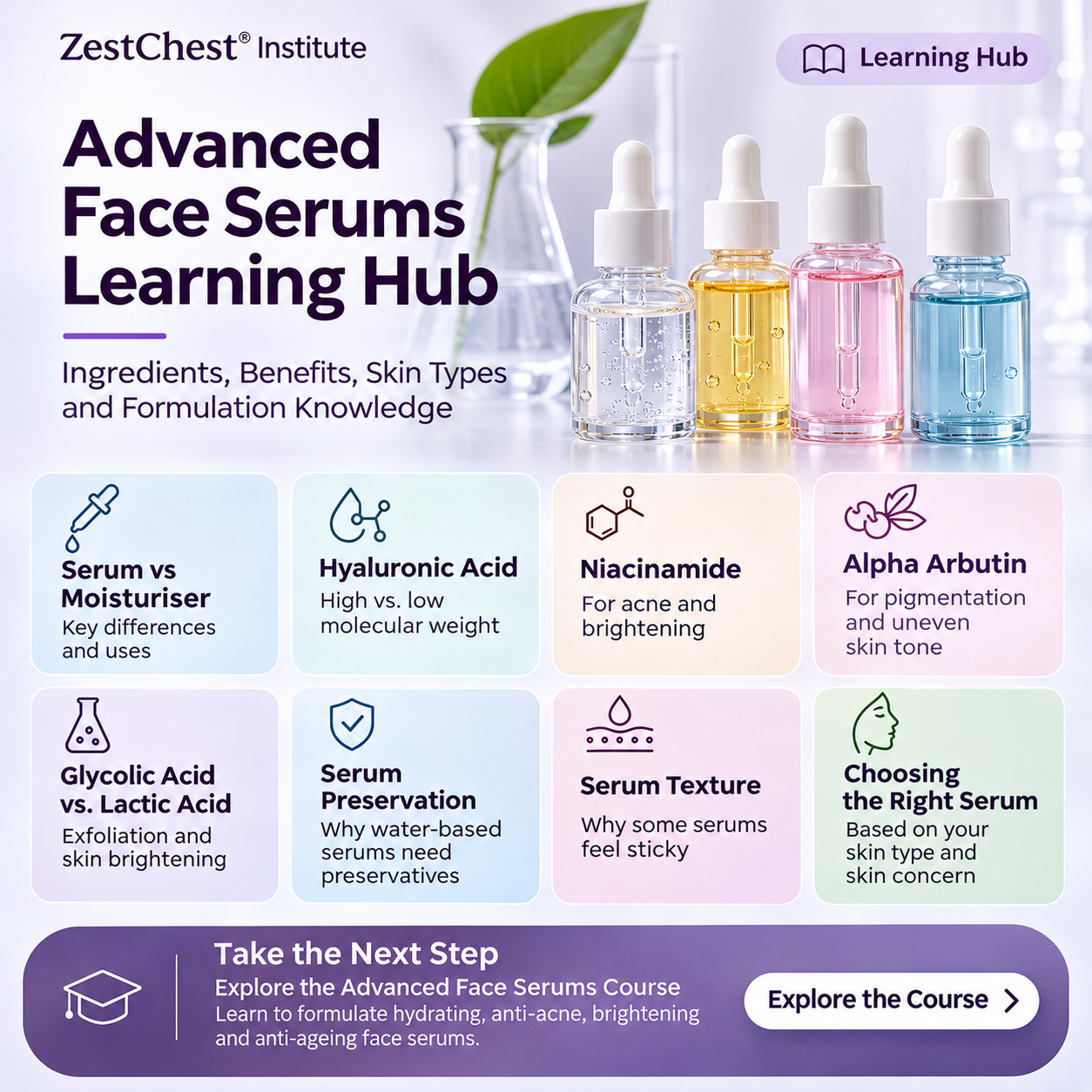
Face serums are lightweight skincare products developed to address specific concerns such as dryness, excess oiliness, acne, pigmentation, dullness and signs of ageing.
Unlike ordinary moisturisers, many serums focus on delivering selected active ingredients for particular skincare purposes.
But what makes one serum different from another? Why are ingredients such as niacinamide, hyaluronic acid and alpha arbutin used? And how do formulation choices influence texture, stability and product performance?
This learning hub brings together practical educational articles covering the ingredients, principles and common questions associated with facial serums.
Whether you are exploring skincare ingredients, selecting products for your skin or learning about cosmetic formulation, these articles will help you understand the important concepts behind face serums.
1. Understanding Face Serums
Before exploring individual ingredients, it is useful to understand what makes a serum different from other skincare products.
What Is the Difference Between a Face Serum and a Moisturiser?
Face serums and moisturisers serve different primary purposes. Moisturisers mainly focus on hydration and skin comfort, while serums are commonly developed to address particular concerns through selected active ingredients.
Learn how their textures, benefits and uses differ and why both product types have a place in skincare.
Read: What Is the Difference Between a Face Serum and a Moisturiser?
How Do You Choose the Right Serum for Your Skin Type?
Not every serum is suitable for every skincare concern.
A person with dry skin may need hydration, while someone with acne-prone skin may benefit from a product developed for breakouts. Pigmentation, dullness and fine lines require different considerations.
Understand how to identify your primary skin concern and select a serum according to its intended purpose.
Read: How Do You Choose the Right Serum for Your Skin Type?
2. Hydration and Moisturising Ingredients
Hydration is an important consideration when developing facial serums.
Different moisturising ingredients can influence how well a product retains moisture and how it feels during application.
High vs. Low Molecular Weight Hyaluronic Acid: What’s the Difference?
Hyaluronic acid is used in skincare for its moisture-retaining properties.
However, high and low molecular weight hyaluronic acid have different characteristics.
Learn why molecular size matters, how these forms are used for different hydration objectives and how hyaluronic acid contributes to the appearance of plumper skin.
Read: High vs. Low Molecular Weight Hyaluronic Acid
Why Do Some Face Serums Feel Sticky?
Two hydrating serums can feel completely different on the skin.
Ingredients such as glycerin and other humectants help retain moisture but may also influence the product’s texture and stickiness.
Understand why some serums leave a sticky sensation, why others feel lighter and why a thicker or stickier serum is not necessarily more moisturising.
Read: Why Do Some Face Serums Feel Sticky?
3. Acne, Pigmentation and Skin-Brightening Ingredients
Different active ingredients are selected for different skin concerns.
Some are associated with reducing breakouts, while others are used for pigmentation, tanning or improving uneven skin tone.
Why Is Niacinamide Used in Anti-Acne and Brightening Serums?
Niacinamide, also known as vitamin B3, is used in serums intended for acne-prone skin and uneven skin tone.
Learn why niacinamide is associated with reducing acne formation, improving the appearance of acne marks and addressing pigmentation-related concerns.
Read: Why Is Niacinamide Used in Anti-Acne and Brightening Serums?
What Is Alpha Arbutin and How Is It Used for Pigmentation?
Alpha arbutin is used in skincare products developed for pigmentation, tanning and uneven skin tone.
Discover its role in pigmentation-focused serums, how it differs from exfoliating ingredients and why it is often compared with niacinamide.
Read: What Is Alpha Arbutin and How Is It Used for Pigmentation?
4. Exfoliation and Skin Brightening
Dull-looking skin can be associated with accumulated dead skin cells.
Exfoliating ingredients are used in skincare to help remove these cells and improve the appearance of the skin’s surface.
Glycolic Acid vs. Lactic Acid: What’s the Difference?
Glycolic acid and lactic acid are both exfoliating ingredients used in skincare products.
Although they share similar purposes, they are associated with different sources and are selected according to the characteristics desired in a finished product.
Learn how these ingredients are used for exfoliation, dullness and brighter-looking skin.
Read: Glycolic Acid vs. Lactic Acid
5. Serum Stability, Preservation and Product Quality
A serum’s performance is not determined by its active ingredients alone.
The stability and preservation of the finished product are also important considerations, particularly for water-based skincare preparations.
Why Do Water-Based Face Serums Need Preservatives?
Water-based serums require appropriate preservation because microbial contamination can cause the product to spoil.
A serum may begin deteriorating before visible fungus or unpleasant odours appear.
Learn why preservatives are important, how product spoilage occurs and why appearance alone cannot confirm that a serum remains suitable for use.
Read: Why Do Water-Based Face Serums Need Preservatives?
6. Bringing the Concepts Together
Understanding face serums involves more than recognising popular active ingredients.
A useful approach is to consider three important questions:
- What is the skincare concern? Determine whether the priority is hydration, oiliness, acne, pigmentation, dullness or ageing-related changes.
- What is the intended function of the ingredient? Understand whether an ingredient is selected for moisture retention, exfoliation, acne care or pigmentation.
- How does the finished product behave? Consider texture, comfort during application, stability and preservation.
These distinctions help explain why serums with similar appearances may have very different purposes.
They also help prevent the common mistake of assuming that every popular skincare ingredient is suitable for every skin concern.
7. Learn More About Advanced Face Serum Formulation
Understanding ingredients and skincare principles is an important foundation for learning cosmetic formulation.
For those interested in developing facial serums, the Advanced Face Serums Course at ZestChest Institute covers serum formulation concepts and practical product development.
The course includes serum categories such as hydrating, anti-acne, brightening and anti-ageing preparations, along with ingredient selection and formulation considerations.
Explore the Advanced Face Serums Course
Final Thoughts
The most useful way to understand face serums is to connect the skin concern, the ingredient function and the characteristics of the finished product.
Knowing why an ingredient is used is just as important as knowing its name.
Explore the articles in this learning hub to build a clearer understanding of face serum ingredients, their applications and the principles that influence effective skincare products.

