
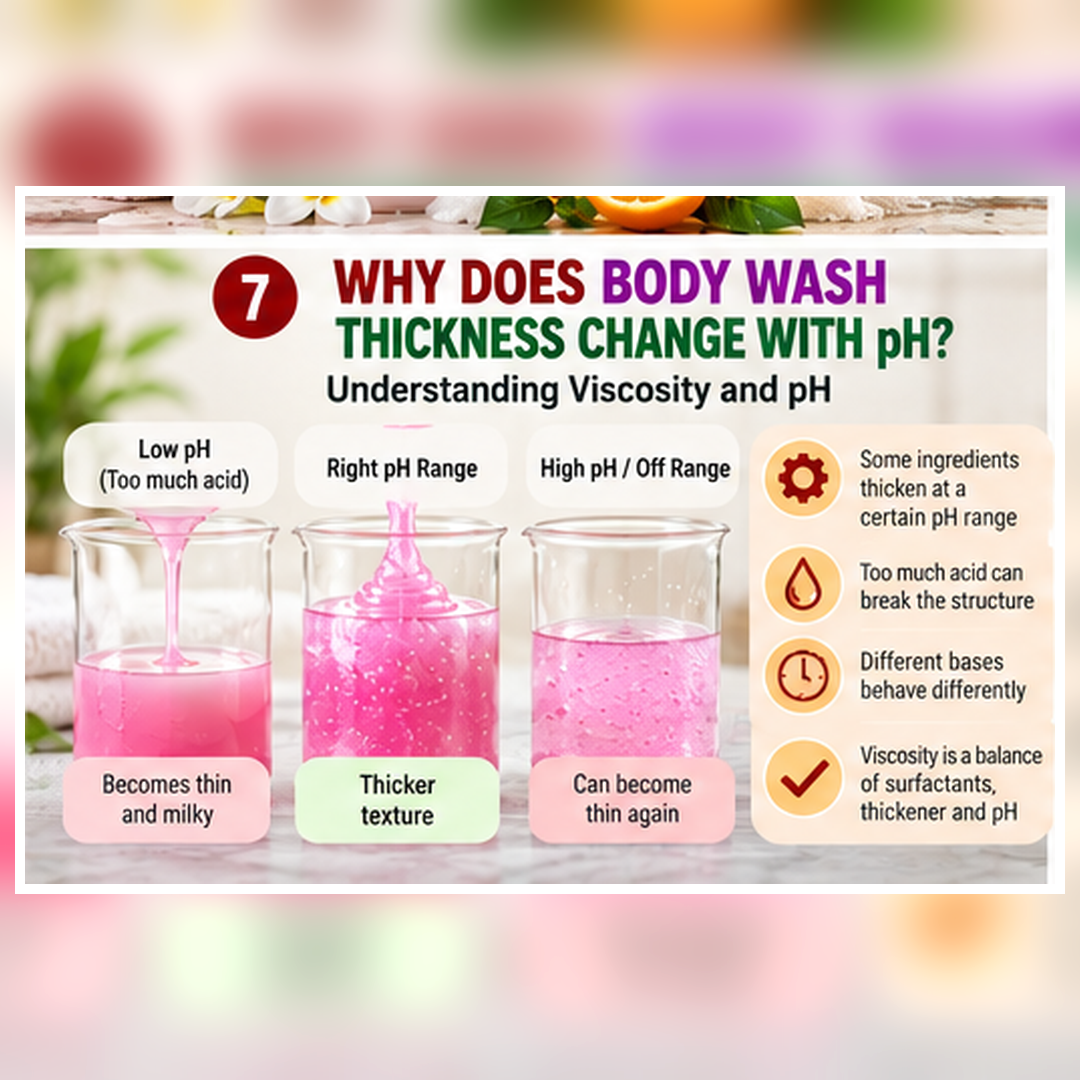
The thickness of some body-wash systems changes as the pH changes.
This is why a shower gel can look relatively thin at one stage, become thicker as the system approaches the desired condition, and then become thin again if the adjustment goes too far.
Why Does This Happen?
Some surfactant systems and thickening polymers behave differently depending on the pH of the surrounding product.
The final viscosity is therefore not determined only by how much thickener has been added.
The surfactant balance, thickening system and pH work together.
What Happened During the Workshop?
This became very clear during the live demonstration.
One product initially became thicker as its pH was adjusted.
In another demonstration, too much acidic adjustment was added.
The product that had been thick suddenly became watery and developed a milky appearance.
The lesson was useful precisely because it happened live.
Adding more of a pH-adjusting ingredient does not mean the body wash will continue becoming thicker.
After a certain point, the structure can begin to break down.
Why Shouldn’t You Chase Thickness With Acid?
Because pH adjustment is not simply a thickening trick.
The goal is to bring the complete product into the appropriate condition.
If you keep adding acid only because you want more viscosity, you can overshoot the useful range and lose the texture you were trying to create.
Does Every Body Wash Thicken in the Same Way?
No.
The workshop showed different thickening behaviour in different bases.
A creamy product develops its final texture partly as it cools.
A transparent surfactant system depends strongly on the surfactant balance and pH.
A suspending-bead system also depends on a polymer that takes time to develop its final structure.
The Practical Takeaway
Never assume a freshly mixed product has reached its final viscosity.
And never assume that more pH adjustment automatically means more thickness.
In some body-wash systems, viscosity is the result of balance rather than simply adding more thickener.