Perfume is more than a pleasant smell. It is part of how we present ourselves, how we feel when we dress up, and even how we associate particular aromas with moods, occasions and memories.
A fragrance can feel calming, fresh, joyful, warm or earthy. A bad smell can irritate us even when we were previously relaxed, while a pleasant aroma can make a room feel more comfortable.
This emotional connection is one reason perfume is such a personal product: the fragrance that feels beautiful to one person may not appeal to another.
Understanding perfumery therefore begins before formulation. It begins with three questions:
- What kind of experience should the fragrance create?
- How should it behave when worn?
- What type of perfume product is best suited to that purpose?
If you would like to explore individual perfumery concepts in more depth, visit our Perfume Learning Hub.
Why Fragrance Is So Personal
People do not all respond to the same fragrance in the same way. Some enjoy woody aromas such as sandalwood. Others are drawn to lemon, orange, mandarin or sweet lime because they experience them as lively and uplifting. Some prefer floral aromas such as rose, while others enjoy fresher minty or citrusy profiles.
This matters whether you are choosing a perfume for yourself or thinking about a fragrance as a product. A perfume should not be judged only by whether it smells “strong.” Its character matters just as much.
There is also a difference between wearing fragrance for other people and wearing it for yourself. A perfume does not always have to announce itself across a room. A more intimate fragrance may stay close to the body, allowing you to enjoy it for longer without projecting as far.
Essential Oils and Fragrance Oils Are Not the Same Thing
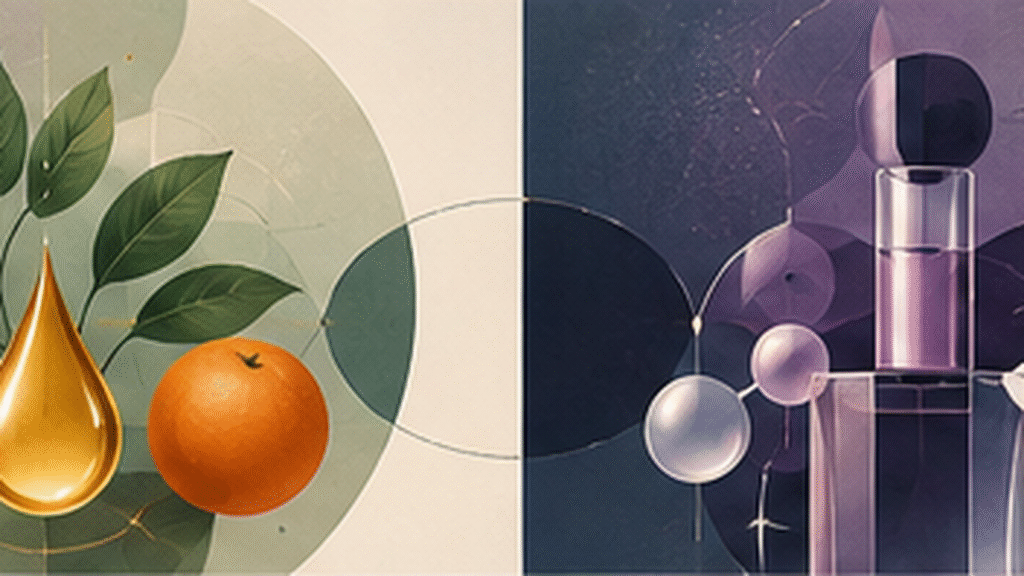
One of the first distinctions to understand is the difference between essential oils and fragrance oils.
Essential oils come from aromatic parts of plants. Depending on the plant, the aromatic material may come from flowers, leaves, roots or other parts. Rose, rosemary, mint and vetiver are examples.
The range of essential oils is naturally limited by the aromatic materials available from plants. This places some boundaries on the kinds of fragrances that can be created entirely from essential oils.
Fragrance oils offer a much broader palette. Aromatic chemicals can be combined to create or reproduce many kinds of smells, including fragrances that do not correspond directly to a single plant. This is why commercial fragrance creation can involve a far wider range of possible aromas.
For somebody who prefers mild, earthy or natural-feeling fragrances, essential-oil blends can be very attractive. They should not, however, be expected to behave exactly like a strong conventional fragrance oil.
Related guide: Essential Oils vs Fragrance Oils in Perfume: What Is the Difference?
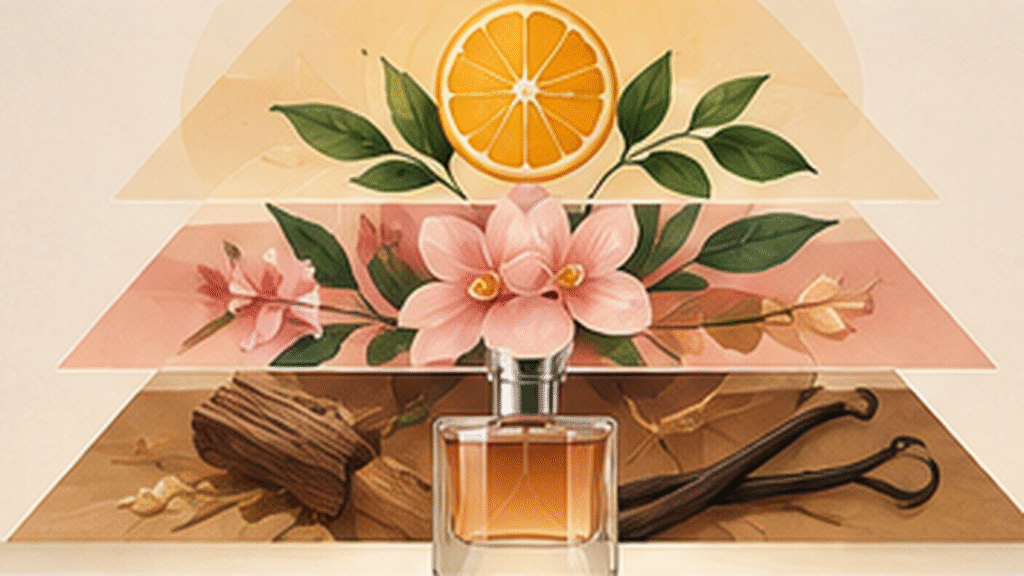
Understanding Top, Middle and Base Notes
A useful way to understand an essential-oil perfume is through top, middle and base notes.
Top Notes: The First Impression
Top notes are the fragrances you notice quickly. They give the perfume its immediate character and can create a fresh, lively first impression. Citrus and minty aromas are examples of the kind of fragrances that can play this role.
Their strength is immediacy. Their limitation is that they tend to disappear sooner.
Middle Notes: The Bridge
Middle notes sit between the fast first impression and the slower, longer-lasting base. They help give a fragrance body and continuity as the top notes begin to fade.
Some essential oils can sit near the boundary between categories. This is why an oil may sometimes be treated as both a top and middle note, or as both a middle and base note.
Base Notes: The Lingering Character
Base notes develop more slowly and remain noticeable for longer.
Sandalwood is a useful example. It may not strike the nose as sharply as a bright citrus aroma, but its fragrance can feel soothing and rewarding when experienced over time.
Vanilla, patchouli, vetiver and frankincense are other examples of long-lasting base-note materials.
A perfume built only around the first smell can therefore be misleading. What you smell immediately is not necessarily what you will smell later.
Related guide: Top, Middle and Base Notes in Perfume: What Is the Difference?
Why a Perfume Changes After It Is Made
One of the most important practical lessons in perfumery is that a freshly mixed perfume should not automatically be judged as the finished fragrance.
In an alcohol-based perfume, the initial smell may be dominated by alcohol. Even after some time has passed, the fragrance may still not represent its final character. A curing or resting period allows the fragrance to develop before the blend is judged properly, while longer aging can contribute to the character and longevity of premium perfumes.
This helps explain why an experienced perfume maker does not simply mix, smell once and make a final decision.
Consider the analogy of aged wine or whisky: time itself becomes part of the product. In perfumery, the fragrance blend has time to sit together and develop before it reaches the customer.
The practical lesson is simple: do not be too quick to reject or approve a perfume based only on the smell immediately after preparation.
Related guide: Why Does Perfume Smell Different After It Has Rested?
Fragrance Throw: Why Some Perfumes Fill a Room and Others Stay Close
Different perfume formats behave very differently in the air.
“Fragrance throw” describes how effectively the smell travels away from the wearer.
Alcohol evaporates readily. In an alcohol-based spray perfume, the evaporating alcohol helps carry fragrance into the surrounding air. This is why somebody wearing a strong alcohol-based fragrance may enter a room and be noticed almost immediately by smell.
Water behaves differently. A water-based perfume can still spread fragrance, but the effect is slower because the water does not evaporate as quickly as alcohol.
Oil-based roll-ons and solid perfumes are different again. Their bases do not readily evaporate, so they do not carry fragrance across a room in the same way. Someone standing close to you may notice the perfume, but someone at the opposite end of the room may not.
This is not necessarily a disadvantage. It is a different style of perfume.
Related guide: What Is Fragrance Throw and Why Do Some Perfumes Fill a Room?
Alcohol-Based Spray Perfume: Fast Projection
The defining experience of an alcohol-based spray perfume is rapid fragrance throw.
It is useful when you want the perfume to project beyond the body rather than remain very close to the wearer. The alcohol evaporates and helps distribute the fragrance through the air.
The trade-off is that the same evaporation that creates strong projection also means the perfume can disappear sooner than a non-evaporating solid or oil-based format.
Different alcohols also behave differently, and the choice of alcohol and intended skin contact matter. Perfume products should therefore be used according to how they were designed rather than assuming every spray perfume is intended for direct application to skin.
Water-Based Perfume: Gentler Throw, Slower Movement
A water-based perfume behaves more quietly.
Because water evaporates slowly, the fragrance does not move through a room as rapidly as it does with an alcohol-based perfume. It may take longer before other people notice it.
That can be useful when the aim is not maximum projection. The important point is to set the right expectation: changing the base changes the sensory performance of the product.
A water-based perfume should not simply be evaluated as a weaker version of an alcohol perfume. It is a different format with a different fragrance-release pattern.
Solid Perfume: Intimate Fragrance That Stays With the Wearer
Solid perfume is closer to a balm than to a conventional spray. This style of perfume is based on oils and waxes rather than alcohol.
Because the base does not evaporate rapidly, the fragrance tends to remain close to the wearer. It does not have the same ability to fill a room, but it can remain noticeable to the person wearing it for longer.
Solid perfume is applied directly to the skin rather than to clothing.
This creates an important distinction:
- A spray perfume can project strongly and travel farther.
- A solid perfume stays more intimate and close to the body.
- A roll-on perfume behaves similarly in the sense that its oil base does not evaporate like alcohol.
Choosing between them is therefore not simply a question of which is “better.” It depends on whether you want projection, intimacy or a particular style of application.
Related guide: Solid Perfume vs Spray Perfume: What Is the Difference?
Why Pulse Points Matter for Solid and Roll-On Perfumes
Solid and roll-on perfumes can be applied at pulse points.
Pulse points are areas where body temperature is relatively higher, such as the wrist area and behind the ears. The warmth helps the fragrance become more noticeable even though the perfume base itself is not rapidly evaporating.
This is especially useful for formats that naturally stay close to the skin.
Related guide: Why Are Pulse Points Used for Solid and Roll-On Perfume?
Perfume, Eau de Parfum and Eau de Cologne: What Changes?
Commercial perfumes appear under different names, including perfume, eau de parfum and eau de cologne. These categories differ in the balance of fragrance, alcohol and water.
Rather than focusing only on exact percentages, the useful consumer principle is that changing this balance changes strength, evaporation, skin feel and how the product is intended to be used.
A stronger perfume designed primarily for clothing is not the same experience as a lighter product intended for closer or more direct use. Eau de cologne and splash-style products can also be used differently.
When buying a fragrance, do not look only at the name on the bottle. Think about how you want to use it and whether you want a strong projected perfume or something lighter and closer to the skin.
Related guide: Perfume, Eau de Parfum and Eau de Cologne: What Is the Difference?
What Makes a Fragrance Last Longer?
Longevity is not controlled by one single factor.
The Fragrance Materials Themselves Matter
Top-note materials naturally create a quicker impression and tend to fade sooner, while base-note materials provide a slower and longer-lasting character.
A well-considered fragrance therefore needs to think about what happens over time, not only what smells impressive in the first few seconds.
The Product Base Matters
A highly evaporative base creates projection but can also disappear more quickly. An oil or solid base does not travel as far, but it can remain on the wearer for longer.
Aging Matters
Resting and aging matter too. A perfume that has been allowed to mature can behave differently from one that has just been mixed.
Fixatives Can Matter
Fixatives are used to help perfume last longer. Different fixing materials may be considered depending on the product, and some commercial fixing materials are not considered suitable for direct skin use.
The important point is not to assume that “long lasting” automatically means “better for skin.” Performance and intended use have to be considered together.
Light Can Affect Fragrance, So Packaging Matters
Perfume is not only about what goes inside the bottle. The bottle itself can help protect the fragrance.
Light can affect fragrance materials over time. Packaging that reduces light exposure—such as thick, designed or frosted glass—can help protect the perfume.
This is a useful buying consideration as well. A perfume bottle is not necessarily decorative only; packaging can also have a protective role.
Colour Is Mainly Aesthetic
Perfume can be coloured, but colour is not what creates its fragrance performance.
Colour is an optional aesthetic element, and different types of colour systems are appropriate for oil-based products and for water- or alcohol-based products.
For the consumer, this is a useful reminder not to judge perfume quality by how dramatic the liquid looks. Colour and fragrance performance are separate considerations.
Why Expensive Perfume Can Cost So Much More
The raw materials alone do not explain every difference in perfume pricing.
A major part of the value of an original designer fragrance can be the work required to create a smell that is distinctive. Fragrance-development teams may experiment with blends over long periods, test them with many people and refine them before launch.
This is very different from buying a ready-made fragrance oil that already imitates a known smell and placing it into a perfume base.
A useful analogy is a familiar food seasoning whose exact taste is difficult to reproduce. The individual ingredients may not be impossibly expensive, but creating a distinctive combination that people recognize and want can be valuable in itself.
This is also why a duplicate fragrance and an original fragrance should not be viewed only through the cost of the liquid in the bottle. The original may carry the cost of developing the fragrance identity in the first place.
Related guide: Why Are Some Perfumes Much More Expensive Than Others?
Stronger Is Not Always Better
A common mistake is to equate more fragrance with better perfume.
Perfume strength is a design choice. A very strong fragrance may project farther, but that does not automatically make it more refined, more pleasant or more appropriate for the skin.
Some people prefer mild, classy, earthy fragrances. Others enjoy stronger scents. The right choice depends on the intended experience.
Before deciding that a perfume is “too weak,” ask a better question:
Is this product intended to fill a room, or is it meant to remain close to the wearer?
Solid Deodorant and Perfume Are Not the Same Product
Although both may be solid and fragranced, a solid deodorant has a different purpose from a solid perfume.
Perfume is primarily about fragrance. Deodorant is intended to address body odour while also providing a pleasant smell.
A fragranced solid product should therefore not automatically be assumed to be a deodorant. Its purpose depends on what the product was designed to do.
Common Perfume Mistakes
Several practical mistakes become easier to avoid once you understand how perfume behaves.
Judging a fresh alcohol perfume immediately. The initial alcohol smell does not necessarily represent the final fragrance after resting.
Expecting a solid perfume to fill a room. A solid base does not evaporate like alcohol. Its strength is intimacy and staying close to the wearer.
Assuming maximum strength is always desirable. A perfume can be deliberately mild, earthy or personal.
Treating every perfume format as interchangeable. Spray, water-based, roll-on and solid perfumes behave differently and may be intended for different kinds of application.
Ignoring packaging. Light exposure can affect fragrance, so the container has a role beyond appearance.
Designing only for the first smell. Top notes are only one part of the experience. The fragrance that remains later matters too.
Common Questions About Perfume
Can an Essential-Oil Perfume Smell as Strong as a Conventional Fragrance-Oil Perfume?
Essential-oil perfumes can be beautiful, especially when the aim is a mild, earthy or classy fragrance. But the range of available essential oils is limited, and they should not automatically be expected to produce the same kind of loud fragrance as conventional fragrance oils.
For a deeper comparison, see Essential Oils vs Fragrance Oils in Perfume.
Why Does My Solid Perfume Not Project Like a Spray Perfume?
That is a characteristic of the format. A solid perfume base does not evaporate and carry fragrance through the air the way alcohol does. It is designed to stay closer to the wearer.
Read Solid Perfume vs Spray Perfume and What Is Fragrance Throw? for the two concepts in more detail.
Where Should Solid or Roll-On Perfume Be Applied?
Pulse points such as the wrist area and behind the ears can be useful because body warmth helps activate the fragrance.
See Why Are Pulse Points Used for Solid and Roll-On Perfume? for a fuller explanation.
Does Perfume Smell the Same Immediately After It Is Prepared?
No. Freshly prepared perfume needs time before its final character can be judged, particularly with alcohol-based perfume.
Read Why Does Perfume Smell Different After It Has Rested?.
Does a Long-Lasting Perfume Necessarily Need to Be Very Strong?
No. Longevity and immediate strength are not the same thing. Base notes, the perfume format, aging and the way fragrance is released all influence how long the perfume remains noticeable.
Why Do Some Premium Perfumes Cost Far More Than Inexpensive Duplicates?
One reason is fragrance development. Creating a distinctive original smell can involve prolonged experimentation, testing and refinement. A duplicate begins with an existing successful fragrance to imitate, so the creative development effort is different.
Read Why Are Some Perfumes Much More Expensive Than Others? for a deeper look at this distinction.
Learning to Make Perfumery Products
Understanding why perfume behaves the way it does is different from learning the complete formulation and manufacturing process.
If you want to explore the concepts further, including our focused articles on fragrance notes, perfume formats, fragrance throw, essential oils and fragrance development, visit the Zestchest Perfume Learning Hub.
For structured practical instruction in making perfumery products, including the formulations and manufacturing methods taught in the workshop, explore the Zestchest Perfumery Products Making Course.
The Most Useful Way to Think About Perfume
The easiest mistake in perfumery is to reduce everything to one question:
“How do I make the fragrance stronger?”
A better approach is to think about the complete experience.
Do you want the fragrance to arrive quickly or reveal itself slowly? Should it travel across a room or stay close to the body? Do you enjoy bright top notes or the slower character of woody and earthy base notes? Will the perfume be worn on clothing or directly on the skin? Do you want a conventional spray, a water-based fragrance, a roll-on or a solid perfume?
Once these differences are understood, perfume becomes much easier to evaluate.
Strength, longevity, fragrance throw and intimacy are not the same quality. Each format makes different trade-offs, and a good perfume is one whose behaviour matches the experience it was designed to create.