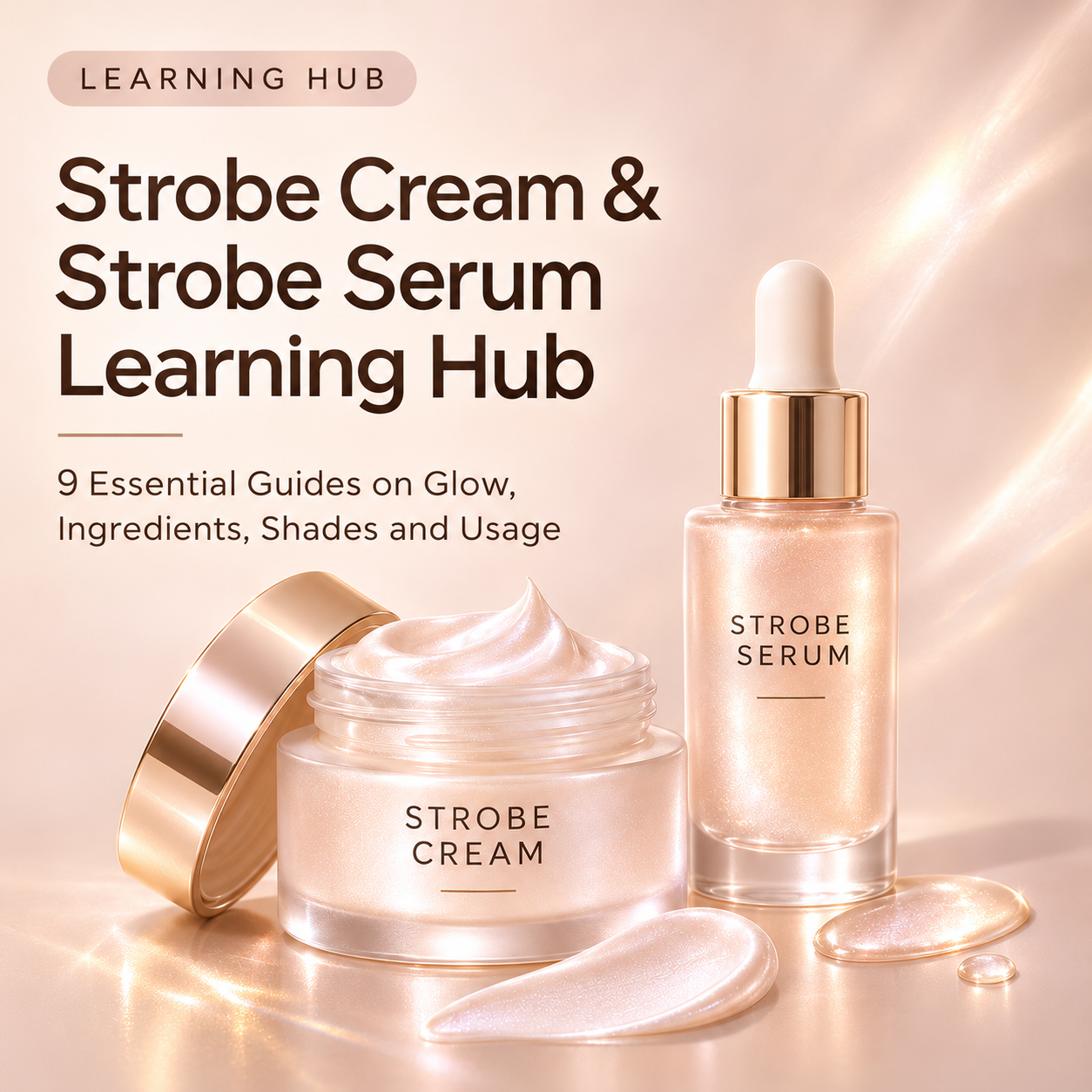
Strobe creams and strobe serums combine the luminous finish of makeup with the benefits of skincare ingredients. They are designed to create an instant, light-reflecting glow while also providing moisturising and skin-conditioning benefits.
But how does a strobe cream actually work? What makes it different from a strobe serum? Why is mica used instead of glitter, and how do you choose the right shade for your skin tone?
This Strobe Cream & Strobe Serum Learning Hub brings together nine educational guides covering the most important questions about these products.
Whether you are exploring strobe products for personal use, learning about cosmetic ingredients or interested in skincare formulation, these articles will help you understand the science and practical concepts behind luminous skincare products.
1. What Is a Strobe Cream and How Does It Create a Glass-Skin Glow?
Strobe cream is a skincare and makeup product designed to give the skin an instant luminous appearance.
Its characteristic glass-skin glow comes from light-reflecting ingredients that make the skin appear brighter when exposed to light.
Understand what strobe cream is, how its reflective finish works and why it is different from an ordinary moisturiser.
Read Article: What Is a Strobe Cream and How Does It Create a Glass-Skin Glow?
2. Strobe Cream vs Strobe Serum: What Is the Difference?
Strobe creams and strobe serums serve similar purposes, but they differ in texture and application experience.
Creams generally offer a creamy or lotion-like consistency, while serums provide a different, often lighter application feel.
Learn how these two products compare, whether you need both and how to choose the right format for your skincare routine.
Read Article: Strobe Cream vs Strobe Serum: What Is the Difference?
3. Why Is Mica Used in Strobe Cream Instead of Glitter?
Mica is one of the key ingredients responsible for the luminous effect of strobe products.
Unlike obvious glitter particles, fine mica helps create a softer, more refined light-reflecting finish.
Discover how mica works, why lighting affects its appearance and what makes it suitable for creating a glass-skin effect.
Read Article: Why Is Mica Used in Strobe Cream Instead of Glitter?
4. Which Strobe Cream Shade Should You Choose for Your Skin Tone?
Strobe creams are available in different reflective shades, including rose, champagne, gold and bronze.
Each shade creates a slightly different appearance depending on the natural complexion and the desired glow.
Explore how different mica colours complement fair, medium and deeper skin tones and how to select a natural-looking finish.
Read Article: Which Strobe Cream Shade Should You Choose for Your Skin Tone?
5. What Is the Difference Between Instant Glow and Skin Brightening in a Strobe Cream?
Instant glow and skin brightening are often confused, but they are not the same.
The immediate glow of a strobe cream comes from light reflection, while ingredients such as niacinamide and alpha-arbutin are included for their intended skin-brightening benefits.
Understand the difference between a temporary cosmetic effect and skincare ingredients intended to address concerns such as uneven pigmentation.
Read Article: What Is the Difference Between Instant Glow and Skin Brightening in a Strobe Cream?
6. Why Do Lightweight Emollients Matter in a Strobe Cream?
A glowing finish does not necessarily mean the skin should feel oily or greasy.
Lightweight emollients help provide moisturisation while maintaining a smooth, comfortable skin feel.
Learn why ingredients such as caprylic/capric triglyceride (CCTG) and olive squalene are discussed in strobe cream formulation and how they differ from heavier oils.
Read Article: Why Do Lightweight Emollients Matter in a Strobe Cream?
7. Can You Use Strobe Cream Every Day or at Night?
Strobe creams can be used for everyday cosmetic wear and evening occasions.
However, the reflective effect depends on light, which makes it less relevant when using a skincare product purely for moisturisation before sleeping.
Learn when strobe cream is useful, how its appearance changes under different lighting conditions and whether you need a reflective finish at night.
Read Article: Can You Use Strobe Cream Every Day or at Night?
8. Should Strobe Cream Go Before or After Sunscreen?
The order of skincare and makeup products can affect their final appearance.
Strobe cream is generally preferred as a finishing cosmetic product when the goal is to preserve its luminous, light-reflecting effect.
Explore how sunscreen texture can influence the visible glow, why mattifying products may change the finish and why strobe cream should not replace tested sun protection.
Read Article: Should Strobe Cream Go Before or After Sunscreen?
9. Tinted Strobe Cream vs Regular Strobe Cream: What Is the Difference?
Regular strobe cream primarily creates luminosity through light reflection.
Tinted strobe cream combines that reflective finish with cosmetic colour pigments that can provide some visible coverage.
Understand how these products differ, why mica alone does not provide foundation-like coverage and which option better suits your preferred makeup appearance.
Read Article: Tinted Strobe Cream vs Regular Strobe Cream: What Is the Difference?
Explore Strobe Cream and Strobe Serum Formulation
Understanding strobe products involves more than recognising their visible glow.
Their performance also depends on ingredient selection, moisturising properties, texture, colour, product consistency and the difference between cosmetic appearance and skincare functionality.
For those interested in learning the practical formulation of these products, the ZestChest Strobe Cream & Strobe Serum Course covers formulation concepts and hands-on preparation.
Explore the Strobe Cream & Strobe Serum Course
Final Thoughts
Strobe creams and serums are examples of how skincare and makeup functions can be combined within a single product.
The most important distinction is between the immediate glow produced by light-reflecting ingredients and the intended skincare benefits of moisturising and brightening actives.
Understanding this difference, along with the role of texture, shade and application, makes it easier to select a strobe product that suits your preferences.
Use the nine guides in this learning hub to explore each concept in greater detail.