Body wash may look like a simple cleansing product, but its texture, foam, clarity, ingredients and overall performance depend on several different formulation principles.
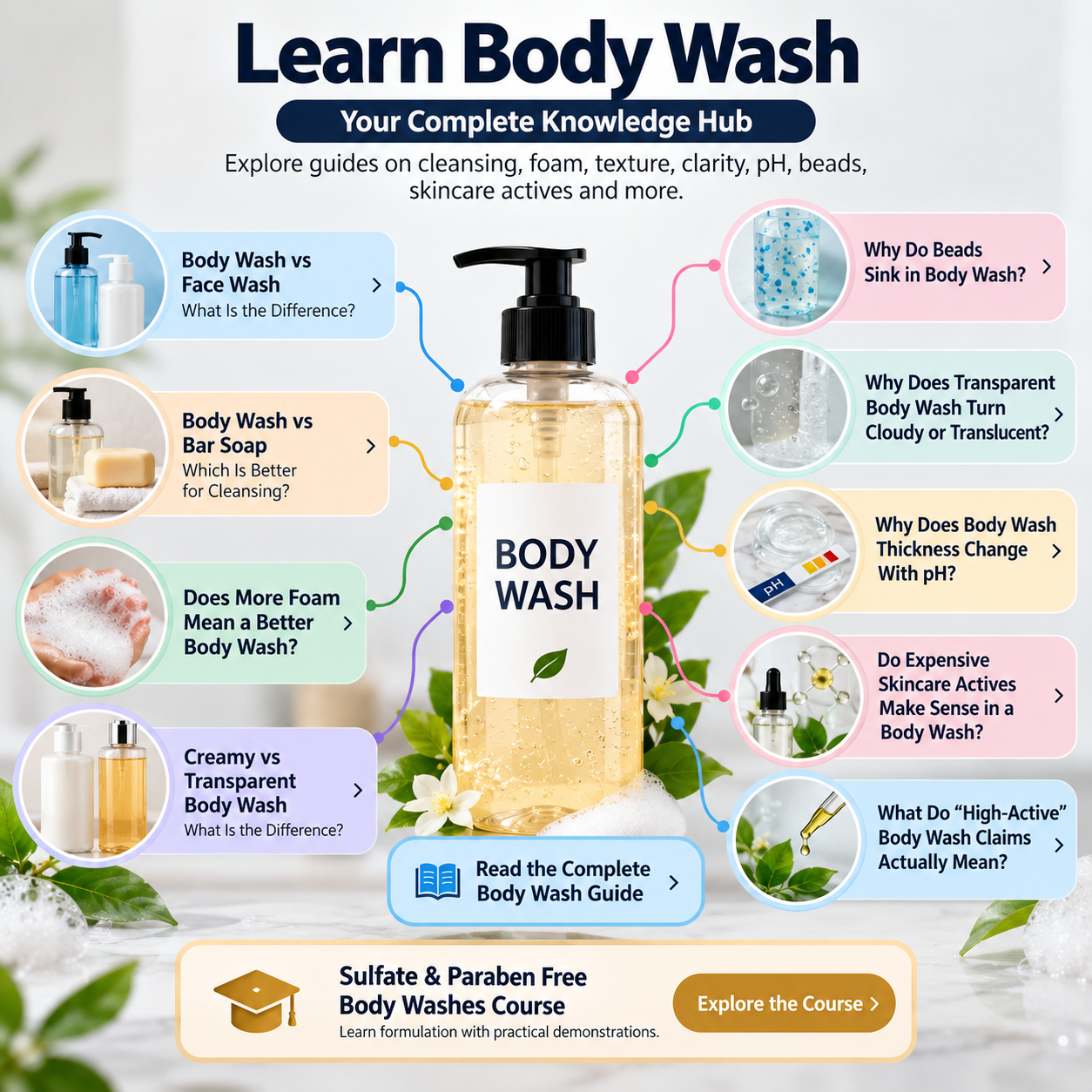
This Body Wash Learning Hub brings together our educational guides on body wash, including how it differs from face wash and bar soap, what creates foam, why some body washes are creamy while others are transparent, why beads may sink, how pH affects thickness and how skincare actives are used in rinse-off products.
Use the guides below to explore each topic individually.
Start With the Main Body Wash Guide
If you are new to body wash formulation and want to understand the subject as a whole, begin with our main guide.
Read the Complete Body Wash Guide
The main guide introduces the key concepts behind different body-wash styles, cleansing systems, texture, ingredients, actives and common formulation observations.
Body Wash vs Face Wash: What Is the Difference?
Body wash and face wash may both be liquid cleansers, but they are designed for different cleansing requirements.
Facial cleansing generally needs to be milder, while body wash is designed to handle the cleansing needs of skin that remains covered by clothing and may accumulate sweat, oil and dirt.
Read: Body Wash vs Face Wash – What Is the Difference?
Body Wash vs Bar Soap: Which Is Better for Cleansing?
Body wash is not automatically better than bar soap, and bar soap is not automatically better than body wash.
The formulation, cleansing system and personal preference all influence the experience.
This guide explains why both formats can cleanse effectively and why the individual product matters more than whether it comes as a liquid or a bar.
Read: Body Wash vs Bar Soap – Which Is Better for Cleansing?
Does More Foam Mean a Better Body Wash?
A large amount of foam can make a body wash feel luxurious, but more bubbles do not automatically mean stronger or better cleansing.
This guide explains the difference between lather and cleansing performance and why surfactant combinations can create rich foam without simply increasing cleansing strength.
Read: Does More Foam Mean a Better Body Wash?
Creamy vs Transparent Body Wash: What Is the Difference?
Body wash can be created in very different visual and textural styles.
A creamy body wash provides a richer, more lotion-like appearance, while a transparent body wash is designed around clarity.
The ingredients selected for each type must support the intended appearance and texture.
Read: Creamy vs Transparent Body Wash – What Is the Difference?
Why Do Beads Sink in Body Wash?
One of the most common misunderstandings in bead-containing shower gels is assuming that a very thick product will automatically keep beads suspended.
Thickness and suspension are not the same thing.
This guide explains why beads can settle even in a thick body wash and why a suspending product requires a different internal structure.
Read: Why Do Beads Sink in Body Wash?
Why Does Transparent Body Wash Turn Cloudy or Translucent?
A body wash may begin as a clear product but lose some of its transparency after certain ingredients are added.
Fragrance type, essential oils and coloured herbal extracts can all influence the final appearance.
This does not automatically mean that the product has failed.
Read: Why Does Transparent Body Wash Turn Cloudy or Translucent?
Why Does Body Wash Thickness Change With pH?
Body-wash viscosity is not always controlled simply by adding more thickener.
In some systems, pH also influences how the product develops its final thickness.
The body wash may become thicker during adjustment but can become thin again when that balance is pushed too far.
Read: Why Does Body Wash Thickness Change With pH?
Do Expensive Skincare Actives Make Sense in a Body Wash?
Body wash is a rinse-off product.
That means expensive skincare ingredients should be considered differently from ingredients used in leave-on products such as serums and creams.
This guide discusses the practical thinking behind ingredients such as hyaluronic acid, niacinamide and alpha arbutin in body wash.
Read: Do Expensive Skincare Actives Make Sense in a Body Wash?
What Do “High-Active” Body Wash Claims Actually Mean?
A high-active body wash does not necessarily contain a very large quantity of one ingredient.
A product may contain several botanical extracts, skincare ingredients and highlighted actives that together contribute to its overall active story.
Understanding this distinction makes it easier to interpret ingredient and marketing claims.
Read: What Do “High-Active” Body Wash Claims Actually Mean?
Explore Body Wash by Topic
If you are trying to understand cleansing, start with:
Does More Foam Mean a Better Body Wash?
If you are interested in appearance and texture, read:
Creamy vs Transparent Body Wash
Why Transparent Body Wash Turns Cloudy
Why Body Wash Thickness Changes With pH
If you want to understand skincare actives in body wash, continue with:
Do Expensive Skincare Actives Make Sense in a Body Wash?
What Do High-Active Body Wash Claims Actually Mean?
Learn Body Wash Formulation
These Knowledge Articles are designed to explain individual concepts and answer common body-wash questions.
If you want structured training on creating different types of body washes, including practical formulation demonstrations, you can explore the complete course.
Sulfate & Paraben Free Body Washes Course
Understanding body wash becomes much easier when cleansing, foam, texture, clarity and skincare actives are treated as separate formulation decisions rather than assuming that one ingredient or one characteristic determines the entire product.
Use this hub whenever you want to explore a particular body-wash question in more detail.