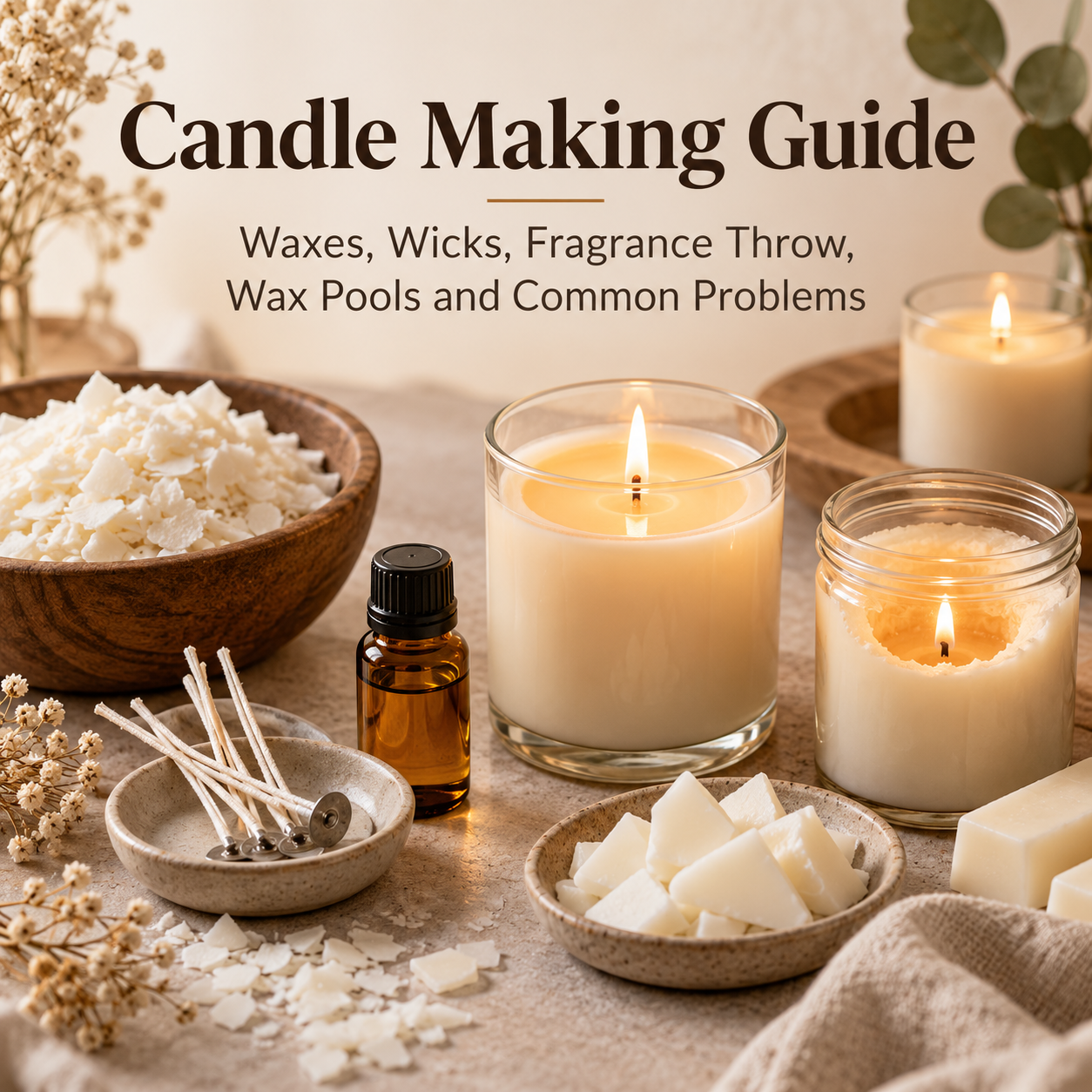
Candle making may look simple, but a good candle depends on much more than melting wax and pouring it into a container.
The type of wax, wick size, number of wicks, candle width, wax-pool formation and fragrance performance all affect how the finished candle burns.
A candle can look beautiful before lighting and still perform poorly if the wick is unsuitable, the centre begins tunnelling or the candle fails to develop a proper wax pool.
This learning hub brings together our candle-making guides so you can understand the most important concepts behind how candles burn and how common candle problems develop.
Start With Candle Making Fundamentals
If you are completely new to candle making, first understand the relationship between the wick, flame and melted wax.
The wick creates the flame. The flame melts the wax around it. The amount of wax that melts affects how the candle burns and, in scented candles, how the fragrance spreads.
This relationship explains many common candle-making problems.
Why Does a Candle Tunnel in the Centre?
Candle tunnelling happens when the centre of the candle continues to melt while wax around the sides remains solid.
Over repeated burns, the centre becomes deeper and deeper, creating a hollow or tunnel around the wick.
This is often connected to the relationship between candle width, wick size and the amount of surface wax being melted.
Read the guide:
Why Does a Candle Tunnel in the Centre?
Cold Throw vs Hot Throw in Candles
Cold throw and hot throw describe two different ways we experience fragrance from a candle.
Cold throw is the fragrance you smell from the candle while it is unlit.
Hot throw is the fragrance experienced after the candle is burning and the wax begins developing a melted pool around the wick.
Understanding this difference is important when evaluating a scented candle because smelling the candle while it is unlit does not tell you everything about how it will perform during burning.
Read the guide:
Cold Throw vs Hot Throw in Candles
Why Does Wick Size Matter in Candle Making?
The wick controls the flame, and the flame controls how much wax melts around it.
A wick that is too small for a wide candle may melt only the centre, while an unsuitable larger wick may create more heat than required.
This is why the same wick cannot simply be used for every candle.
The width of the candle and the amount of wax that needs to melt should be considered when choosing a wick.
Read the guide:
Why Does Wick Size Matter in Candle Making?
How Many Wicks Does a Candle Need?
Small candles may work with a single wick, while broader candles can require more than one wick to create sufficient melt-pool coverage.
Each wick creates its own melted area.
When multiple wicks are positioned appropriately, these melted areas can eventually merge and help the candle melt more evenly across the surface.
Wick count should therefore be decided according to the candle rather than chosen simply for appearance.
Read the guide:
How Many Wicks Does a Candle Need?
Why Does a Candle Need a Proper Wax Pool?
A wax pool is the layer of melted wax that develops around the wick while the candle burns.
For scented candles, wax-pool formation is closely connected with fragrance performance.
If only a very small area around the wick melts, the candle may produce a weaker fragrance throw and may also begin burning downward through the centre.
A wider candle generally takes longer to develop its melted surface than a narrow candle.
Read the guide:
Why Does a Candle Need a Proper Wax Pool?
Why Is My Scented Candle Not Giving Enough Fragrance?
Weak fragrance does not always mean that the candle simply needs more fragrance.
The problem can also be connected with the wick, the amount of melted wax, the type of wax being used or the fragrance material itself.
If the candle has only developed a very small melt pool, it may not yet be giving the fragrance performance expected from it.
The type of wax and whether essential oils or candle fragrances are being used can also change the final aroma experience.
Read the guide:
Why Is My Scented Candle Not Giving Enough Fragrance?
Soy Wax vs Beeswax vs Paraffin Wax
Different candle waxes have different characteristics.
Soy wax is plant-based.
Beeswax is a natural wax obtained from bees and is therefore not considered vegan.
Paraffin wax is a mineral-based wax and is traditionally widely used in candle making.
The workshop also distinguishes these waxes by factors such as firmness, fragrance performance and how they behave in different candle formats.
Understanding the characteristics of the wax helps you choose it according to the type of candle you want to create rather than assuming that every wax behaves the same way.
Read the comparison:
Soy Wax vs Beeswax vs Paraffin Wax: What Is the Difference?
Why Shouldn’t You Use Ordinary Thread or Wool as a Candle Wick?
A candle wick is not simply any piece of thread that can catch fire.
The wick needs to burn in a controlled way while helping melt the wax surrounding it.
Ordinary sewing thread and knitting wool are not the same as purpose-made candle wick material.
Even after choosing a proper candle wick, its thickness still needs to suit the candle being made.
Read the guide:
Why Shouldn’t You Use Ordinary Thread or Wool as a Candle Wick?
How These Candle-Making Concepts Connect
Many candle problems are connected rather than isolated.
For example, a wick that is too small for a broad candle may create only a small melt pool.
A small melt pool can reduce fragrance performance.
If the outer wax continues to remain solid during repeated burns, the candle may then begin tunnelling through the centre.
This means that when troubleshooting a candle, it is useful to look at the complete burning behaviour rather than examining only one ingredient.
Think about:
- the width and shape of the candle;
- the size and type of wick;
- the number and placement of wicks;
- the wax being used;
- the amount of surface wax that melts;
- cold throw and hot throw;
- and how the candle behaves during repeated burning.
Understanding these fundamentals makes it much easier to identify why a candle is not performing as expected.
Learn Candle Making in Detail
These guides explain individual candle-making concepts and common problems.
If you want to learn the complete candle-making process in a structured course, including different candle types and practical candle-making techniques, you can explore our full course.
Explore the course:
Exotic Candles Making Course – ZestChest Institute
Candle Making Learning Path
If you are new to candle making, a useful order is:
1. Understand the wax
Start with the differences between soy wax, beeswax and paraffin wax.
2. Understand the wick
Learn why wick material, wick size and wick count matter.
3. Understand the wax pool
See how the wick and flame create the melted surface of the candle.
4. Understand fragrance throw
Learn the difference between cold throw and hot throw and why a candle may appear weak while burning.
5. Understand common problems
Finally, study tunnelling and other burning problems by connecting them back to wick and melt-pool behaviour.
Once these concepts are clear, candle making becomes much easier to understand because you are no longer looking at wax, wick and fragrance as separate elements. You are looking at how they work together as one complete candle.